Physical Address
304 North Cardinal St.
Dorchester Center, MA 02124
Physical Address
304 North Cardinal St.
Dorchester Center, MA 02124

Disclaimer: This article provides general information only. It is for educational purposes and does not replace professional mechanical advice or service manuals. Always follow safety guidelines and manufacturer instructions when working on vehicles.
Throughout this guide, you may see Bilal and Omar discussing vehicle systems, maintenance procedures, and troubleshooting situations. They are fictional educational characters created by Remliks Solutions to help explain automotive and truck concepts in a practical and engaging way.
Have you ever wondered how an engine knows exactly when to breathe in fresh air and when to push out burnt gases? The answer lies deep inside the cylinder head. Engine valves are the precise mechanical doors that make this possible. They open and close thousands of times per minute to seal the combustion chamber perfectly.
When you look at the engine components, you will find many complex parts. However, the valves are arguably the most stressed components in the entire assembly. They face extreme heat, massive pressure, and continuous physical impacts.
At Remliks Solutions, we want to help you understand exactly how these critical parts work. In this guide, we will explore the difference between intake and exhaust valves, how they open and close, the materials used to build them, and what happens when they fail.
Bilal: Omar, I hear people talking about “burnt valves” all the time. What does that actually mean?
Omar: It means the valve has been damaged by extreme heat. Remember, the combustion chamber reaches thousands of degrees. If the valve cannot transfer that heat to the cylinder head quickly enough, the metal begins to melt or warp.
Bilal: But metal usually melts at very high temperatures, right? Why would a valve get that hot?
Omar: A good question. The valve cools itself by touching the valve seat in the cylinder head during the brief moment it is closed. This transfers heat away from the valve face. If the seat is dirty, if the valve is adjusted wrong, or if the engine runs too lean, that heat transfer stops. The valve then burns.
Every combustion chamber requires at least two valves. One brings the air and fuel in, and the other pushes the exhaust out.
The intake valve’s job is to open the door for the air intake system to fill the cylinder.
The exhaust valve must open right after the power stroke to release the high-pressure, superheated burnt gases.
Valves do not open and close by themselves. They are controlled by the camshaft, which is a rotating shaft with egg-shaped lobes.
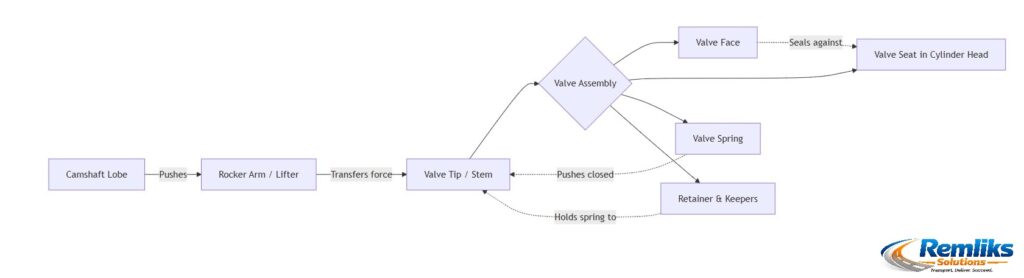
To understand the valve, you must look at the parts connected to it:
Here is the step-by-step process:
Timing is everything. If the valves open and close at the wrong time, the engine will lose power or fail to run. We discussed the ignition timing in a previous guide, but valve timing is just as important.
In a normal four-stroke engine, the exhaust valve is closing while the intake valve is just starting to open. This brief moment when both valves are open at the same time is called Valve Overlap.
Omar and Bilal Workshop Scenario
Bilal: Wait, if both valves are open at the same time, doesn’t the exhaust gas go back up into the air intake components?
Omar: Actually, Bilal, the moving air creates a scavenging effect. The exhaust gas rushing out the exhaust port creates a vacuum. This vacuum helps pull the fresh air and fuel mixture into the cylinder. It also helps cool the exhaust valve. Engineers carefully calculate this overlap to balance power and emissions.
In the past, camshafts were locked in one position. Today, most engines use Variable Valve Timing. An oil-pressure-controlled actuator rotates the camshaft slightly.
Because valves live in a fiery environment, standard steel would quickly fail. Manufacturers use special alloys.
Exhaust valves require much tougher materials.
The valve does not float in empty space. It is guided and sealed by two critical parts.
The valve stem moves up and down inside a small tube called the guide.
The seat is a ring pressed into the cylinder head. The valve face presses against it to seal the cylinder.
Valves are tough, but they can fail. Here are the most common issues you may encounter in the troubleshooting center.
In modern direct injection engines, fuel is sprayed directly into the cylinder. This means fuel never washes over the back of the intake valve. Over time, oil vapor from the PCV system bakes onto the back of the intake valve, forming hard carbon.
As Omar explained earlier, if the valve cannot transfer heat to the seat, it burns.
This is a catastrophic failure. If the timing belt or chain breaks, the camshaft stops turning, but the crankshaft keeps moving. The pistons will crash into the open valves, bending them.
Over time, the guides wear out, and the rubber seals harden.
To help you picture these parts, here is a breakdown of the valve assembly
Some engines have “hydraulic lifters” that automatically keep the gap (lash) at zero. However, older cars, heavy-duty trucks, and performance cars use solid lifters. These require manual valve adjustment.
At the top of the valve guide sits a tiny rubber seal. Its only job is to keep engine oil from running down the stem and into the cylinder.
When these harden with age, oil slips past. This is a very common cause of oil burning in high-mileage engines. Replacing them usually requires removing the cylinder head, but it can save your engine pistons from becoming coated in thick carbon.
While you cannot easily see the valves without taking the engine apart, you can monitor their health. Use this checklist to stay ahead of major problems.
| Check | Action | Frequency | Why It Matters |
|---|---|---|---|
| Oil Changes | Change engine oil on time. | Per owner’s manual | Clean oil prevents sludge, which can clog lifters and varnish valve stems. |
| Coolant Levels | Check and maintain coolant. | Monthly | Proper cooling keeps cylinder heads from warping, which ruins valve seats. |
| Misfire Scan | Use an OBD2 scanner for misfire codes. | When the check engine light appears | A misfire in one cylinder often points to a burnt valve or bad spark plugs. |
| Oil Consumption | Check oil level regularly. | Weekly | Burning oil may indicate worn valve stem seals or guides. |
| Valve Lash | Measure clearance (if applicable). | 50k – 100k miles | Prevents burnt valves and excessive wear on the camshaft. |
1. Can a bad valve cause a check engine light?
Yes. If a valve is burnt or not sealing properly, the cylinder will have low compression. This causes a misfire, which triggers a check engine light and a code like P0300 (Random Misfire) or a specific cylinder misfire code.
2. How do you test for a burnt valve?
A mechanic will perform a compression test and a cylinder leak-down test. They pump air into the cylinder and listen to where the air escapes. If they hear hissing in the exhaust pipe, the exhaust valve is bad. If they hear hissing in the throttle body, the intake valve is bad.
3. What does a bad valve sound like?
A burnt exhaust valve often sounds like a rhythmic “puffing” or “hissing” from the tailpipe, matching the RPM of the engine. A worn valve guide might cause a light ticking noise from the top of the engine.
4. Can I drive with a bad valve?
It is not recommended. Driving with a misfire caused by a bad valve can destroy your catalytic converter by pumping unburnt fuel into it. It can also cause further internal engine damage.
5. Why do some engines have 4 valves per cylinder?
Many modern cars use 4 valves per cylinder (2 intake, 2 exhaust) instead of the older 2-valve design. Smaller valves are lighter and can open faster. This allows the engine to breathe better at high RPMs, increasing power and efficiency.
6. Are valve seats replaceable?
Yes. In many cast-iron cylinder heads, the valve seats are pressed into the head and can be removed and replaced if they are damaged or worn. In aluminum heads, the seats are often inserted at the factory and can also be replaced by a machine shop.
Engine valves may be small, but they carry a massive responsibility. They seal in violent explosions, guide the flow of air and exhaust, and endure temperatures that would melt ordinary metals. Understanding how intake and exhaust valves function helps you appreciate the precision required to build a reliable engine.
Whether you are dealing with a rough idle caused by carbon buildup or ensuring your timing belt is replaced to protect your valves from bending, knowledge is your best tool. At Remliks Solutions, we are here to provide clear, honest, and practical guides to help you understand your vehicle. Always prioritize regular maintenance, and never ignore the warning signs your engine gives you. Safe driving.
