Physical Address
304 North Cardinal St.
Dorchester Center, MA 02124
Physical Address
304 North Cardinal St.
Dorchester Center, MA 02124

Disclaimer: This article provides general information only. Always consult a certified automotive professional for specific diagnostic or repair advice.
Throughout this guide, you may see Bilal and Omar discussing vehicle systems, maintenance procedures, and troubleshooting situations. They are fictional educational characters created by Remliks Solutions to help explain automotive and truck concepts in a practical and engaging way.
Your vehicle’s engine is essentially a large air pump. It pulls air in, mixes it with fuel, ignites the mixture, and pushes exhaust out. To do this efficiently, the engine relies on precise air intake system components. When these parts work together perfectly, your vehicle runs smoothly, efficiently, and safely. However, when one part fails or gets dirty, engine performance drops, fuel economy suffers, and warning lights may appear.
In this detailed guide, we will explore how the air intake system works. We will look closely at the air filters, the Mass Air Flow (MAF) sensor, and the throttle body. By understanding these parts, you can make better maintenance decisions and communicate more effectively with your mechanic.
Before we look at individual parts, it helps to understand the journey of the air. A gasoline or diesel engine needs oxygen to burn fuel. The air intake system’s job is to provide clean, measured air to the engine cylinders.
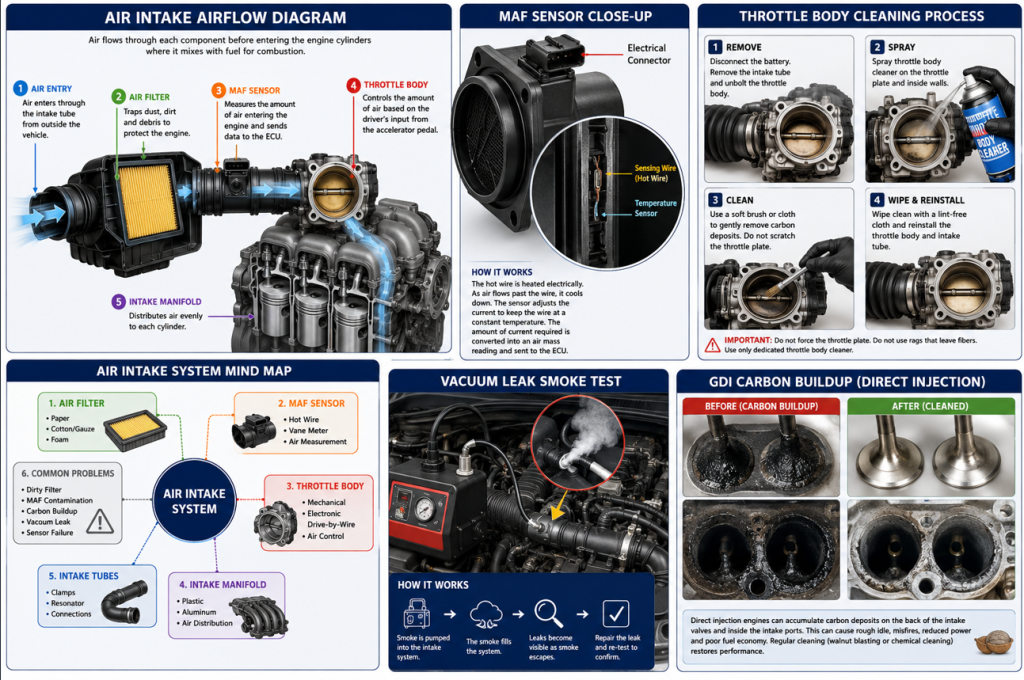
Here is the basic path the air takes:
Understanding this flow is important because a problem at any step affects the entire system.
Below is a visual mind map of the primary air intake system components we will discuss:
| 🌬️ Air Intake System |
|---|
| 1. Air Filter ➔ Protects engine from debris • Paper • Cotton/Gauze • Foam |
| 2. MAF Sensor ➔ Measures air volume • Hot-Wire • Vane Meter |
| 3. Throttle Body ➔ Controls air flow • Mechanical Cable • Electronic (Drive-by-Wire) |
| 4. Intake Manifold ➔ Distributes air to cylinders • Plastic • Aluminum |
The air filter is one of the most critical air intake system components. An engine can take in thousands of gallons of air for every gallon of fuel it burns. If that air contains dust, sand, or debris, it acts like sandpaper inside the engine cylinders, causing severe damage. The air filter traps these harmful particles.
Not all air filters are the same. They come in different materials, each with its own benefits and drawbacks.
| Filter Type | Pros | Cons | Best For |
|---|---|---|---|
| Paper | Inexpensive, excellent filtration, easy to replace | Not reusable, restricts flow slightly when dirty | Daily driving, standard maintenance |
| Cotton/Gauze | Reusable, higher airflow potential, long lifespan | Expensive initially, requires special oiling kit, oil can affect MAF | Performance-oriented driving, off-road |
| Foam | Excellent dust trapping, reusable | Can restrict airflow if over-oiled, requires frequent cleaning | Heavy dust environments, trucks |
A dirty air filter restricts airflow. When the engine cannot get enough air, it runs “rich” (too much fuel, not enough air). This reduces fuel economy and power.
However, you should not replace it too early. A slightly dirty filter actually traps smaller particles better than a brand-new one. Instead of guessing, inspect the filter visually. Hold it up to a bright light; if you cannot see light passing through the pleats, it is time to replace it. A general rule is to inspect it every 12,000 to 15,000 miles, but dusty environments may require more frequent checks.
Once the air is filtered, the engine computer needs to know exactly how much air is entering. This is the job of the Mass Air Flow (MAF) sensor. The Engine Control Unit (ECU) uses this measurement to calculate the correct amount of fuel to inject. If the MAF sensor reads incorrectly, the air-fuel mixture will be wrong.
The most common type is the “hot-wire” MAF sensor. Inside the sensor, there is a tiny wire heated to a specific temperature above the incoming air. As air flows past the wire, it cools it down. The sensor’s electronics work constantly to keep the wire at that set temperature.
The more air that flows past the wire, the more electrical current is needed to keep it hot. The sensor sends this current measurement to the ECU, which translates it into air mass. It is a highly precise system.
Because the MAF sensor is located right after the air filter, it is exposed to the air stream. Over time, microscopic dust and oil from oiled filters can coat the hot wire. This coating acts as an insulator, preventing the air from cooling the wire properly.
Symptoms of a contaminated MAF sensor may include:
Bilal: The engine hesitates when I press the gas pedal, and the idle is rough. The check engine light is on. Could this be a bad fuel pump?
Omar: Before we assume the fuel pump is failing, let us check the diagnostic trouble codes. The ECU reports a P0171 code, which means the system is running lean. The engine is getting too much air or not enough fuel.
Bilal: So, should I just replace the MAF sensor since it measures the air?
Omar: Not yet. Replacing parts without testing them is expensive and often does not fix the problem. A lean code can also be caused by a vacuum leak—unmetered air entering the engine after the MAF sensor. Let us visually inspect the intake hose for cracks first. If there are no leaks, we can safely clean the MAF sensor with a specialized MAF cleaner. A dirty sensor often reads low, causing a lean condition.
Bilal: I did use an oiled cotton filter recently. Could the oil have caused this?
Omar: That is very possible. Over-oiling a reusable filter can allow oil droplets to coat the hot wire. Let us clean the sensor properly and see if the running condition improves.
Cleaning a MAF sensor may help restore engine performance, but it must be done carefully.
The throttle body is the valve that controls how much air enters the engine. It is located between the intake tube and the intake manifold. When you press the gas pedal, you are actually opening the throttle plate inside the throttle body, allowing more air into the engine. The ECU sees this increased air flow (via the MAF) and adds more fuel.
In older vehicles, the gas pedal was connected to the throttle body by a physical metal cable. This is a mechanical throttle.
Most modern vehicles use an Electronic Throttle Control (ETC) system, often called “drive-by-wire.” In this system, there is no cable. When you press the gas pedal, a sensor sends a signal to the ECU. The ECU then commands an electric motor to open the throttle plate. This allows the computer to precisely manage engine power, improve fuel economy, and integrate safety systems like traction control.
Over time, a small amount of crankcase vapors and exhaust gases are recycled back into the intake system. When these vapors pass through the throttle body, they can leave a hard, black carbon deposit around the throttle plate and the throttle bore.
This carbon buildup restricts airflow when the throttle is closed (at idle). To keep the engine running, the ECU opens the throttle plate slightly more than normal. When the carbon gets too thick, the ECU cannot compensate anymore, resulting in a rough idle or stalling.
Cleaning the throttle body may help restore smooth idling. However, on electronic throttle bodies, you must use extreme caution.
Even with regular maintenance, air intake system components can develop problems. Let us look at a few common issues and how they are diagnosed.
A vacuum leak occurs when air enters the intake manifold after the MAF sensor. The ECU does not know about this extra air, so it does not add enough fuel. This results in a lean mixture.
Common causes: Cracked intake hoses, leaking intake manifold gaskets, or broken vacuum lines.
Diagnostic approach: Mechanics often use a smoke machine to find vacuum leaks. Smoke is pumped into the intake system, and the mechanic looks for smoke escaping from cracks or bad seals.
Gasoline Direct Injection (GDI) engines spray fuel directly into the cylinder, not onto the back of the intake valves. Because of this, the intake valves are never “washed” by fuel. Over time, oil vapors from the PCV (Positive Crankcase Ventilation) system bake onto the intake valves and cause severe carbon buildup.
This buildup restricts airflow into the cylinder, causing misfires, rough running, and power loss. Fixing this usually requires specialized cleaning methods, like walnut blasting, which should be done by a professional.
Bilal: The engine idle surges up and down, and I hear a hissing sound under the hood. I checked the MAF sensor, and it seems clean.
Omar: A surging idle and a hissing sound strongly suggest a vacuum leak. The engine is drawing in unmetered air. The ECU detects the lean mixture and tries to add fuel, which causes the idle to rise. Then it realizes the idle is too high and cuts fuel, causing the idle to drop. This creates the surging cycle.
Bilal: Should I spray carburetor cleaner around the intake hoses to find the leak?
Omar: I strongly advise against using flammable sprays to find vacuum leaks. It is a serious fire hazard. Instead, let us connect the smoke machine to the intake system. It is safe, accurate, and will show us exactly where the unmetered air is entering without risking a fire.
Regular maintenance is the best way to keep your engine breathing properly. Treating your air intake system components well ensures longevity and reliability.
Here is a practical maintenance schedule to follow. Always refer to your vehicle’s owner manual for specific intervals.
| Component | Maintenance Action | Suggested Interval |
|---|---|---|
| Air Filter | Visual inspection | Every 10,000 miles or annually |
| Air Filter | Replacement | Every 15,000 to 30,000 miles (or as needed) |
| MAF Sensor | Visual inspection / Cleaning | Every 30,000 miles or if symptoms appear |
| Throttle Body | Inspection / Cleaning | Every 50,000 miles or if idle is rough |
| Intake Hoses | Visual check for cracks/clamps | Every 20,000 miles or during oil changes |
The aftermarket industry is full of “cold air intake” kits and performance filters. They claim to increase horsepower and improve throttle response. It is important to approach these claims objectively.
A cold air intake moves the filter outside the engine bay to draw in cooler, denser air. Cooler air contains more oxygen, which can allow the engine to burn more fuel and make more power.
Pros:
Cons:
A short ram intake keeps the filter inside the engine bay. It has a shorter tube, which reduces airflow restriction. However, because it draws in hot air from around the engine, the air is less dense. This may actually reduce power compared to a factory intake, even if the engine sounds faster.
Factory air intake systems are engineered very well by vehicle manufacturers. They are designed to provide the best balance of filtration, airflow, noise reduction, and water protection. Unless you are building a dedicated track car, a high-quality paper filter in the factory airbox is usually the best and safest choice. If you choose to upgrade, ensure the product has a CARB Executive Order (EO) number if you live in a state with strict emissions laws.
Working on your vehicle’s air intake system requires careful attention to safety. Here are vital rules to follow:
Use this checklist to keep your air intake system in top condition:
Q1: Can a dirty air filter damage my engine?
A: Yes. If an air filter becomes completely clogged, it can tear or collapse, allowing unfiltered dirt to enter the engine cylinders. This dirt acts as an abrasive and can score the cylinder walls, leading to permanent engine damage and loss of compression.
Q2: How do I know if my MAF sensor is bad or if I just have a vacuum leak?
A: Both issues cause similar symptoms, like rough idling or lean codes. However, a vacuum leak introduces “unmetered” air, while a bad MAF sensor simply misreads the “metered” air. A professional mechanic uses a smoke machine to test for vacuum leaks and a scan tool to view the MAF sensor’s live data. If the MAF data shows unusually low airflow at idle but the engine runs fine when revved, a vacuum leak is likely.
Q3: Is it safe to drive with a check engine light for the MAF sensor?
A: It is not recommended. A failing MAF sensor can cause the engine to run extremely lean or rich. Running lean can cause engine overheating and damage pistons. Running rich can wash the oil off the cylinder walls, causing premature wear, and will ruin your catalytic converter over time. Have the vehicle diagnosed as soon as possible.
Q4: Why does my car idle rough after I cleaned the throttle body?
A: This is very common on electronic throttle bodies. When you clean the carbon away, the throttle plate closes further than it did when dirty. The ECU has not “relearned” this new closed position, so it thinks the throttle is open slightly, causing the idle to surge or drop. You must perform a throttle body relearn procedure using a scan tool, or follow the specific pedal-press sequence outlined in your vehicle’s service manual.
Q5: Do performance air filters really increase horsepower?
A: They may help increase horsepower slightly by reducing airflow restriction. However, the gain is usually very small on a completely stock engine. You must also balance this against the risk of allowing more dirt into the engine or coating the MAF sensor with oil. Always choose a high-quality filter that meets OEM filtration standards.
Q6: Can I use a generic MAF cleaner instead of a branded one?
A: You should only use a cleaner specifically labeled as “MAF Sensor Cleaner.” These are formulated to clean the delicate hot-wire without leaving a residue. Other chemicals, like brake cleaner or rubbing alcohol, can leave a film or damage the sensor’s internal electronics.
The air intake system components—the air filter, MAF sensor, and throttle body—work together as a precise team. The filter protects the engine, the MAF sensor measures the air, and the throttle body controls the flow. When you understand how these parts function, you can better maintain your vehicle, avoid unnecessary repairs, and ensure your engine breathes safely and efficiently for years to come.
For more information on engine maintenance and diagnostic tools, explore the Remliks Solutions Learning Center or read our guide on OBD2 Error Code Lookup.
