Physical Address
304 North Cardinal St.
Dorchester Center, MA 02124
Physical Address
304 North Cardinal St.
Dorchester Center, MA 02124

Disclaimer: This guide provides general information only. Always consult a qualified professional for specific diagnostic, repair, or safety advice.
When you open a vehicle owner’s manual, read a diagnostic report, or speak with a technician, you will likely encounter a wall of letters. Understanding common automotive abbreviations is essential for every driver and vehicle owner. These shortened terms act as a quick language for complex vehicle systems, but they can easily confuse beginners. This guide by Remliks Solutions translates these letters into simple, clear English so you can maintain, diagnose, and repair your vehicle with confidence.
Throughout this guide, you may see Bilal and Omar discussing vehicle systems, maintenance procedures, and troubleshooting situations. They are fictional educational characters created by Remliks Solutions to help explain automotive and truck concepts in a practical and engaging way.
Vehicles are built with advanced computer systems and tight engineering spaces. Because of this, technicians and engineers use abbreviations to save time and space. However, when you do not know what the letters mean, you cannot make informed decisions.
Also, knowing these terms helps you in several practical ways:
Before we explore the specific letters, let us look at how these abbreviations connect across your vehicle.
To help you visualize how these terms group together, here is a simple text-based mind map of the primary abbreviation categories:
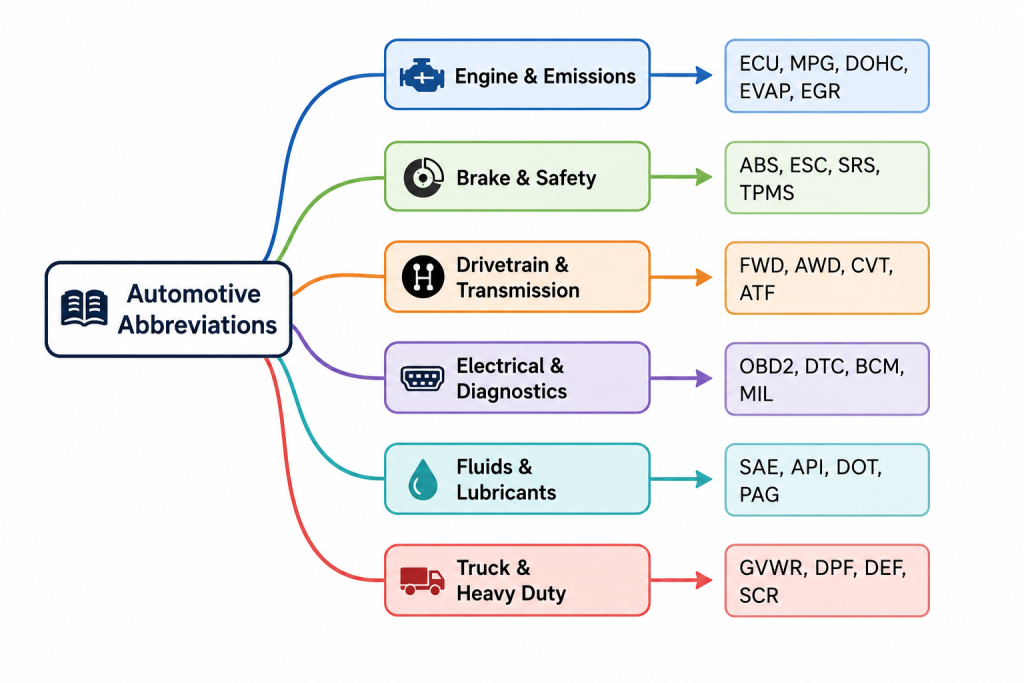
The engine is the heart of the vehicle, and it uses many sensors and computers to run efficiently. Here are the most common automotive abbreviations you will see under the hood.
| Abbreviation | Full Term | Simple Definition | Practical Importance |
|---|---|---|---|
| ECU | Engine Control Unit | The main computer that manages the engine. | It adjusts fuel, air, and spark to keep the engine running smoothly. |
| MAF | Mass Air Flow | A sensor that measures the amount of air entering the engine. | Helps the ECU calculate how much fuel to inject. |
| MAP | Manifold Absolute Pressure | A sensor that measures air pressure inside the intake manifold. | Critical for altitude changes and engine load calculations. |
| MPG | Miles Per Gallon | A measure of fuel efficiency. | Helps you understand how far a vehicle can travel on a specific amount of fuel. |
| RPM | Revolutions Per Minute | How fast the engine crankshaft is spinning. | Shifting at the correct RPM prevents engine strain and saves fuel. |
Omar and Bilal Workshop Scenario
Bilal: The check engine light is on, and the scanner shows an EGR code. Can I just unplug the sensor to stop the light?
Omar: No, that is not a safe or proper solution. The EGR system is designed to reduce combustion temperatures and harmful emissions. If you disable it, the engine may run too hot, which could cause internal damage over time. We should remove the valve and clean it, or test the sensor properly before replacing anything.
Safety systems use sensors and computers to protect you during driving and in a crash. Understanding these abbreviations helps you respect the advanced systems in modern vehicles.
Active safety systems work while you drive to prevent accidents.
| Abbreviation | Full Term | Simple Definition | Practical Importance |
|---|---|---|---|
| ABS | Anti-lock Braking System | Prevents wheels from locking during hard braking. | Allows you to steer the vehicle while braking hard on slippery roads. Required by USA FMVSS. |
| ESC | Electronic Stability Control | Helps prevent the vehicle from sliding or rolling sideways. | Automatically applies individual brakes to keep the vehicle on the driver’s intended path. |
| TCS | Traction Control System | Prevents the drive wheels from spinning during acceleration. | Helps maintain grip when accelerating on wet or icy roads. |
Passive safety systems protect you after a crash happens, or they monitor conditions to warn you.
The drivetrain moves the power from the engine to the wheels. Abbreviations here usually describe how the vehicle shifts gears and which wheels receive the power.
| Abbreviation | Full Term | Simple Definition | Practical Importance |
|---|---|---|---|
| AT | Automatic Transmission | Shifts gears automatically using fluid pressure and computers. | Easier to drive in heavy traffic. |
| MT | Manual Transmission | The driver shifts gears manually using a clutch pedal. | Offers more driver control and generally lower maintenance costs. |
| CVT | Continuously Variable Transmission | Uses belts and pulleys instead of fixed gears to provide seamless acceleration. | Keeps the engine in its most efficient RPM range. |
| DCT | Dual-Clutch Transmission | Uses two separate clutches for odd and even gear sets for faster shifting. | Combines the efficiency of a manual with the ease of an automatic. |
How power is delivered to the wheels affects traction and handling.
When a problem occurs, the electrical and diagnostic systems record it. Knowing these common automotive abbreviations is vital for troubleshooting.
| Abbreviation | Full Term | Simple Definition | Practical Importance |
|---|---|---|---|
| OBD2 | On-Board Diagnostics (2nd Generation) | The standardized system used in all USA vehicles since 1996 to monitor emissions and engine health. | Allows any standard scan tool to read error codes from the vehicle. |
| DTC | Diagnostic Trouble Code | An alphanumeric code stored in the computer when a fault is detected. | Points you toward the specific system or component that failed. |
| MIL | Malfunction Indicator Lamp | The official name for the “Check Engine Light.” | Illuminates to warn the driver of an emissions or engine problem. |
Modern vehicles have multiple computers, called modules, that communicate over a network.
Omar and Bilal Workshop Scenario
Bilal: I scanned the car and got a DTC for the MAP sensor. Should I replace the sensor right away?
Omar: Not yet. A DTC only tells us where the system is failing, not necessarily which part is broken. The MAP sensor code might mean the sensor is bad, but it could also mean there is a vacuum leak in the hose connected to it. Always test the component and the wiring before buying replacement parts.
Using the wrong fluid can severely damage your vehicle. Abbreviations on fluid bottles tell you exactly what standards the fluid meets. (Visit our Automotive Fluids & Chemicals section for more details).
| Abbreviation | Full Term | Simple Definition | Practical Importance |
|---|---|---|---|
| DOT | Department of Transportation | Sets the safety standards for brake fluids (e.g., DOT 3, DOT 4, DOT 5). | Never mix DOT types. Using the wrong DOT fluid may cause brake failure. |
| ATF | Automatic Transmission Fluid | A specialized fluid for automatic transmissions. | Must be checked regularly; low ATF causes shifting problems. |
| PAG | Polyalkylene Glycol | A type of synthetic refrigerant oil used in A/C systems. | Used specifically in newer R-1234yf A/C systems to meet EPA standards. |
Trucks operate under heavy loads and strict emissions regulations. They use specific terminology that everyday cars do not. (Explore our Truck Systems section for deeper learning).
Understanding weight limits is critical for safety and legal operation on USA roads.
Modern diesel engines use complex systems to clean exhaust gases.
| Abbreviation | Full Term | Simple Definition | Practical Importance |
|---|---|---|---|
| DPF | Diesel Particulate Filter | A filter in the exhaust that traps and burns off soot (ash) from diesel fuel. | Requires “regeneration” cycles to burn off the soot. Ignoring it may ruin the filter. |
| DEF | Diesel Exhaust Fluid | A liquid (urea and water) injected into the exhaust to reduce NOx emissions. | Must be refilled regularly; running out of DEF may limit engine power. |
| SCR | Selective Catalytic Reduction | The system that uses DEF to turn harmful NOx into harmless nitrogen and water. | Essential for modern diesel trucks to meet EPA regulations. |
Below is a Flexbox-style table that connects the most important common automotive abbreviations to the core sections of the Remliks Solutions website. Use this to quickly look up terms and navigate your learning path.
| Remliks Learning Center Section | Key Abbreviations Covered |
|---|---|
| Engine System | ECU, MAF, MAP, MPG, RPM, DOHC, EGR, EVAP |
| Brake System | ABS, ESC, TCS, SRS, TPMS, DOT |
| Transmission & Drivetrain | AT, MT, CVT, DCT, FWD, RWD, AWD, 4WD, ATF |
| Electrical System | OBD2, DTC, MIL, PCM, BCM, CAN |
| Lubrication & Fluids | SAE, API, ILSAC, PAG |
| Truck Systems | GVWR, GCWR, DPF, DEF, SCR |
Use this simple checklist to apply your new knowledge safely and effectively:
OBD2 stands for On-Board Diagnostics, Second Generation. It is important because it is a standardized system required by USA law for all vehicles built after 1996. This standard means any basic scan tool can plug into your car and read the DTCs (Diagnostic Trouble Codes), helping you find out why the MIL (Check Engine Light) is on.
AWD (All-Wheel Drive) operates automatically. It normally sends power to two wheels but will instantly send power to the other two wheels if it detects slipping. It is designed for on-road safety in rain or light snow. 4WD (Four-Wheel Drive) usually requires the driver to manually engage it, and it locks power to all four wheels equally. It is designed for severe off-road conditions or deep mud and snow.
No, they are not the same, even though they look similar. DOT 4 has a higher boiling point than DOT 3, which means it handles the heat from heavy braking better. However, both are glycol-based. You must always check your owner’s manual before adding brake fluid. Using the wrong fluid may damage the seals in your Brake System.
If you run out of DEF (Diesel Exhaust Fluid), your truck’s SCR (Selective Catalytic Reduction) system cannot clean the exhaust emissions. To comply with EPA regulations, the vehicle’s computer is programmed to limit engine speed and power until you refill the DEF tank. This prevents you from emitting illegal levels of pollution.
Mechanics use abbreviations for efficiency and accuracy. Writing “ECU” is much faster than writing “Engine Control Unit” on a repair order. Also, because these terms are standardized by SAE and the EPA, using the abbreviation ensures there is no confusion about which specific system they are discussing.
Decoding the letters on your dashboard, under your hood, or on a repair invoice removes the confusion from vehicle ownership. When you understand common automotive abbreviations, you hold the key to better communication, smarter purchases, and safer driving.
At Remliks Solutions, we are committed to giving you honest, clear, and practical knowledge. We will not promise that an abbreviation will fix your car—because understanding the term is only the first step. Proper testing, safe practices, and professional diagnosis are always required. However, knowing the difference between an ECU and an EGR, or understanding why your GVWR matters, protects you from poor decisions and unnecessary expenses.
Also, remember that vehicles change rapidly. Emissions standards tighten, and new technologies like CVTs and SCR systems become common. Stay patient, keep learning, and always prioritize safety over shortcuts. If you want to dive deeper into how these systems work, explore our Learning Center, review our Maintenance Guides, or use our Troubleshooting Center for step-by-step help. Drive safely, and continue building your knowledge with Remliks Solutions.
Decoding the letters on your dashboard, under your hood, or on a repair invoice removes the confusion from vehicle ownership. When you understand common automotive abbreviations, you hold the key to better communication, smarter purchases, and safer driving.
continue building your knowledge with Remliks Solutions.
