Physical Address
304 North Cardinal St.
Dorchester Center, MA 02124
Physical Address
304 North Cardinal St.
Dorchester Center, MA 02124

Understanding the camshaft function and types is essential for anyone interested in how engines work. The camshaft plays a critical role in your engine’s performance, controlling the timing of valve operations that allow air and fuel to enter and exhaust to exit the combustion chambers. This comprehensive guide will explain everything you need to know about camshafts, from basic principles to maintenance and troubleshooting.
Disclaimer: This article provides general information only and should not be considered professional mechanical advice. Always consult a qualified technician for specific vehicle issues.
Throughout this guide, you may see Bilal and Omar discussing vehicle systems, maintenance procedures, and troubleshooting situations. They are fictional educational characters created by Remliks Solutions to help explain automotive and truck concepts in a practical and engaging way.
A camshaft is a rotating shaft inside an engine that converts rotary motion into linear motion to open and close the engine’s valves at precisely the right times. This timing is crucial for optimal engine performance, efficiency, and emissions control.
The camshaft contains specially shaped protrusions called lobes. As the shaft rotates, these lobes push against valve components, opening the valves in sequence. When the lobe rotates away, spring pressure closes the valve. This precise choreography happens thousands of times per minute while your engine runs.
Bilal: I keep hearing about camshafts, but I’m not exactly sure what they do. Can you explain their basic purpose?
Omar: Think of the camshaft as the engine’s timing conductor. It ensures that the intake valves open to let air and fuel in at the right moment, and exhaust valves open to let burnt gases out at the right moment. Without this precise timing, the engine couldn’t run efficiently—if at all.
Bilal: So the camshaft basically controls when the valves open and close?
Omar: Exactly. The shape and position of the cam lobes determine not just when the valves open, but also how far they open and for how long. This is what we call valve lift and duration, which directly affects engine performance.
To fully understand camshaft function and types, we need to examine the key components that make up this critical engine part.
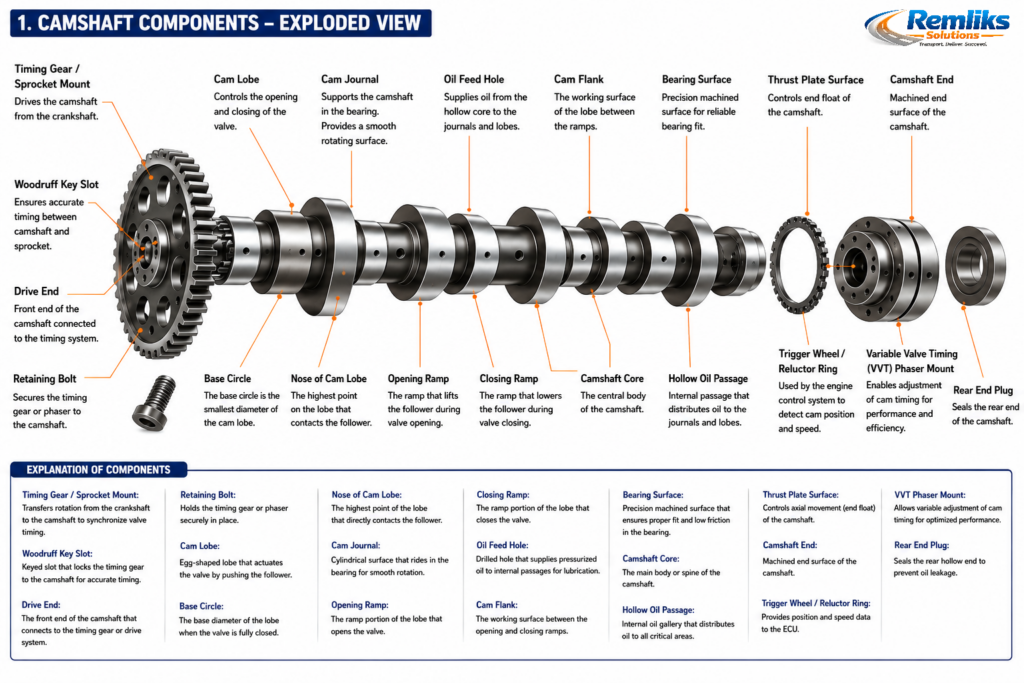
Cam lobes are the egg-shaped protrusions on the shaft. Their shape determines the valve lift—how far the valve opens from its seat. Higher lift allows more air/fuel mixture to enter the cylinder, which can increase power output. However, there are limits based on valve-to-piston clearance and other engine design factors.
The lobe profile consists of:
Duration refers to how long (in degrees of crankshaft rotation) the valve stays open. Longer duration can improve high-RPM power but may reduce low-end torque and idle quality.
Overlap occurs when both the intake and exhaust valves are open simultaneously at the end of the exhaust stroke and beginning of the intake stroke. This helps with cylinder filling and exhaust scavenging but can affect idle quality and emissions.
Camshafts must withstand tremendous forces and friction. They’re typically made from:
| Material | Characteristics | Common Applications |
|---|---|---|
| Cast Iron | Durable, cost-effective | Most production vehicles |
| Billet Steel | Stronger, more precise | Performance applications |
| Chilled Iron | Harder surface, wear-resistant | High-wear applications |
| Forged Steel | Excellent strength | Heavy-duty applications |
The cam lobes often receive additional surface treatments like induction hardening or specialized coatings to resist wear.
Understanding the different camshaft types helps clarify how various engine designs operate. The main distinction comes from how the camshaft is positioned relative to the valves.
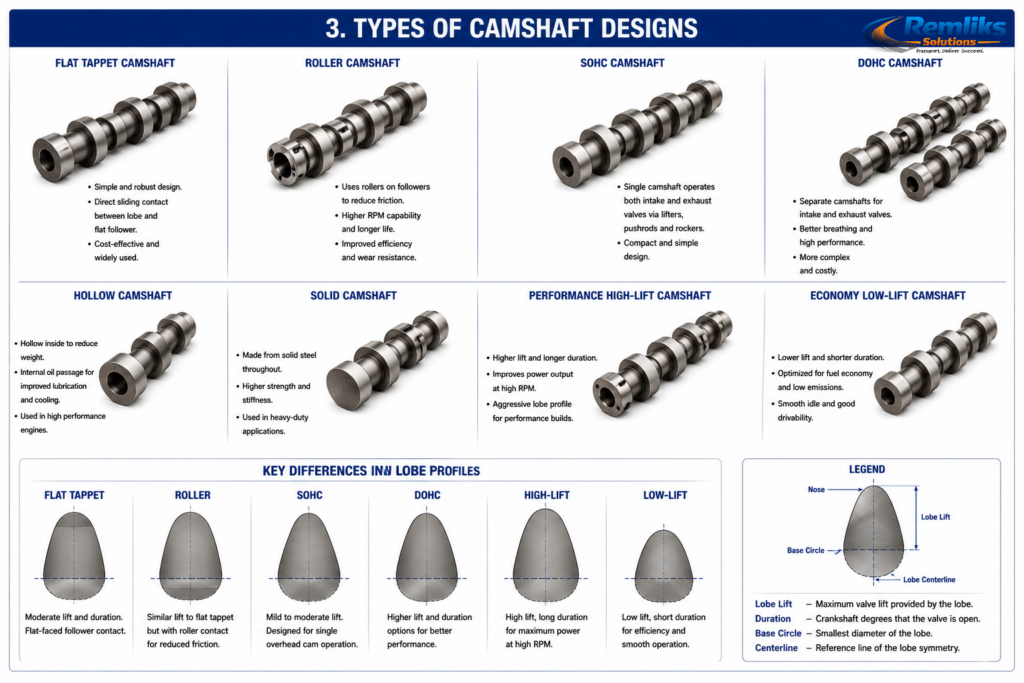
In SOHC designs, one camshaft sits in the cylinder head above the valves. This single camshaft operates both intake and exhaust valves, usually through rocker arms or direct contact.
Advantages:
Disadvantages:
DOHC engines use two camshafts per cylinder head—one for intake valves and one for exhaust valves. This design allows independent control of intake and exhaust valve timing.
Advantages:
Disadvantages:
In pushrod (also called OHV or overhead valve) designs, the camshaft is located in the engine block, rather than the cylinder head. It operates the valves through pushrods and rocker arms.
Advantages:
Disadvantages:
| Feature | SOHC | DOHC | Pushrod (OHV) |
|---|---|---|---|
| Camshaft Location | Cylinder head | Cylinder head | Engine block |
| Number of Cams | 1 per head | 2 per head | 1 in block |
| Valve Control | Good | Excellent | Adequate |
| High RPM Performance | Good | Excellent | Limited |
| Complexity | Moderate | High | Low |
| Manufacturing Cost | Moderate | High | Low |
| Common Applications | Economy cars, older designs | Modern performance, many newer vehicles | Trucks, American V8s, some economy cars |
The camshaft doesn’t operate in isolation—it’s part of a complex system that must work in perfect synchronization with other engine components.
The camshaft connects to the crankshaft through a timing belt, timing chain, or in some cases, gears. This connection ensures the camshaft rotates at exactly half the crankshaft speed in four-stroke engines (since the camshaft completes one rotation for every two crankshaft rotations).
The timing marks must align perfectly during installation. Incorrect timing can cause poor performance, engine damage, or complete failure to start.
The camshaft directly interacts with several other engine components:
Bilal: How does the camshaft stay synchronized with the rest of the engine?
Omar: The crankshaft and camshaft are connected through a timing belt or chain. They have specific alignment marks that must line up perfectly. If they’re even one tooth off, the valve timing will be incorrect, which can cause poor performance or even engine damage.
Bilal: What happens if the timing belt breaks while driving?
Omar: In an interference engine, the pistons can hit the valves if the belt breaks, causing serious internal damage. In non-interference engines, the engine will simply stop running without internal damage, but you’ll still be stranded. That’s why following the manufacturer’s replacement interval for timing belts is so important.
Modern engines use a camshaft position sensor (CMP) to monitor the position and rotational speed of the camshaft. This information helps the engine control module (ECM) determine exactly which cylinder is in its power stroke.
The camshaft position sensor:
Without accurate camshaft position information, the engine may run in a “limp mode” with reduced performance and fuel efficiency.
Camshaft position sensor issues include:
Symptoms of a faulty camshaft position sensor may include:
Many modern engines use Variable Valve Timing systems to optimize camshaft function across different RPM ranges. VVT allows the engine to adjust camshaft timing dynamically rather than using fixed timing.
VVT systems typically use:
Some advanced systems can adjust both camshaft timing (when valves open/close) and lift (how far they open), though these are less common.
Variable Valve Timing provides several advantages:
VVT represents a significant evolution in camshaft technology, allowing engines to achieve better performance and efficiency than possible with fixed camshaft timing.
Like any mechanical component, camshafts can experience issues that affect engine performance.
Over time, cam lobes can wear down, reducing valve lift and altering duration. This results in:
Causes include insufficient lubrication, contaminated oil, or normal wear over high mileage.
Camshaft timing problems can result from:
Symptoms include poor performance, unusual noises, or engine damage in severe cases.
Since camshafts rely heavily on proper lubrication, oil-related issues are common:
These issues can accelerate camshaft and lifter wear significantly.
Bilal: What would cause a camshaft to fail prematurely?
Omar: The most common cause is inadequate lubrication. If oil changes are skipped or if the engine runs low on oil, the cam lobes and lifters don’t get proper lubrication. This leads to excessive wear and eventual failure.
Bilal: How would I know if my camshaft is wearing out?
Omar: You might notice reduced engine power, a rough idle, or unusual tapping noises from the valvetrain. A diagnostic scan tool might show camshaft position sensor codes or misfire codes. However, these symptoms can also indicate other problems, so proper diagnosis is important before replacing parts.
Proper maintenance can significantly extend camshaft life and prevent costly repairs. The good news is that most camshaft care comes down to a few simple habits.
The most important camshaft maintenance is regular oil changes with the correct oil type and viscosity. Clean oil provides essential lubrication and cooling for the cam lobes and associated components.
Follow the manufacturer’s recommended oil change intervals, and consider more frequent changes if you operate in severe conditions (short trips, extreme temperatures, towing, etc.).
While camshafts aren’t typically inspected during routine maintenance, certain situations warrant inspection:
Be alert for these potential camshaft issues:
Addressing these symptoms promptly can prevent more serious damage.
When camshaft problems are diagnosed, replacement may be necessary. Here are key considerations:
Camshaft replacement is typically needed when:
Sometimes, what appears to be a camshaft problem might actually be a lifter issue, which is less expensive to address.
When replacing a camshaft, you’ll have choices:
| Option | Advantages | Disadvantages |
|---|---|---|
| OEM | Exact specifications, warranty, reliable | Usually more expensive |
| Aftermarket Standard | Less expensive, readily available | Quality can vary |
| Performance Aftermarket | Potential power gains | May affect driveability, emissions, fuel economy |
Your choice depends on your goals, budget, and vehicle use. For most drivers seeking reliable transportation, OEM or quality aftermarket standard camshafts are appropriate.
For enthusiasts seeking more power, performance camshafts offer modified lobe profiles that can increase engine output.
Performance camshafts differ from factory camshafts in several ways. Their lobes are carefully designed to change how the valves behave. This may help the engine breathe better and produce more power.
Here is a simple breakdown of what changes:
| Feature | What It Means | Expected Result |
|---|---|---|
| Higher lift | Valves open farther | More air and fuel enter the cylinder |
| Longer duration | Valves stay open longer | Better airflow at high RPM |
| Specialized lobe profiles | Custom shapes for specific goals | Power tuned for certain RPM ranges |
| Asymmetric designs | Intake and exhaust lobes differ | Fine-tuned power delivery |
Important: The result can be noticeable horsepower gains. However, these gains come with real trade-offs that every driver should understand before making a decision.
Before installing a performance camshaft, think carefully about what you might lose. More power does not always mean a better daily driving experience.
Warranty implications — The manufacturer warranty may become void
Reduced low-end torque — The car may feel sluggish at low speeds
Rougher idle quality — The engine may shake or vibrate more at a stop
Emissions compliance issues — The vehicle may not pass local inspections
Supporting modifications needed — You may also need new springs, ECU tuning, or other parts
Proper diagnosis is essential before condemning a camshaft. Many symptoms can mimic camshaft problems but have different, often less expensive, causes.
Bilal: I’m getting a P0340 code for the camshaft position sensor circuit. Does that mean I need a new camshaft?
Omar: Not necessarily. That code indicates a problem with the sensor circuit, which could be the sensor itself, the wiring, the connector, or in rare cases, an issue with the camshaft’s tone wheel. We need to diagnose systematically, not just replace parts.
Bilal: How would you approach this diagnosis?
Omar: First, I’d check the wiring and connector for damage or corrosion. Then I’d test the sensor output using an oscilloscope if available. If the sensor tests bad, I’d replace it. Only if the sensor tests good but we’re still getting an erratic signal would I suspect a problem with the camshaft’s trigger wheel or physical camshaft issues.
A: In most modern engines with proper maintenance, camshafts can last the life of the vehicle—often 200,000 miles or more. Premature failure is usually due to lubrication issues.
A: It depends on the nature of the problem. Minor wear might only affect performance slightly, while severe issues could cause engine damage. If you suspect camshaft problems, have it diagnosed promptly.
A: The crankshaft converts the linear motion of pistons into rotational energy that drives the vehicle. The camshaft controls valve timing but doesn’t directly produce power. They’re connected through the timing system.
A: Yes, diesel engines have camshafts that serve the same basic function—controlling valve timing. However, diesel camshaft designs may differ from gasoline engines due to different operating characteristics.
A: It’s generally recommended to replace all camshafts together, especially if they have similar wear patterns. Mixing new and worn camshafts can lead to unbalanced performance.
A: Costs vary widely based on vehicle type, engine design, and labor requirements. Generally, expect to pay $500-$2,000+ including parts and labor, with higher costs for more complex engines or performance applications.
Use this checklist to help maintain your camshaft and related components:
Understanding camshaft function and types provides valuable insight into how your engine operates and breathes. The camshaft’s role in controlling valve timing directly impacts engine performance, efficiency, and emissions. Whether you’re maintaining a daily driver or considering performance upgrades, knowledge of camshaft principles helps you make informed decisions about maintenance and repairs.
Regular oil changes remain the single most important maintenance task for camshaft longevity. When problems arise, proper diagnosis is essential to avoid unnecessary replacements. For those seeking more power, performance camshafts offer potential gains but with trade-offs that must be carefully considered.
By understanding how camshafts work within the broader engine system, you’ll be better equipped to maintain your vehicle and communicate effectively with technicians when issues arise. For more automotive fundamentals, explore our Learning Center or check our automotive terms glossary for additional technical definitions.
