Physical Address
304 North Cardinal St.
Dorchester Center, MA 02124
Physical Address
304 North Cardinal St.
Dorchester Center, MA 02124

Disclaimer: This article provides general information only. Always consult a qualified mechanic or your vehicle’s service manual for specific diagnostic and repair procedures.
The engine in your vehicle relies on a precise mixture of air and fuel to generate power. To achieve this, the car fuel system components must work together perfectly to deliver clean fuel at the correct pressure and in the right spray pattern. When any part of this system fails, engine performance drops, fuel economy suffers, and the vehicle may stop running altogether.
Throughout this guide, you may see Bilal and Omar discussing vehicle systems, maintenance procedures, and troubleshooting situations. They are fictional educational characters created by Remliks Solutions to help explain automotive and truck concepts in a practical and engaging way.
By understanding how these systems function, you can make better maintenance decisions and communicate more effectively with repair professionals. Let us explore the core elements of the fuel delivery system.
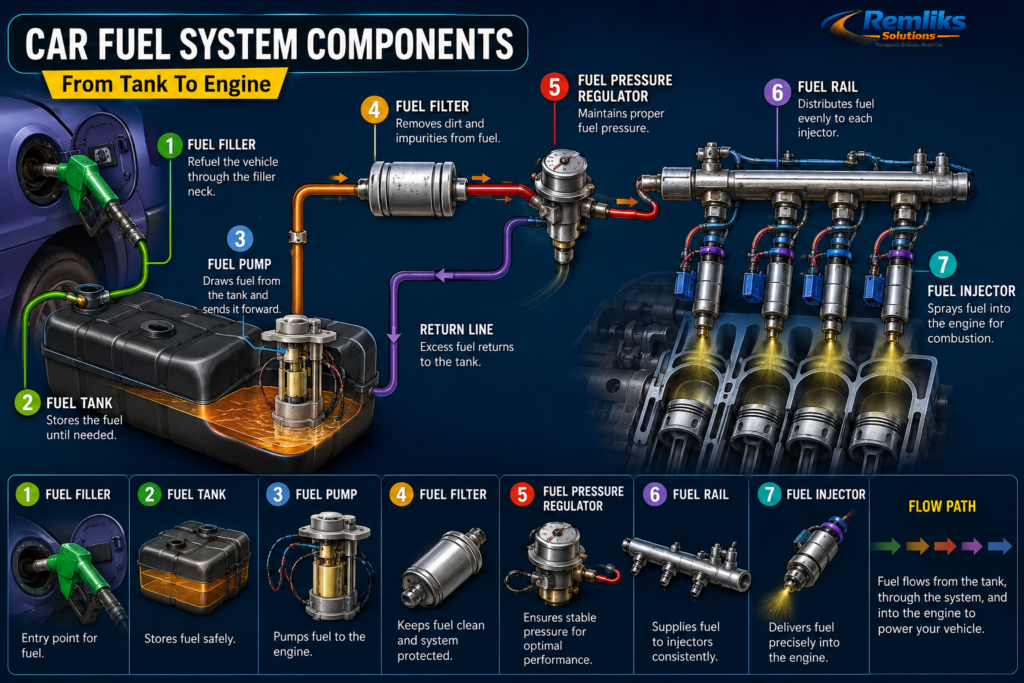
Before diving into individual parts, it is helpful to understand the journey of fuel. Fuel sits in the gas tank. However, the engine cannot use it in that state. The fuel must be moved, filtered, pressurized, and atomized.
Atomization is the process of breaking liquid fuel into a fine mist. This mist mixes with air perfectly, allowing the spark plug to ignite it efficiently. If the fuel arrives as a solid stream, it will not burn completely. This causes wasted fuel, higher emissions, and poor engine response.
The main path of fuel follows these steps:
If you want to learn more about how engines use this fuel, visit our Engine System section
Let us examine the four primary parts of the fuel delivery system. Each component has a specific job, and a weakness in one can affect the others.
The fuel pump acts as the heart of the fuel system. It pulls fuel from the tank and pushes it through the lines toward the engine. Modern vehicles typically use electric fuel pumps, while older cars with carburetors often use mechanical pumps driven by the engine camshaft.
Electric pumps are usually located inside the fuel tank. This placement keeps the pump cool and reduces the risk of vapor lock (fuel boiling in the lines).
How it works: When you turn the ignition key, the pump activates for a few seconds to build pressure. Once the engine cranks, the pump runs continuously. It must supply enough fuel to meet the engine’s highest demands, such as during heavy acceleration.
Common signs of a failing fuel pump:
Maintenance tip: Fuel pumps rely on the surrounding fuel for lubrication and cooling. Frequently driving with a very low fuel tank may cause the pump to overheat and wear out prematurely. Keeping your tank at least one-quarter full may help extend the life of the pump.
Fuel filters are simple but critical car fuel system components. Even high-quality fuel contains microscopic dirt, rust, and debris. If these particles reach the fuel injectors, they can clog the tiny nozzles and cause severe engine problems.
How it works: The filter contains a porous paper or synthetic material. Fuel passes through this material, but the solid particles get trapped. Over time, the filter becomes clogged. When this happens, fuel flow is restricted, and the engine starves for fuel.
Common signs of a clogged fuel filter:
Maintenance tip: Manufacturers specify a replacement interval for fuel filters, usually between 30,000 to 50,000 miles (48,000 to 80,000 kilometers). However, if you frequently drive on dusty roads or use older fuel stations, you may need to replace the filter sooner. For routine care tips, check our Maintenance Guides.
The fuel pump always pushes fuel at a high rate. However, the engine does not always need the same amount of fuel. At idle, the engine needs very little fuel. During rapid acceleration, it needs a lot. The fuel pressure regulator ensures the fuel pressure remains constant, regardless of engine load.
How it works: In older return-style systems, the regulator is a valve that opens and closes. When the engine needs less fuel, the valve opens and sends excess fuel back to the tank. When the engine needs more fuel, the valve closes to keep the pressure high in the fuel rail.
In modern returnless systems, the engine computer controls the fuel pump speed electronically to adjust pressure instantly, eliminating the need for a traditional mechanical vacuum-operated regulator.
Common signs of a bad fuel pressure regulator:
Fuel injectors are the final and most precise components in the system. They take the pressurized fuel and spray it directly into the engine’s intake manifold or combustion chamber.
How it works: A fuel injector is essentially an electronic valve. The engine control unit (ECU) sends an electrical signal to the injector. Inside the injector, an electromagnetic coil pulls a pintle or ball valve off its seat. Fuel rushes through the tiny nozzle, breaking into a fine mist. The ECU controls exactly how long the injector stays open. This is called the “pulse width.”
There are two main types of injection systems:
Common signs of faulty fuel injectors:
To understand how these parts interact during a breakdown, let us look at a scenario in the Remliks Solutions virtual workshop.
Bilal: The engine cranks normally, but it does not start. I hear the fuel pump humming for a few seconds when I turn the key. Where should we begin?
Omar: Since you hear the pump prime, the electrical circuit to the pump is likely working. However, we must verify fuel pressure. Hearing the pump does not guarantee it is pushing enough fuel to the injectors.
Bilal: Why not just replace the fuel filter? It is cheap and might fix the problem.
Omar: While replacing the filter is good maintenance, we should avoid guessing. Professional diagnostics rely on testing before replacing parts. Let us connect a fuel pressure gauge to the fuel rail test port.
Bilal: Okay, the gauge reads 15 PSI. The manual says we need 45 PSI. That is very low. Does this mean the pump is dead?
Omar: Not necessarily. Low pressure could mean a weak pump, but it could also mean a clogged fuel filter or a stuck-open fuel pressure regulator. Before replacing the expensive fuel pump, we must test the other car fuel system components. Let us clamp the fuel return line temporarily.
Bilal: The pressure jumped to 50 PSI when we clamped the return line! What does that mean?
Omar: That means the fuel pump is strong, and the filter is not severely clogged. The pressure regulator was stuck open, sending all the fuel back to the tank instead of holding it in the rail. Replacing the pressure regulator will likely fix the starting issue.
Bilal: That makes sense. Testing saved us from buying an unnecessary fuel pump.
Omar: Exactly. Accurate diagnosis respects the vehicle and avoids unnecessary expenses.
Understanding the symptoms of fuel system problems can save you time and money. Below is a table mapping common symptoms to their likely causes and the recommended next steps.
| Symptom | Likely Component Involved | Possible Cause | Recommended Action |
|---|---|---|---|
| Engine cranks but won’t start | Fuel Pump | Pump failed or not receiving power | Check fuel pump fuse, relay, and test pressure at the rail |
| Hesitation during acceleration | Fuel Filter | Filter is clogged, restricting flow | Replace filter if it is past the service interval |
| Strong smell of gasoline | Fuel Injector | Injector is leaking externally or stuck open | Perform a visual inspection of injectors; use a stethoscope to check clicking |
| Black smoke from exhaust | Fuel Pressure Regulator | Regulator diaphragm broken, causing rich mixture | Check for fuel in the regulator vacuum line |
| Rough idle / Misfire codes | Fuel Injector | Injector nozzle clogged with carbon deposits | Use a professional fuel injector cleaning service or replace the unit |
| Engine dies in hot weather | Fuel Pump / Lines | Vapor lock or failing pump motor | Allow the system to cool; test fuel pressure when hot |
Note: These are general guidelines. Always consult a professional mechanic for an accurate diagnosis.
To help you visualize how these car fuel system components connect, here is a visual mind map. This shows the relationship between the fuel tank, the delivery components, and the engine.
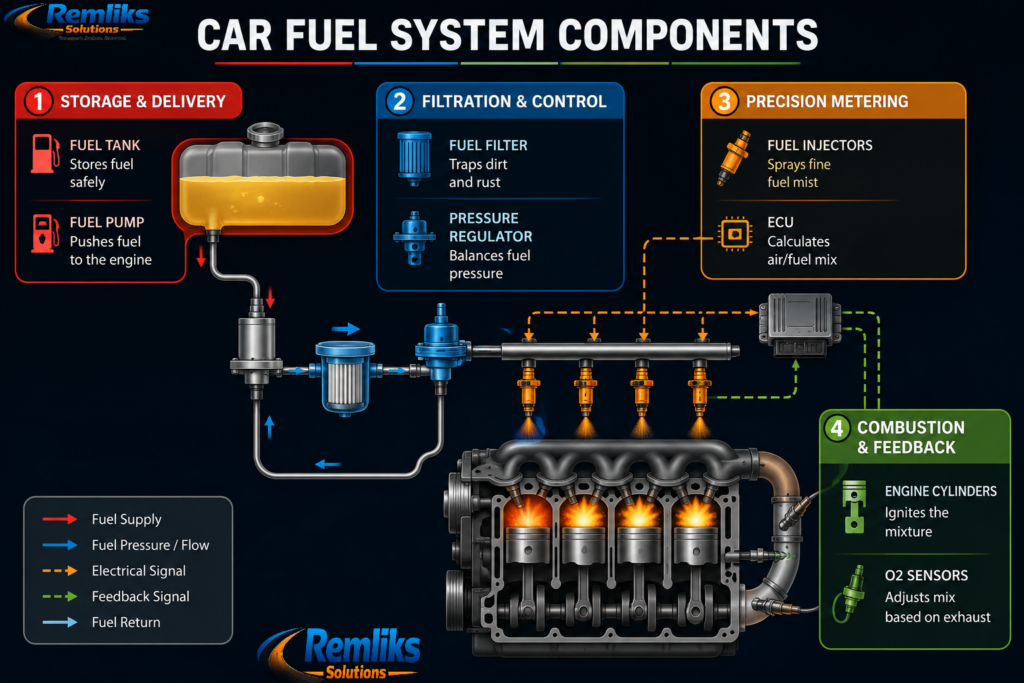
Proper maintenance is the best way to prevent fuel system failures. Responsible vehicle ownership involves regular inspections and timely replacement of wear items. Here are practical steps to keep your fuel system healthy.
As mentioned earlier, the electric fuel pump sits inside the tank. The fuel acts as a coolant and lubricant for the pump motor. Frequently running the tank down to empty pulls sediment from the bottom of the tank into the fuel filter. Keeping the tank at least one-quarter full is a simple habit that may help prolong pump life.
Do not wait for a fuel filter to clog completely before replacing it. A restricted filter forces the fuel pump to work harder, which shortens its lifespan. Check your owner’s manual for the specific interval. If you are unsure, visit our Automotive Fluids & Chemicals section to learn more about what flows through your system.
Not all gasoline is the same. Top Tier fuel brands add more detergents to their fuel, which helps keep fuel injectors clean and prevents carbon buildup. Using high-quality fuel does not mean you must buy premium octane if your car requires regular; it simply means choosing fuel with higher detergent additives.
Fuel injector cleaners are pour-in additives that may help remove light deposits from injectors and intake valves. However, these products are optional tools, not magic solutions. They will not fix a mechanically broken fuel pump or a severely clogged filter. If you choose to use them, follow the instructions carefully. Always frame these products as preventive maintenance rather than guaranteed repairs.
Pay attention to changes in engine sound, performance, and fuel economy. If you notice a new whining noise from the rear of the car, or if the engine starts to hesitate, do not ignore it. Early diagnosis prevents being stranded on the road. For more complex issues, explore our Troubleshooting Center.
Use this checklist to keep track of your fuel system maintenance.
How long do fuel pumps usually last?
Fuel pumps generally last between 100,000 and 150,000 miles. However, their lifespan depends heavily on driving habits. Keeping the fuel tank above one-quarter full and replacing the fuel filter regularly may help the pump reach its full lifespan.
Can a bad fuel pressure regulator cause a no-start condition?
Yes. If the fuel pressure regulator fails and allows all the fuel to return to the tank, the fuel injectors will not have enough pressure to spray fuel into the engine. This results in a crank-no-start condition.
What happens if I never replace my fuel filter?
A clogged fuel filter restricts the flow of fuel. This forces the fuel pump to work harder, often leading to premature pump failure. Additionally, the engine will run lean (not enough fuel), causing poor performance, potential overheating of internal engine parts, and illuminated warning lights.
Are fuel injector cleaners safe for my engine?
When used according to the manufacturer’s instructions, fuel injector cleaners are generally safe. They may help clean light deposits. However, they cannot repair mechanical failures. If you have a misfiring injector, a cleaner will not fix it.
How can I tell if my fuel injector is leaking?
A leaking fuel injector will often cause a strong smell of raw fuel, especially after the car has been sitting. You may also notice a rough idle when first starting the engine, or black smoke from the exhaust. A mechanic can perform a “leak-down test” to confirm if an injector is leaking internally.
The car fuel system components work as a team to ensure your engine receives the exact amount of clean, pressurized fuel it needs. From the fuel pump pulling liquid from the tank, to the filter removing contaminants, to the regulator managing pressure, and finally the injector spraying the fine mist—every step must be precise.
By understanding these components, you can maintain your vehicle responsibly and diagnose issues before they leave you stranded. Remember to follow routine maintenance schedules, use quality fuel, and consult professionals when faced with complex electrical or mechanical failures.
For more educational content on vehicle maintenance and repairs, explore the Learning Center at Remliks Solutions. Safe driving begins with understanding your vehicle.
