Physical Address
304 North Cardinal St.
Dorchester Center, MA 02124
Physical Address
304 North Cardinal St.
Dorchester Center, MA 02124

Disclaimer: This article provides general information only. Always consult your vehicle’s manual and a certified professional for specific maintenance, diagnostics, and repairs.
Throughout this guide, you may see Bilal and Omar discussing vehicle systems, maintenance procedures, and troubleshooting situations. They are fictional educational characters created by Remliks Solutions to help explain automotive and truck concepts in a practical and engaging way.
The engine in your vehicle is a complex machine that relies on perfect harmony to generate power. At the center of this mechanical machine are timing belts. These reinforced rubber belts ensure that the engine’s crankshaft and camshaft rotate at the exact same speed. This synchronization is critical. When the timing is correct, the engine valves open and close precisely when the pistons move up and down. Without a properly functioning belt, the engine cannot run, and severe internal damage may occur.
Understanding how this system works helps you make informed maintenance decisions. You can learn more about the foundation of these systems in our Learning Center Automotive Fundamentals.
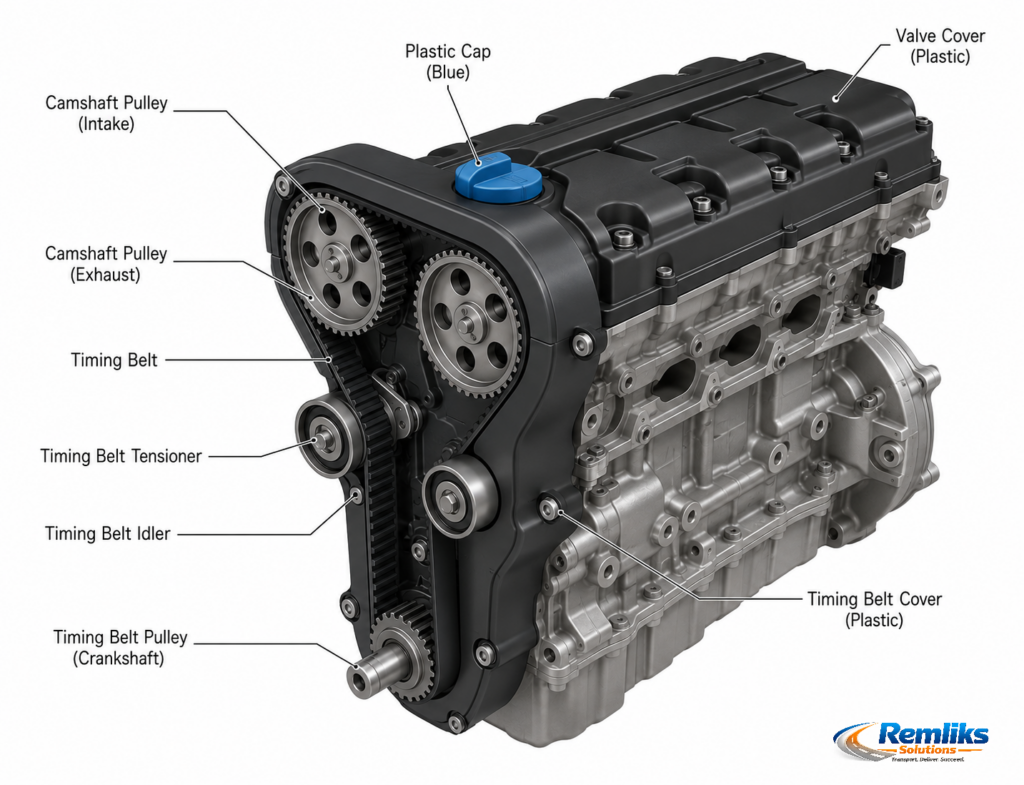
A timing belt is a toothed rubber belt that connects the engine crankshaft to the camshaft. The teeth on the belt match grooves on the engine pulleys. This design prevents the belt from slipping, ensuring exact mechanical synchronization.
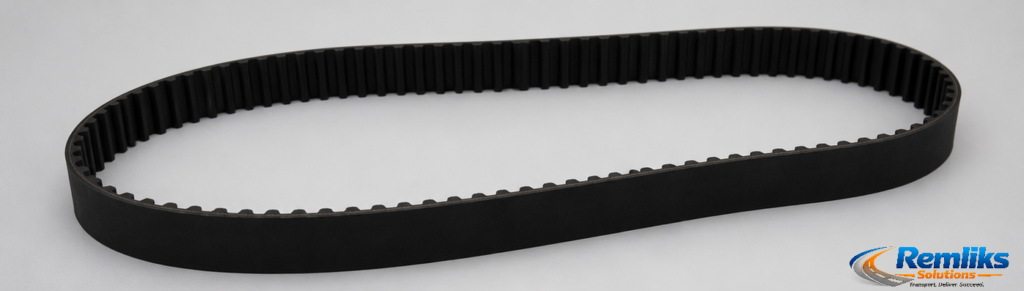
The primary job of a timing belt is to control the timing of the engine valves.
If the timing belt skips a tooth or breaks, this precise dance fails. The pistons may hit the valves, causing catastrophic engine failure.
Bilal: The engine cranks normally, but it makes a loud clattering noise and will not start. Could this be a timing belt issue?
Omar: It is possible, Bilal. When a timing belt skips a tooth, the engine loses its synchronization. The valves may open at the wrong time. However, we must avoid guessing. Let us perform a compression test first. If the timing is off, the compression will be very low or zero across all cylinders.
Bilal: Why not just replace the belt immediately?
Omar: Because professional diagnostics rely on testing before replacing parts. If the belt jumped timing, the engine might have internal damage. A compression test or a borescope inspection may reveal the actual condition of the cylinders and valves before we spend money on parts.
Bilal: I understand. So the timing belt is not just a drive belt; it is the heart of engine timing.
Omar: Exactly. It directly affects the ignition timing and valve operation. We must treat it with careful diagnostic procedures.
Manufacturers use different methods to synchronize the engine. Each method has distinct advantages and disadvantages.
| Feature | Timing Belt | Timing Chain | Gear Drive |
|---|---|---|---|
| Material | Reinforced Rubber (HNBR) | Metal Alloy | Hardened Steel |
| Noise Level | Very Quiet | Moderate to Loud | Loud |
| Lifespan | 60,000 to 100,000 miles | 150,000+ miles (Often lifetime) | Lifetime of engine |
| Lubrication | Dry (Runs in air) | Oil-lubricated (Inside engine) | Oil-lubricated |
| Stretch | Minimal stretch over time | Can stretch with age | No stretch |
| Weight | Light | Heavy | Very Heavy |
Most modern passenger vehicles use timing chains because they require less frequent replacement. However, many cars still use timing belts because they are quieter, lighter, and cheaper to manufacture.
The belt itself is just one part of the system. Several other components work together to keep the engine running smoothly.
Modern timing belts are made from Highly Saturated Nitrile Butadiene Rubber (HNBR) or Neoprene. They contain fiberglass or Kevlar cords for strength. These materials resist heat and oil but will eventually degrade.
A timing belt must remain tight to prevent slipping.
If a tensioner fails, the belt becomes loose. A loose belt will skip teeth on the camshaft sprocket, ruining the engine timing.
In many vehicles, the timing belt also drives the water pump. The water pump circulates coolant through the cooling system to prevent the engine from overheating.
When replacing a timing belt, mechanics highly recommend replacing the water pump simultaneously. Since the labor required to access the belt is intensive, replacing the water pump at the same time may save future labor costs.
Understanding your engine type is crucial when dealing with timing belts. Engines fall into two categories regarding valve-to-piston clearance.
In an interference engine, the valves and pistons share the same space inside the cylinder, but at different times. If the timing belt breaks or slips, the valve will remain open when the piston reaches the top of its stroke. The piston will strike the valve.
In a non-interference engine, the piston and valves do not share the same space. Even if the timing belt breaks, the piston will not hit the valves.
| Interference Engine | vs | Non-Interference Engine |
|---|---|---|
| High Damage Risk | Low Damage Risk | |
| Valves and Pistons share space | Valves and Pistons have clearance | |
| Belt break = Engine rebuild | Belt break = Tow and Replace Belt | |
| Common in modern cars | Common in older cars |
Always check your vehicle manual to determine if your engine is an interference type. This information changes how urgently you must approach timing belt maintenance.
Timing belts rarely fail without warning. Recognizing the early signs of wear may prevent expensive engine damage.
When a timing belt wears out, it becomes stiff and brittle. As it rotates around the pulleys, it may produce a high-pitched ticking or clicking noise. This sound may also indicate low engine oil pressure, which affects the hydraulic tensioner.
If the timing belt breaks completely, the engine will crank, but it will not start. The starter motor turns the crankshaft, but the camshaft does not move. Therefore, no air, fuel, or spark reaches the combustion chamber. You can learn more about this in our Troubleshooting Center.
A worn belt may skip a tooth on the camshaft sprocket. When this happens, the valves open slightly too early or too late. This mistiming causes a rough idle, a loss of power, and engine misfires. Misfires can also relate to the ignition system, so proper diagnosis is essential.
The timing belt cover protects the belt from dirt and debris. Behind the cover, the camshaft and crankshaft seals keep engine oil inside. If these seals leak, oil may contaminate the timing belt. Oil breaks down rubber quickly. If you see oil near the front of the engine, inspect the timing belt system immediately.
Bilal: A customer brought in a car that ran fine yesterday, but today it just cranks and will not start. I checked the battery and the fuel system, and they seem okay. What should I check next?
Omar: Since the engine cranks fast but does not fire, we should check for spark and compression. However, let us first look at the timing belt.
Bilal: How do I check the timing belt?
Omar: First, ensure safety. Turn off the ignition. Locate the timing belt cover on the front of the engine. Remove the upper inspection cover. Have a partner crank the engine for two seconds while you watch the camshaft sprocket.
Bilal: The crankshaft is turning, but the camshaft sprocket is not moving at all!
Omar: That confirms our diagnosis. The timing belt has snapped. Because this is an interference engine, we must remove the cylinder head and inspect the valves for damage.
Bilal: This is a costly repair. Could the customer have prevented this?
Omar: Yes. Preventive maintenance is always cheaper than mechanical failure. The customer ignored the recommended replacement interval. We must always follow the manufacturer’s maintenance schedule.
Maintaining timing belts is not about fixing a problem; it is about preventing one.
Manufacturers specify exact replacement intervals.
Check your owner’s manual or visit our Maintenance Guides for specific intervals.
When performing timing belt maintenance, do not just replace the belt. A complete timing belt kit includes:
Replacing all these components at once is considered a best practice. It ensures the system operates reliably for the next 100,000 miles.
Disclaimer: This is an educational overview, not a DIY guide. Timing belt replacement requires specific tools and expertise. Always use a certified mechanic.
The cost of replacing a timing belt varies depending on the vehicle make, model, and engine layout.
| Component/Service | Average Cost Range | Notes |
|---|---|---|
| Timing Belt Kit | $100 – $250 | Includes belt, tensioner, and pulleys. |
| Water Pump | $50 – $150 | Highly recommended to replace together. |
| Labor | $300 – $800 | Takes 3 to 7 hours depending on engine design. |
| Total Average Cost | $450 – $1,200 | Varies by region and mechanic rates. |
While this seems expensive, it is a fraction of the cost of replacing a destroyed engine. A failed interference engine rebuild may cost $3,000 or more. Therefore, proactive maintenance is the financially responsible choice.
A healthy timing belt ensures the engine runs at peak efficiency. If the belt is loose or stretched by even one degree, the engine control unit (ECU) cannot optimize the air-fuel mixture.
For the engine to breathe properly, the air intake system and the exhaust system must work in harmony with the timing belt. If any part of this chain fails, overall vehicle performance drops significantly.
Use this checklist to stay ahead of timing belt problems. You can find more resources in our Resource Center.
Q1: What happens if a timing belt breaks while driving?
If the belt breaks, the engine will immediately stop running. You will lose power steering and power brakes, making the vehicle harder to control. If you have an interference engine, the internal components will collide, causing severe damage. Safely pull over to the side of the road and call for a tow truck.
Q2: Can I visually inspect my timing belt myself?
In some vehicles, you can remove a small inspection cover to see a portion of the belt. However, visual inspection is not enough because the internal cords may be failing even if the rubber looks fine. Always follow the mileage replacement interval.
Q3: Are timing belts used in diesel engines?
Yes, many diesel engines use timing belts. However, diesel engines operate under higher compression, which places more stress on the belt. Diesel timing belts may require more frequent replacement intervals. Learn more in our Truck Systems section.
Q4: Does a timing belt stretch over time?
Timing belts do not stretch in the traditional sense. The fiberglass cords inside keep the length stable. However, the teeth may wear down, causing the belt to “jump” timing. Timing chains, on the other hand, do stretch over time due to metal wear.
Q5: Is it worth replacing the water pump with the timing belt?
Yes. If the water pump fails later, the mechanic must remove the timing belt again to access it. Since the labor is the most expensive part of the job, replacing the water pump preventatively may save you money and prevent future downtime.
Timing belts are a critical component of your vehicle’s engine. They ensure the perfect synchronization between the crankshaft and the camshaft. Ignoring timing belt maintenance is a risk no responsible vehicle owner should take.
By understanding how the system works, recognizing the signs of wear, and following a strict maintenance schedule, you may prevent catastrophic engine failure. Always rely on professional diagnostics and quality parts. If you are unsure about your vehicle’s timing system, consult a certified mechanic or explore more diagnostic guides in our Learning Center.
Remember: Maintaining your engine is not just about fixing what is broken. It is about preserving the harmony of the machine before the music stops.
