Physical Address
304 North Cardinal St.
Dorchester Center, MA 02124
Physical Address
304 North Cardinal St.
Dorchester Center, MA 02124

Disclaimer: This article provides general information only and is not intended as professional mechanical advice. Always consult with a qualified technician for specific vehicle issues.
Throughout this guide, you may see Bilal and Omar discussing vehicle systems, maintenance procedures, and troubleshooting situations. They are fictional educational characters created by Remliks Solutions to help explain automotive and truck concepts in a practical and engaging way.
Engine pistons are critical components in your vehicle’s internal combustion engine, converting the energy from burning fuel into mechanical motion that ultimately powers your wheels. Understanding how these components work can help you recognize problems early and maintain your engine properly for longer life.
Engine pistons are cylindrical metal components that move up and down inside the engine’s cylinders. They form the bottom part of the combustion chamber and are connected to the crankshaft via connecting rods.
The main job of a piston is to:
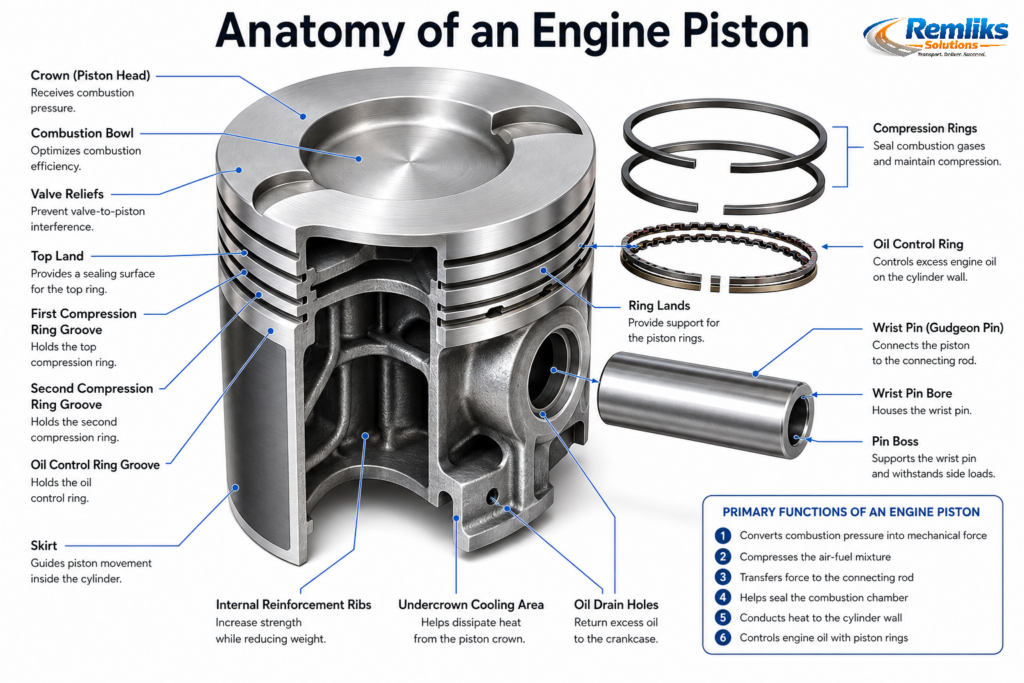
To understand how pistons work, it’s helpful to know their parts. Here’s a breakdown of the key components:
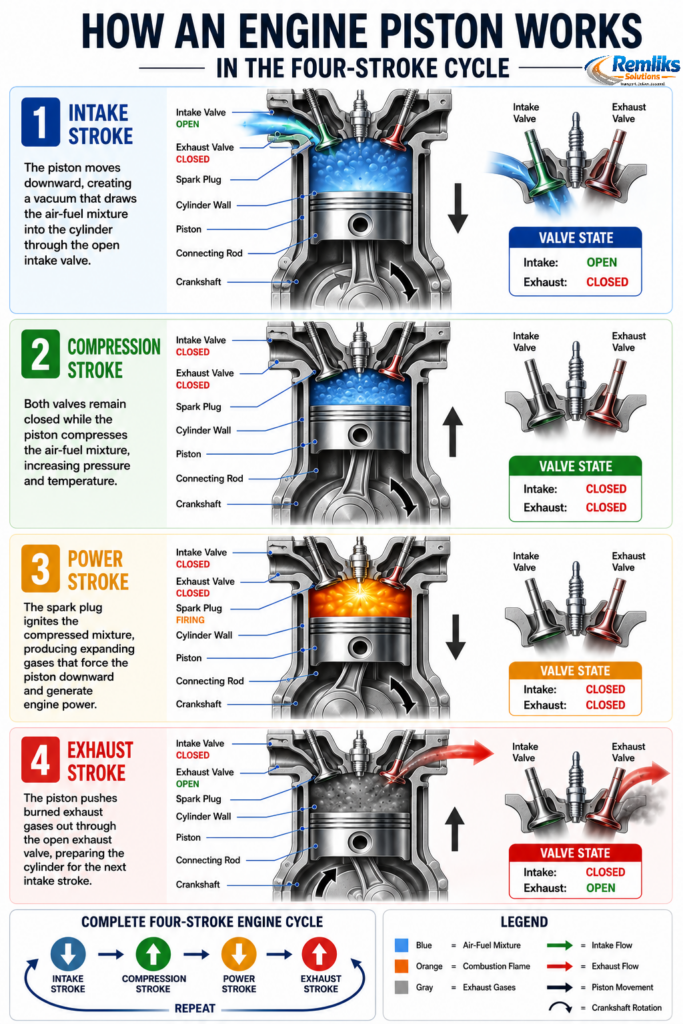
Most modern vehicles use four-stroke engines. Here’s how the piston participates in each stroke:
Bilal: I understand that pistons move up and down, but how does that actually create the rotational motion needed to move the car?
Omar: Good question, Bilal. The key is the connecting rod that attaches the piston to the crankshaft. As the piston moves down during the power stroke, it pushes the connecting rod, which rotates the crankshaft. The crankshaft’s design converts this up-and-down motion into rotational motion.
Bilal: So every time the piston goes down in the power stroke, it’s turning the crankshaft?
Omar: Exactly. And since most engines have multiple cylinders with pistons working in sequence, the power delivery becomes smoother. A 4-cylinder engine has a power stroke happening every half rotation of the crankshaft.
Engine pistons come in several designs, each with specific advantages for different applications:
These have a completely flat crown surface and are the most common type in standard engines. They provide a uniform combustion chamber shape and are simple to manufacture.
These have a concave depression in the crown, which helps reduce the compression ratio. They’re often used in turbocharged or supercharged engines where lower compression helps prevent detonation.
These have a raised portion in the center of the crown, which increases the compression ratio. They’re typically found in high-performance naturally aspirated engines.
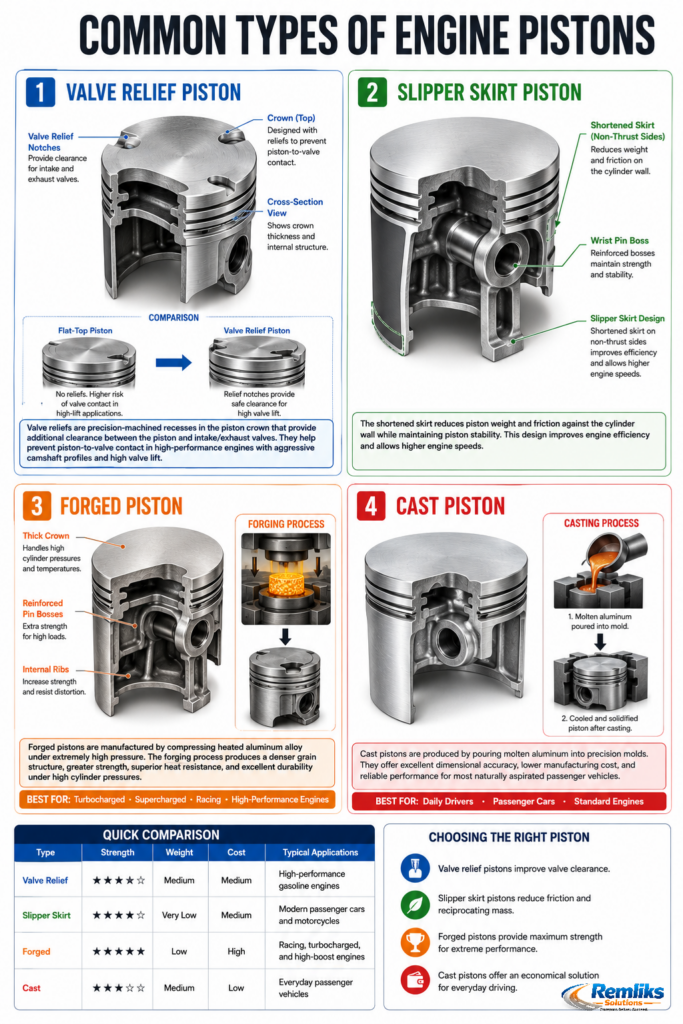
The material choice for pistons balances weight, strength, heat resistance, and cost:
| Material | Advantages | Disadvantages | Common Applications |
|---|---|---|---|
| Cast Aluminum Alloy | Cost-effective, adequate strength for normal use, good thermal conductivity | Not as strong as forged alternatives, more prone to failure under extreme conditions | Most standard passenger vehicles |
| Forged Aluminum Alloy | Higher strength, better resistance to detonation, more durable under stress | More expensive, slightly heavier than some cast alternatives | Performance engines, racing, turbocharged applications |
| Hypereutectic Aluminum | Better wear resistance than standard cast, less expansion with heat, can be thinner | More brittle than forged, can crack under extreme detonation | Many modern factory performance engines |
| Steel | Extremely strong, can handle very high temperatures | Much heavier than aluminum, more expensive, less efficient due to weight | Diesel engines, some industrial applications |
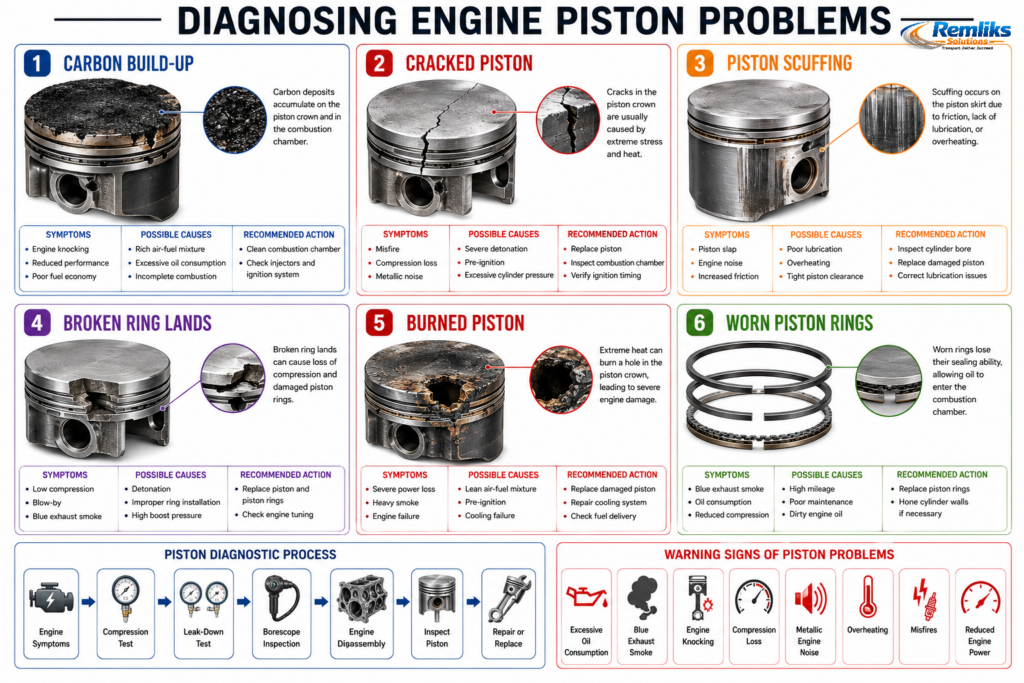
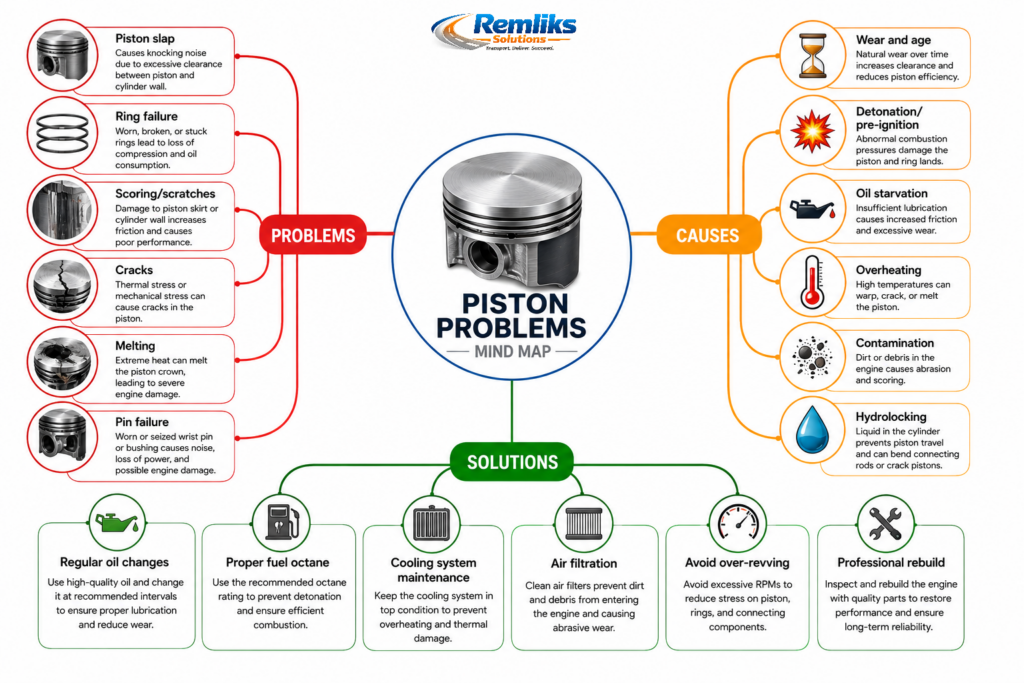
Engine pistons operate under extreme conditions and can develop several issues over time:
Symptoms may include:
Physical damage to pistons can occur due to:
A knocking sound that’s most noticeable when the engine is cold. It occurs when there’s excessive clearance between the piston and cylinder wall.
Bilal: A customer brought in a car with a knocking sound that gets quieter as the engine warms up. Could this be a piston problem?
Omar: That’s a good observation, Bilal. What you’re describing sounds like piston slap, which is indeed related to pistons. When the engine is cold, the metal components have contracted, creating more clearance between the piston and cylinder wall. As the engine warms up, the piston expands and the clearance decreases, reducing the noise.
Bilal: Is piston slap something we need to fix immediately?
Omar: It depends on the severity. Some mild piston slap is common in certain engines and may not cause immediate problems. However, if it’s loud or getting worse, it could indicate excessive wear that will eventually lead to more serious damage. We should perform a thorough diagnostic to determine the cause and severity before recommending any action.
Proper diagnosis is essential before deciding on any repair approach:
While you can’t directly maintain pistons without engine disassembly, these practices help protect them:
Clean oil with proper viscosity provides the lubrication film that prevents metal-to-metal contact between pistons and cylinder walls. Follow your manufacturer’s recommended oil change intervals.
Using fuel with the correct octane rating for your engine helps prevent detonation, which can damage pistons. For more information about fuel systems, you can read our guide on car fuel system components.
A clean air filter prevents dust and debris from entering the engine, which could scratch cylinder walls and accelerate piston wear. Our engine air filters guide provides more details on this important maintenance item.
Overheating can cause pistons to expand excessively and scuff against cylinder walls. Maintain your cooling system to prevent this damage. For more information, visit our cooling system section.
Excessive engine speeds increase stress on pistons and connecting rods, potentially leading to premature failure.
Piston replacement typically occurs during engine rebuilds rather than as isolated repairs. Consider piston replacement when:
Use this checklist to help maintain your engine’s pistons and related components:
In most cases, no. Pistons are typically replaced as a set to ensure balanced performance. Additionally, if one piston has failed, the others may have similar wear even if not yet showing symptoms. However, in some specialized situations, a single piston replacement might be possible if the damage was due to an isolated incident and the engine has low mileage.
In normal driving conditions, pistons can often last the lifetime of the engine (150,000-200,000+ miles). However, factors like maintenance habits, driving conditions, and engine design significantly affect piston life. Severe conditions like frequent overheating, detonation, or oil starvation can dramatically shorten piston life.
Piston melting typically results from extreme heat, often caused by:
Mild piston slap may not cause immediate engine failure but can lead to increased wear over time. Severe piston slap indicates significant clearance between the piston and cylinder wall, which can lead to further damage if not addressed. If you notice piston slap, have a qualified technician evaluate the severity.
Yes, but with considerations. Performance pistons often have different compression ratios, clearances, or material properties that may require additional modifications. Always research compatibility with your specific engine and consult with a knowledgeable engine builder before making such changes.
Pistons directly affect compression through their design and condition. The shape of the piston crown influences the compression ratio, while worn piston rings can allow compression to leak past the piston, reducing overall compression. For more information about engine compression and related components, you might find our article on ignition system components helpful.
Cast pistons are made by pouring molten aluminum into a mold, while forged pistons are formed by pressing heated aluminum alloy under extreme pressure. Forged pistons are typically stronger and more resistant to detonation but are also more expensive. Cast pistons are sufficient for most standard applications and are more cost-effective.
Engine pistons are fundamental components that play a crucial role in converting fuel energy into motion. Understanding their function, types, and potential problems can help you maintain your vehicle better and recognize issues before they become serious.
Remember that proper maintenance—especially regular oil changes, using the correct fuel, and keeping your cooling and air intake systems in good condition—goes a long way toward protecting your engine’s pistons and extending their service life.
If you suspect piston problems, seek professional diagnosis rather than guessing. Proper testing can identify the exact issue and prevent unnecessary repairs. For more information about engine components and systems, explore our engine system section or check out our automotive terms glossary to better understand technical terminology.
