Physical Address
304 North Cardinal St.
Dorchester Center, MA 02124
Physical Address
304 North Cardinal St.
Dorchester Center, MA 02124

The engine crankshaft is the backbone of your vehicle’s internal combustion system. It translates the up-and-down motion of the pistons into the rotational force needed to move your car or truck. Understanding this component helps you appreciate how engine power is generated and maintained.
Disclaimer: This article provides general information only. Always consult a certified mechanic for specific diagnostic, repair, or safety advice.
Throughout this guide, you may see Bilal and Omar discussing vehicle systems, maintenance procedures, and troubleshooting situations. They are fictional educational characters created by Remliks Solutions to help explain automotive and truck concepts in a practical and engaging way.
Bilal: Omar, I understand pistons move up and down, but how does that actually make the wheels spin?
Omar: That is a great question, Bilal. The pistons connect to the engine crankshaft. When the pistons move, they push the crankshaft, causing it to spin. Think of riding a bicycle; your knees move up and down, but the pedal arm converts that into a circular motion that turns the wheels.
Bilal: So, if the crankshaft breaks, the engine completely stops?
Omar: Exactly. Without a functioning crankshaft, the engine cannot produce power. However, crankshafts rarely break suddenly. They usually fail over time due to poor lubrication or extreme stress.
The engine crankshaft is a heavy, precisely machined metal shaft located inside the engine block. It is the primary moving component that allows an engine to generate usable power. Inside the engine, the crankshaft works closely with the engine pistons and connecting rods to keep the vehicle running smoothly.
The primary function of the engine crankshaft is to convert linear motion into rotational motion. When the air-fuel mixture ignites in the cylinder, it pushes the piston downward. This linear (straight-line) force pushes on the crankshaft, forcing it to rotate.
Also, the crankshaft drives other essential engine accessories. It turns the serpentine belt, which powers the alternator, water pump, and air conditioning compressor. It also drives the camshaft via a timing belt or chain, ensuring the engine’s valves open and close at the correct times.
To understand how the crankshaft works, we must look at its anatomy. The design is complex but logical.
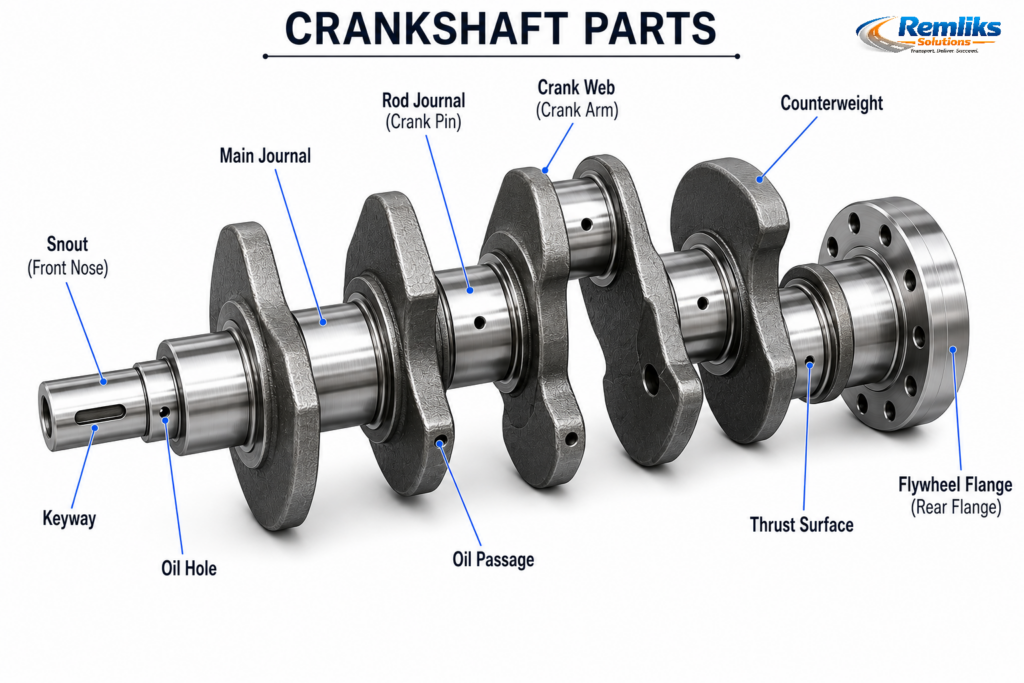
Below is a table explaining the main parts of the engine crankshaft:
| Part Name | Location on Crankshaft | Primary Function |
|---|---|---|
| Main Journals | Along the center axis | Support the crankshaft inside the engine block. They align with the main bearings. |
| Rod Journals (Crankpins) | Offset from the center | Connect to the connecting rods. The offset creates the turning force. |
| Crank Webs (Arms) | Between journals | Connect the main journals to the rod journals. Provide structural support. |
| Counterweights | Opposite the rod journals | Balance the rotating assembly. They reduce engine vibration and stress. |
| Oil Passages | Drilled inside the shaft | Route engine oil from the main journals to the rod journals for lubrication. |
| Crankshaft Snout | Front of the shaft | Holds the timing gear and harmonic balancer. |
| Flange | Rear of the shaft | Connects to the flywheel or flexplate to transfer power to the transmission. |
The engine crankshaft operates on a simple principle of leverage. Because the rod journals are offset from the center axis of the main journals, the downward push of the piston creates torque.
When a piston fires at Top Dead Center (TDC), the pressure pushes the connecting rod against the rod journal. The crankshaft rotates to Bottom Dead Center (BDC). However, a single piston only pushes during the power stroke.
Therefore, engines with multiple cylinders are designed so their power strokes overlap. This overlapping ensures the crankshaft always has rotational force pushing it forward. The flywheel attached to the rear flange stores this rotational energy, keeping the engine running smoothly between power strokes.
Manufacturers use different methods to build crankshafts. The type of crankshaft depends on the engine’s performance requirements and budget.
Cast crankshafts are made by pouring molten iron into a mold. They are affordable to produce and perfectly adequate for standard daily driving. Most passenger cars use cast iron crankshafts. However, they are more brittle and cannot handle extreme power upgrades.
Forged crankshafts are made by heating a solid block of steel and pressing it into shape under immense pressure. This process aligns the metal’s grain structure, making it incredibly strong. Performance cars, heavy-duty trucks, and forced induction systems usually use forged crankshafts. They handle high torque and stress without bending or cracking.
Billet crankshafts are cut from a solid block of high-grade steel using CNC machines. These are the strongest and most expensive crankshafts available. They are usually custom-made for racing applications where extreme durability is required.
Here is a side-by-side comparison of crankshaft materials:
| Feature | Cast Iron | Forged Steel | Billet Steel |
|---|---|---|---|
| Strength | Moderate | High | Very High |
| Cost | Low | High | Very High |
| Use Case | Daily Commuting | Towing, Performance | Racing, Heavy Duty |
| Durability | Good | Excellent | Maximum |
While crankshafts are built to last, they can suffer from problems if the engine is poorly maintained. Issues usually arise from friction, vibration, or extreme stress.
The crankshaft does not actually touch the engine block. Instead, it rides on a thin film of oil between the journals and soft metal bearings. However, if oil pressure drops or oil becomes dirty, the metal contacts metal. This wears down the journals, causing a deep knocking sound.
The front of the crankshaft (snout) holds the timing gear and harmonic balancer. If the timing belt is over-tightened, or if the harmonic balancer fails, it can wear out the keyway on the snout. Consequently, the timing gear may slip, causing severe engine timing issues.
Cracks usually occur due to extreme torsional vibration or manufacturing defects. When a cylinder fires, it twists the crankshaft slightly. The harmonic balancer is designed to absorb this twist. If the balancer fails, the metal fatigues over time and eventually snaps. This is a catastrophic failure that destroys the engine.
The oil passages inside the crankshaft are narrow. If sludge builds up in the engine, these passages can block. When oil cannot reach the rod journals, the bearing burns up rapidly. Regular oil changes in the lubrication system are the best way to prevent this.
A failing crankshaft gives several warning signs before it completely fails. If you notice any of these symptoms, have your vehicle inspected immediately.
Bilal: I hear a knocking sound from the engine, but it goes away when I rev it slightly. Is the crankshaft broken?
Omar: Probably not broken, but it may be worn. When engine bearings wear out, they create a gap. The knocking is the piston hitting the crankshaft journal because the oil film is too thin.
Bilal: Can we just tighten the bearings to fix the gap?
Omar: No, we cannot. Instead, we must measure the journal diameter with a micrometer. If the journal is worn, the crankshaft must be removed, machined to a smaller size, and fitted with thicker oversized bearings.
Bilal: That sounds expensive. How can we prevent this?
Omar: Prevention is simple. Change the engine oil regularly, use the correct oil grade, and never ignore a low oil pressure warning. Good maintenance is always cheaper than a repair.
You cannot maintain a crankshaft directly because it is hidden inside the engine. However, you can protect it by maintaining the surrounding systems.
Clean oil is the crankshaft’s best friend. Always follow the manufacturer’s oil change intervals. Use high-quality oil that meets the required specifications. Fresh oil prevents sludge and ensures the journal bearings stay lubricated.
The harmonic balancer (crankshaft pulley damper) is critical for crankshaft longevity. Inspect it during routine maintenance. If the rubber ring inside the balancer looks cracked or degraded, replace the balancer before it damages the crankshaft snout.
When an engine is cold, the oil is thick and flows slowly. Before starting the engine, avoid revving it aggressively. Give the oil a few seconds to reach the crankshaft journals. This simple habit may help extend the life of your engine bearings.
Beginners often confuse the crankshaft with the camshaft. While both are rotating shafts in the engine, they do very different jobs.
The crankshaft handles the bottom end of the engine. It converts piston movement into rotational power. The camshaft handles the top end. It uses lobes to open and close the intake and engine valves at the correct time. The crankshaft drives the camshaft using a timing chain or belt. Learn more about this in our Learning Center.
Use this checklist to keep your crankshaft and related components in good condition:
What does the engine crankshaft do?
The engine crankshaft converts the up-and-down linear motion of the pistons into rotational motion. This rotation transfers power to the transmission, which ultimately turns the wheels of the vehicle.
How long does a crankshaft last?
A crankshaft usually lasts the entire life of the engine, often exceeding 200,000 miles. However, poor lubrication, low oil pressure, or a failing harmonic balancer can cause premature wear or failure.
Can you drive with a bad crankshaft?
No. Driving with a worn or damaged crankshaft is unsafe. It can cause catastrophic engine failure, leaving you stranded. If you hear engine knocking, have it inspected immediately.
What causes a crankshaft to break?
Cracks and breaks are usually caused by metal fatigue from torsional vibrations. This happens when the harmonic balancer fails to absorb the engine’s twisting forces. Extreme power modifications can also exceed the crankshaft’s design limits.
How much does it cost to fix a crankshaft?
Repairing a crankshaft is labor-intensive. It involves removing the engine. Machining the journals and replacing bearings can be expensive. Costs vary widely depending on the vehicle type and labor rates.
The engine crankshaft is a marvel of engineering. It handles immense pressure, extreme heat, and constant vibration to keep your vehicle moving. Understanding its function, parts, and common problems helps you appreciate the importance of regular maintenance.
Always remember that a healthy crankshaft relies on clean oil and a functioning harmonic balancer. By following simple maintenance routines, you protect the heart of your engine. For more detailed guides on engine components and troubleshooting, visit our Troubleshooting Center.
