Physical Address
304 North Cardinal St.
Dorchester Center, MA 02124
Physical Address
304 North Cardinal St.
Dorchester Center, MA 02124

Disclaimer: This article provides general information only. Always consult your vehicle’s official service manual for specific instructions, torque specifications, and safety guidelines. When in doubt, seek assistance from a qualified professional.
Throughout this guide, you may see Bilal and Omar discussing vehicle systems, maintenance procedures, and troubleshooting situations. They are fictional educational characters created by Remliks Solutions to help explain automotive and truck concepts in a practical and engaging way.
When you start your car, a complex symphony of moving parts begins. Among these parts, belts and chains rotate silently to keep your engine alive. However, these components cannot work alone. They rely heavily on automotive tensioners to maintain the exact amount of tightness required for smooth operation. Without proper tension, belts slip, chains rattle, and engine performance drops. In this comprehensive guide, we will explore how these critical components work, why they fail, and how to maintain them properly.
Automotive tensioners are mechanical devices designed to maintain constant tension on engine belts and timing chains. Belts and chains naturally stretch over time due to heat, friction, and mechanical load. If a belt becomes loose, it will slip on its pulleys. If a timing chain becomes loose, it will rattle against the engine block and potentially jump teeth, which can cause severe engine damage.
Tensioners act as an automatic adjusting arm. They push against the belt or chain to take up the slack. Consequently, the engine maintains perfect synchronization, and accessory components like the alternator, water pump, and air conditioning compressor continue to spin at the correct speed.
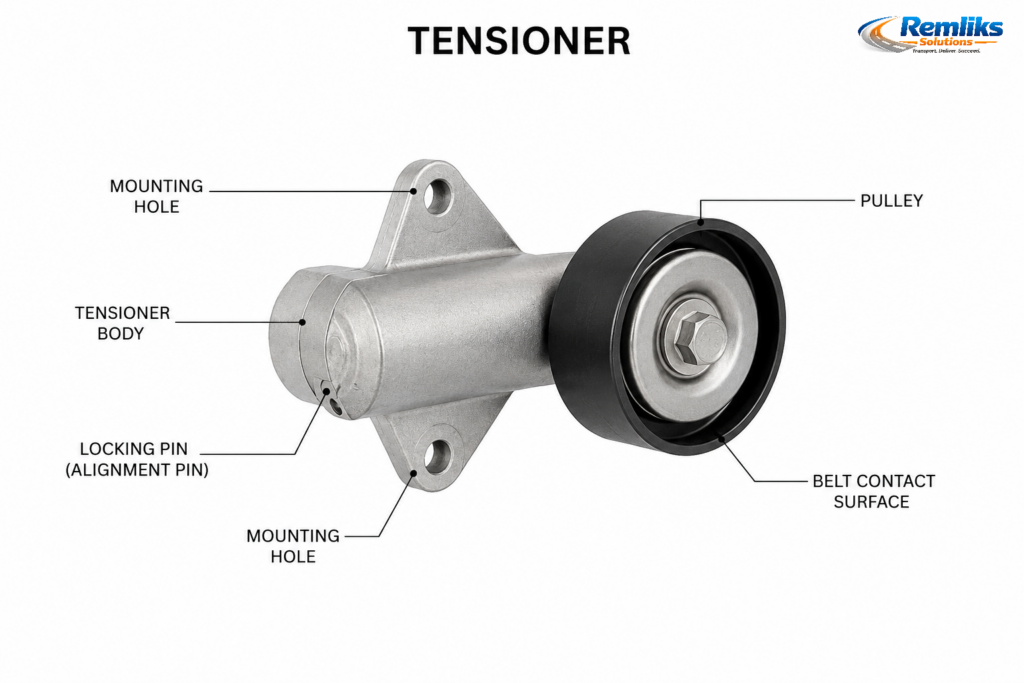
Tension is a balancing act. If the tension is too low, the belt slips, generating excessive heat and causing accessories to underperform. However, if the tension is too high, the belt snaps, and the extreme pressure destroys the bearings inside the alternator, water pump, or tensioner pulley itself. Therefore, automotive tensioners are engineered to apply a specific, constant force, usually measured in pounds-force (lbf) or Newtons (N), regardless of how much the belt stretches over its lifespan.
The basic principle behind all tensioners is the application of opposing force. They use a spring-loaded arm or a hydraulic piston to push a pulley against the belt. As the belt stretches and lengthens over thousands of miles, the tensioner arm slowly moves outward to maintain the same pressure.
To understand this better, let us look at the main components of a standard belt tensioner:
Not all engines use the same type of tensioner. The design depends on whether the engine uses a timing belt, a timing chain, or a serpentine accessory belt. Let us explore the main types of automotive tensioners used in modern vehicles.
Spring-loaded tensioners are the most common type for accessory drive belts (serpentine belts). They use a strong, pre-loaded coil spring hidden inside the tensioner housing. When installed, the spring forces a pivoting arm outward, pushing the pulley against the belt. These are self-adjusting and require no manual intervention once installed. However, the internal spring eventually fatigues and weakens over time.
Hydraulic tensioners use a small piston filled with oil and pressurized gas to apply tension. They are frequently used in timing chain systems and some heavy-duty accessory belt systems. Engine oil pressure usually feeds the tensioner. The hydraulic pressure pushes the piston against a guide rail, which in turn presses against the timing chain. Also, hydraulic tensioners have excellent damping characteristics, absorbing the rapid shocks that occur when the engine changes speed.
Manual tensioners are older designs, often found on classic cars or specific truck systems. They feature a simple pulley on a sliding bracket or a threaded rod. The mechanic must manually turn a bolt to adjust the tension and then lock it down. While simple and reliable, they require regular checks because they do not adjust automatically as the belt stretches.
| Feature | Spring-Loaded | Hydraulic | Manual |
|---|---|---|---|
| Adjustment | Automatic | Automatic | Manual |
| Common Use | Serpentine belts | Timing chains | Older vehicles, V-belts |
| Damping | Internal friction | Hydraulic fluid | None |
| Maintenance | Replace when weak | Check oil leaks | Adjust regularly |
| Complexity | Low | High | Very Low |
Omar and Bilal are in the workshop. They are looking at an engine that makes a loud squealing noise every morning when the weather is cold.
Bilal: The engine cranks normally, but once it starts, there is a terrible squealing noise from the front. It goes away after a few minutes. Could this be a belt problem?
Omar: It certainly sounds like it. The squealing is a classic symptom of a slipping accessory belt. Before we do anything, let us visually inspect the serpentine belt routing and the tensioner. We must avoid guessing and rely on observation.
Bilal: I see the belt. It looks a bit old, but it is not snapped. Why would it only slip when it is cold?
Omar: Rubber contracts and hardens in the cold. Also, a small amount of moisture can settle on the pulleys overnight. If the tension is perfect, the belt grips fine. But if the tension is weak, the cold belt will slip until the engine heat warms it up and makes it pliable again. Look closely at the tensioner arm. Do you see the indicator marks?
Bilal: Yes, there is a small arrow on the tensioner base and another on the moving arm. The arrow on the arm is pointing outside the “normal” range marked on the base.
Omar: Exactly. That tells us the tensioner has reached its maximum travel limit. The belt has stretched, or the internal spring has weakened. We should replace both the belt and the tensioner together.
Bilal: Why not just replace the belt? The tensioner still moves.
Omar: Because professional diagnostics rely on testing before replacing parts. If we put a new belt on a worn-out tensioner, the old spring may not provide enough clamping force for the new belt. The new belt will slip and wear out quickly. Replacing them as a pair ensures proper grip and saves us from doing the job twice.
Automotive tensioners play a vital role in engine longevity and efficiency. They do much more than just keep a belt tight.
Firstly, they protect the engine crankshaft function parts problems and the camshaft function types explained. The timing belt or chain connects the crankshaft to the camshaft. If the tensioner fails and the timing belt skips a tooth, the engine’s synchronization breaks. The pistons can hit the valves, destroying the engine.
Secondly, they ensure electrical and cooling stability. The serpentine belt drives the alternator, which charges the battery. If the tensioner allows the belt to slip, the alternator will not spin fast enough. The battery will drain, and the car will eventually stall. Similarly, the water pump relies on this belt to circulate coolant. A slipping belt leads to engine overheating.
Finally, tensioners improve fuel economy and reduce emissions. When accessories run at their intended speeds without slippage, the engine management system operates efficiently.
Like all mechanical parts, automotive tensioners suffer from wear and tear. Recognizing the symptoms of a failing tensioner early can prevent expensive repairs.
In spring-loaded tensioners, the heavy-duty coil spring slowly loses its tension after millions of cycles. When the spring fatigues, it can no longer push the pulley hard enough against the belt. Consequently, the belt slips under heavy loads, such as when the air conditioning compressor engages.
The pulley on the tensioner spins constantly. Its sealed bearing eventually dries out or gets contaminated with dirt. A failing bearing produces a grinding, growling, or rumbling noise. If the bearing seizes completely, the pulley stops spinning, and the belt friction melts the belt in seconds.
Hydraulic tensioners rely on internal oil pressure. Over time, the internal seals can fail, causing the oil to leak out. Without oil, the tensioner loses its damping ability and cannot maintain pressure. You may hear a rattle from the timing cover area when starting a cold engine.
If a tensioner is installed incorrectly, or if the mounting bracket bends, the pulley will not sit perfectly parallel to the other pulleys. This misalignment forces the belt to twist as it travels, causing rapid edge wear on the belt.
| Symptom | Possible Cause | Immediate Action |
|---|---|---|
| Squealing noise at startup | Weak spring, glazed belt | Check tensioner indicator marks |
| Rattling from engine front | Worn timing chain, bad hydraulic tensioner | Do not drive; inspect timing system |
| Grinding or rumbling noise | Dry pulley bearing | Replace tensioner pulley assembly |
| Belt fraying on edges | Pulley misalignment | Check bracket alignment and pulley fit |
| Visible belt wobble while running | Seized tensioner arm | Replace tensioner immediately |
If you want to learn more about identifying issues, visit our Troubleshooting Center.
Maintaining automotive tensioners requires regular inspection rather than active adjustment. Because most modern tensioners are sealed units, you cannot lubricate or adjust them. You simply replace them when they show signs of weakness.
Include the tensioner in your routine under-hood checks. Look for cracks in the tensioner body, rust on the spring area, or oil leaking from hydraulic units. Also, check the tensioner indicator marks. If the pointer moves out of the “normal” operating range, the belt or the tensioner needs replacement.
If your vehicle does not have indicator marks, you can perform a basic deflection test. Press firmly on the longest unsupported section of the serpentine belt between two pulleys. The belt should deflect about half an inch (10 to 12 mm). If it moves significantly more, the tension is low. However, if it does not move at all, the tension may be dangerously high.
When replacing a belt, always evaluate the tensioner. Spin the pulley by hand. It should spin smoothly and freely. If you feel any roughness, grinding, or side-to-side play, replace the tensioner. Also, never force a tensioner arm back using a cheater bar. Use the correct size socket or wrench on the tensioner’s relief bolt to avoid bending the mounting bracket. For more detailed maintenance schedules, check our Maintenance Guides.
Working on automotive tensioners requires specific tools to do the job safely and correctly. Before starting any work, ensure you have the right equipment from your Automotive Tools & Equipment collection.
Bilal is preparing to install a new serpentine belt and spring-loaded tensioner on an older sedan.
Bilal: I have the new tensioner and belt. I will just bolt the tensioner to the engine, route the belt, and let the spring snap into place. Is that correct?
Omar: Not exactly, Bilal. We must control the spring. First, you should route the belt over all the fixed pulleys—like the crankshaft, alternator, and water pump. Leave the belt off the tensioner pulley for a moment.
Bilal: Oh, I see. So I attach the tensioner base loosely first?
Omar: Yes. Torque the mounting bolts to spec first. Then, use your wrench to rotate the tensioner arm to relieve the pressure. Once the arm is moved, you can slide the belt over the smooth tensioner pulley. Gently release the wrench, and the spring will apply the perfect amount of tension automatically.
Bilal: That makes sense. It is much safer than letting a strong spring snap against my fingers.
Omar: Exactly. Safety always comes first. Also, before you lower the car down, start the engine and watch the belt. Make sure it tracks straight and does not wobble. A straight belt prevents future edge wear.
A failing tensioner does not just ruin a belt; it triggers a domino effect across multiple vehicle systems. When an accessory belt slips due to a weak tensioner, the power steering pump may struggle, making the steering wheel hard to turn. The air conditioning compressor may stop engaging to protect itself from under-rotation.
Furthermore, a failing timing belt tensioner directly threatens the engine components. If the timing belt loses tension, the relationship between the engine pistons and the valves breaks. In an interference engine, the valves will extend into the path of the rising pistons. The resulting collision bends valves, cracks pistons, and destroys the cylinder head.
Therefore, ignoring a noisy tensioner is a severe risk. A $50 tensioner can save a $3,000 engine. Always treat tensioner health as a critical safety issue. For a deeper understanding of how these belts work in sync with the engine, you can read our guide on timing belts function maintenance.
While the basic principles remain the same, truck systems use much more robust tensioner designs. Diesel engines, especially heavy-duty trucks, generate massive vibrations and torque spikes. A standard spring-loaded tensioner cannot handle these forces.
Truck tensioners often feature heavy-duty hydraulic damping and dual-spring designs. They are designed to absorb the violent torsional vibrations of a diesel crankshaft. Also, truck tensioners usually have replaceable pulley faces rather than requiring the whole unit to be replaced. Fleet maintenance schedules strictly dictate checking these tensioners every few thousand miles, as a belt failure on a loaded truck can lead to dangerous roadside situations or costly downtime.
Use this checklist to keep your automotive tensioners in top condition:
1. How long do automotive tensioners last?
Most manufacturers recommend replacing automotive tensioners every 60,000 to 100,000 miles. However, it is best practice to replace the tensioner whenever you replace the timing belt or serpentine belt, as they wear at a similar rate.
2. Can I drive with a bad tensioner?
It is highly discouraged. A bad tensioner can cause the belt to slip or snap suddenly. If the serpentine belt breaks, you lose power steering, the alternator, and the water pump. If a timing tensioner fails, the engine may suffer catastrophic internal damage.
3. What does a bad tensioner sound like?
A failing spring-loaded tensioner often causes a high-pitched squealing noise, especially at startup. A bad hydraulic tensioner or a dry pulley bearing usually produces a rattling, tapping, or grinding noise from the front of the engine.
4. Can I just replace the pulley on a tensioner?
In some cases, yes. If the tensioner arm and spring are strong, but only the pulley bearing is noisy, you can replace just the pulley. However, if the tensioner has high mileage, replacing the entire assembly is safer and more reliable.
5. Why is my new belt still squealing?
If a brand-new belt squeals, the tensioner is likely weak and cannot provide enough clamping force. Alternatively, fluid might be leaking onto the belt, or a pulley may be misaligned. Clean the pulleys and double-check the tensioner’s force.
Automotive tensioners are small but mighty components. They silently handle the stress of engine movement, ensuring belts and chains operate without slipping. By understanding how they work, recognizing the signs of failure, and following proper maintenance routines, you can prevent unexpected breakdowns and expensive engine damage.
Always remember that preventive maintenance is the key to vehicle longevity. Take the time to inspect your tensioners during routine oil changes or belt checks. If you suspect an issue, address it immediately. Safe driving starts with a well-maintained engine, and a well-maintained engine relies heavily on healthy automotive tensioners.
