Physical Address
304 North Cardinal St.
Dorchester Center, MA 02124
Physical Address
304 North Cardinal St.
Dorchester Center, MA 02124

Forced induction systems have revolutionized modern engine design by allowing smaller engines to produce more power while maintaining efficiency. These systems—primarily turbochargers and superchargers—force more air into the engine than it would naturally draw in, creating the potential for increased power output. In this comprehensive guide, we’ll explore how forced induction systems work, examine the differences between turbochargers and superchargers, and understand the crucial role of intercoolers in these systems.
Disclaimer: This article provides general information only and should not be considered professional mechanical advice. Always consult with a qualified technician for specific vehicle issues.
Throughout this guide, you may see Bilal and Omar discussing vehicle systems, maintenance procedures, and troubleshooting situations. They are fictional educational characters created by Remliks Solutions to help explain automotive and truck concepts in a practical and engaging way.
Forced induction refers to the process of compressing air before it enters the engine’s cylinders. This compression allows more oxygen to be packed into the combustion chamber, which means more fuel can be burned, resulting in increased power output.
Naturally Aspirated Engines:
Forced Induction Engines:
Forced induction systems offer several advantages:
A turbocharger is a forced induction device that uses exhaust gases to spin a turbine, which in turn drives a compressor that forces more air into the engine.
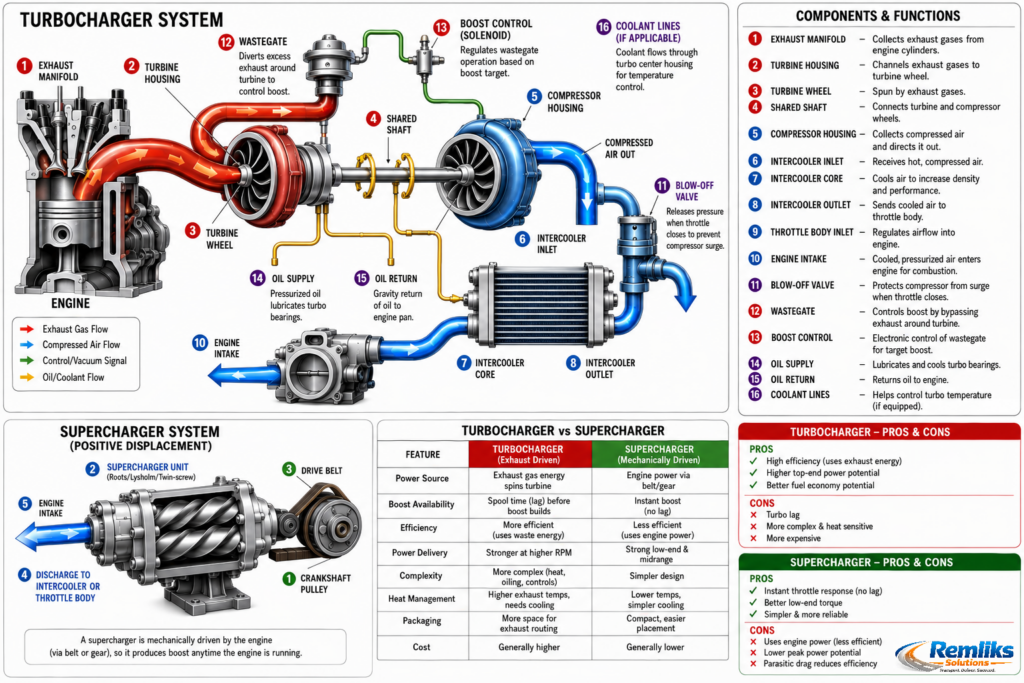
A turbocharger consists of two main sections connected by a shared shaft:
When exhaust gases exit the engine, they pass through the turbine housing, causing the turbine wheel to spin rapidly. This spinning motion transfers through the shaft to the compressor wheel on the intake side, which then compresses the incoming air.
| Component | Function |
|---|---|
| Turbine Housing | Directs exhaust flow to spin the turbine wheel |
| Turbine Wheel | Converts exhaust energy into rotational motion |
| Compressor Housing | Contains and directs the intake air flow |
| Compressor Wheel | Compresses the intake air |
| Center Housing/CHRA | Contains bearings and oil passages for the shaft |
| Wastegate | Controls boost pressure by diverting exhaust flow |
| Blow-off Valve | Releases pressure when throttle is closed |
Single Turbo:
Twin Turbo:
Variable Geometry Turbo (VGT):
Electric Turbo:
Advantages:
Disadvantages:
Bilal: I don’t understand how something powered by exhaust can make the engine more powerful. Doesn’t that just create more restriction?
Omar: That’s a great question, Bilal. While it’s true that the turbine creates some backpressure in the exhaust, the energy recovered from the exhaust gases far outweighs this restriction. Think of it like this: without a turbo, all that heat and kinetic energy in the exhaust just escapes. The turbocharger captures some of that energy to compress the intake air, allowing the engine to burn more fuel and produce more power.
Bilal: So why do turbocharged cars sometimes feel sluggish when you first press the accelerator?
Omar: That’s what we call “turbo lag.” The turbine needs time to spool up to speed before it can deliver significant boost. At low engine speeds, there isn’t enough exhaust energy to spin the turbine quickly. Modern engineering has reduced this issue through technologies like variable geometry turbos, lighter rotating assemblies, and more efficient designs, but some lag is still inherent to the basic turbocharger concept.
Unlike turbochargers, superchargers are mechanically driven by the engine, typically through a belt connected to the crankshaft. This direct connection means they can provide boost almost immediately, eliminating turbo lag.
A supercharger’s basic operation is straightforward:
Because the supercharger is directly connected to the engine, its speed is proportional to engine RPM, providing immediate boost response.
Roots Supercharger:
Twin-Screw Supercharger:
Centrifugal Supercharger:
| Component | Function |
|---|---|
| Drive Pulley | Transfers rotational energy from the engine |
| Drive Belt | Connects engine crankshaft to supercharger |
| Supercharger Housing | Contains the compression elements |
| Rotors/Gears | Internal elements that compress the air |
| Bypass Valve | Routes air around the supercharger when not needed |
| Intercooler Connection | Often includes provisions for cooling compressed air |
Advantages:
Disadvantages:
Bilal: If superchargers use engine power to make more power, doesn’t that cancel out the benefit?
Omar: Not entirely, Bilal. While there is a parasitic loss—typically 10-20% of the engine’s power—the increased air density allows the engine to burn more fuel and produce substantially more power than it loses to drive the supercharger. For example, an engine might use 30 horsepower to drive a supercharger but gain 100 horsepower in return.
Bilal: Why don’t all performance cars use superchargers then? Turbo lag doesn’t seem like that big of a deal.
Omar: It depends on the application. For street performance where immediate throttle response is valued, superchargers are excellent. However, for maximum efficiency and ultimate power potential, turbochargers often have the advantage. Also, in smaller, fuel-efficient vehicles, the efficiency benefits of turbos make them more practical. Many manufacturers choose based on the character they want the vehicle to have—superchargers for instant response and a linear feel, turbos for efficiency and high-end power.
| Aspect | Turbochargers | Superchargers |
|---|---|---|
| Power Delivery | Non-linear, with lag | Linear, immediate |
| Efficiency | Higher (uses waste energy) | Lower (uses engine power) |
| High RPM Performance | Excellent | Varies by type |
| Low RPM Performance | Can suffer from lag | Generally strong |
| Maximum Boost Potential | Very high | Moderate to high |
| Fuel Economy Impact | Can improve in normal driving | Typically reduces |
| Heat Generation | High (exhaust connection) | Moderate |
| Complexity | Higher | Lower to moderate |
Turbocharger Installation:
Supercharger Installation:
Turbocharger Maintenance:
Supercharger Maintenance:
Bilal: If I wanted to add forced induction to my car, how would I decide between a turbo and a supercharger?
Omar: That decision depends on several factors, Bilal. First, consider your goals: do you want maximum power potential, or is immediate response more important? Turbos generally offer higher ultimate power but with some lag, while superchargers provide instant response but with a power ceiling.
Bilal: What about the type of driving I do?
Omar: Excellent point. For daily driving where you’re often at lower RPMs, a supercharger might provide a more enjoyable, responsive feel. For highway driving or track use where you stay in the higher RPM ranges, a turbo’s efficiency advantage becomes more apparent. Also, consider your mechanical aptitude and budget—superchargers are often simpler to install and maintain, while turbos can be more complex but offer more tuning flexibility.
When air is compressed by either a turbocharger or supercharger, its temperature increases significantly. This heated air is less dense, which reduces the potential power gain and increases the risk of engine-damaging detonation. Intercoolers address this problem by cooling the compressed air before it enters the engine.
The relationship between temperature, pressure, and air density is governed by the ideal gas law. When air is compressed:
By cooling the compressed air, an intercooler increases its density, allowing more oxygen molecules to enter the cylinders for a given volume. This results in:
Air-to-Air Intercoolers:
Air-to-Water Intercoolers:
| Component | Function |
|---|---|
| Core | Heat exchange element where cooling occurs |
| End Tanks | Distribute air to and collect air from the core |
| Piping/Hoses | Connect intercooler to turbo/supercharger and engine |
| Mounting Brackets | Secure the intercooler in place |
| Boost Tubes | Rigid piping for high-pressure applications |
| Clamps/Couplers | Connect components and seal the system |
Several factors affect how well an intercooler performs:
Bilal: I’ve seen some turbo cars without intercoolers. Are they really necessary?
Omar: They’re not absolutely necessary in all cases, Bilal, but they’re highly beneficial. Low-boost applications (under 5-6 psi) can sometimes function without intercooling, but even then, performance suffers. As boost levels increase, intercooling becomes essential to prevent detonation and extract maximum power from the system.
Bilal: What happens if an intercooler isn’t working properly?
Omar: Several issues can arise. First, you’ll lose power because the intake air is less dense. Second, the engine may experience detonation (knock), which can cause serious damage over time. Third, the engine management system might reduce boost or ignition timing to protect the engine, further reducing performance. That’s why it’s important to inspect intercoolers regularly for leaks, damage, or obstruction.
Forced induction systems require several additional components to function properly and safely.
Wastegates:
Blow-off/Divertor Valves:
Boost Controllers:
Forced induction often requires additional fuel to match the increased air flow:
Modern engines with electronic control units (ECUs) often need:
Bilal: I’ve heard of people just bolting on a turbo without changing anything else. Is that safe?
Omar: Generally not, Bilal. While some low-boost systems are designed as “bolt-on” kits with pre-calibrated fuel and ignition adjustments, most forced induction installations require careful consideration of supporting systems. The engine needs more fuel to match the increased air, the ignition timing may need adjustment, and the engine management system must be able to handle the new parameters. Without proper supporting modifications, you risk engine damage or poor performance.
Bilal: What about those electronic boost controllers? Are they worth the money?
Omar: For serious performance applications, yes. Manual boost controllers are simple and inexpensive but offer limited control. Electronic boost controllers allow you to program different boost levels for different situations, implement boost-by-gear strategies, and maintain more consistent boost pressures. They’re particularly valuable in high-performance applications where precise control is essential.
Forced induction systems require specific maintenance to ensure reliability and longevity.
Regular Maintenance Tasks:
Common Turbocharger Problems:
| Problem | Symptoms | Possible Causes |
|---|---|---|
| Turbo lag | Delayed power delivery | Worn turbo, boost leaks, incorrect sizing |
| Oil consumption | Blue smoke from exhaust | Worn seals, blocked oil return |
| Overboost | Check engine light, possible engine damage | Stuck wastegate, failed boost control |
| Underboost | Reduced power | Boost leaks, wastegate stuck open, worn turbo |
| Unusual noise | Whining, grinding sounds | Bearing wear, damaged impeller |
Regular Maintenance Tasks:
Common Supercharger Problems:
| Problem | Symptoms | Possible Causes |
|---|---|---|
| Belt slip | Squealing, inconsistent boost | Worn belt, incorrect tension, pulley issues |
| Bearing noise | Whining, rattling | Bearing wear, insufficient lubrication |
| Reduced boost | Lower power output | Worn rotors, internal bypass issues |
| Oil leaks | Oil around supercharger | Failed seals, overfilling |
| Heat soak | Power loss after extended use | Inadequate cooling, high ambient temps |
Regular Maintenance Tasks:
Common Intercooler Problems:
| Problem | Symptoms | Possible Causes |
|---|---|---|
| Boost leaks | Reduced power, hissing sound | Damaged core, loose connections |
| Poor cooling | Power loss, increased intake temps | Blocked fins, inefficient design |
| Physical damage | Visible damage, possible leaks | Road debris, improper installation |
| Internal restriction | Reduced airflow, power loss | Collapsed internal passages, manufacturing defect |
Bilal: My turbocharged car seems slower than it used to be, but there are no warning lights. What should I check?
Omar: That’s a common issue, Bilal. First, check for boost leaks—small air leaks in the intake system can significantly reduce performance. Listen for hissing sounds when the engine is under boost, and inspect all connections and hoses. Also, check your intercooler for damage or restrictions. If those look good, you might want to have a professional check the actual boost pressure with a gauge to see if the turbo is producing the expected pressure.
Bilal: What about that whining sound I sometimes hear from the turbo?
Omar: Some turbo whine is normal, but if it’s louder than usual or changes pitch, it could indicate bearing wear. Turbos spin at extremely high speeds (often over 100,000 RPM), and their bearings are lubricated by engine oil. If the oil is dirty or degraded, or if there’s a restriction in the oil supply or return lines, the bearings can wear prematurely. If you notice a change in the turbo’s sound, it’s worth having it inspected before a minor issue becomes a major failure.
Understanding the performance implications of forced induction helps set realistic expectations.
Forced induction can dramatically increase engine output:
Note: These are general estimates. Actual gains depend on engine design, system efficiency, supporting modifications, and tuning.
The relationship between forced induction and fuel economy is complex:
Turbochargers:
Superchargers:
Forced induction affects engine longevity in several ways:
Positive Factors:
Negative Factors:
Bilal: I’ve seen ads claiming that a simple turbo kit will double my horsepower. Is that realistic?
Omar: Those claims are often exaggerated, Bilal. While forced induction can dramatically increase power, “doubling” horsepower typically requires extensive modifications beyond just adding a turbo or supercharger. The engine’s internal components, fuel system, and engine management all need to support that level of power. A more realistic expectation for a basic bolt-on turbo kit on a stock engine might be a 30-50% power increase, which is still significant but far from doubling the output.
Bilal: What about reliability? Will adding a turbo shorten my engine’s life?
Omar: It depends on several factors. If you add a moderate boost system to an engine that wasn’t designed for it, and you drive aggressively without proper maintenance, yes, you’ll likely reduce reliability. However, many modern engines are designed from the factory for forced induction and can be very reliable when properly maintained. The key is to match your power goals with appropriate engine modifications, quality components, and diligent maintenance.
The following diagram illustrates a typical turbocharged engine system with an air-to-air intercooler:
Use this checklist to maintain your forced induction system:
A: While it’s theoretically possible to add forced induction to almost any engine, the practicality and success depend on the engine’s design, internal strength, and management system capabilities. Some engines are better candidates than others, and extensive modifications may be needed for high-boost applications.
A: With proper maintenance, both can last 100,000 miles or more. Turbochargers are particularly sensitive to oil quality and can fail prematurely if maintenance is neglected. Superchargers generally have simpler lubrication needs but still require regular maintenance.
A: This was more critical with older turbo designs without water cooling. Modern water-cooled turbos don’t typically require a cool-down period after normal driving. However, after hard driving, allowing a brief idle period (30-60 seconds) helps reduce thermal stress on the turbo bearings.
A: It’s possible with low boost levels (typically under 5-6 psi), but performance will be reduced, and the risk of detonation increases. For higher boost levels, an intercooler is generally considered essential for both performance and engine protection.
A: This is often caused by unburned fuel igniting in the exhaust system. Some cars are tuned to produce these sounds deliberately by running rich and retarding ignition timing during shifts. While it can sound impressive, it’s generally not beneficial for engine or turbo longevity.
A: Many forced induction engines are designed to run on premium fuel due to the increased risk of detonation under boost. While some modern engines can adjust for lower octane fuel, performance will typically be reduced, and fuel economy may suffer.
A: It’s generally not practical to disable a factory-installed forced induction system. The engine management system is calibrated for boosted operation, and disabling the system would likely cause poor performance and possibly trigger warning lights. Aftermarket systems sometimes offer bypass options, but these are typically for specific racing applications.
A: Turbo lag is caused by the time needed for exhaust gases to spin the turbine up to speed. While it can’t be completely eliminated, it can be reduced through proper turbo sizing, variable geometry technology, lighter rotating components, and sophisticated engine management strategies.
A: It depends on the type. Roots-type superchargers are typically the loudest, producing a distinctive “whine.” Centrifugal superchargers are generally quieter. Turbochargers produce some whistle and whoosh sounds but are typically quieter than most superchargers.
A: While technically possible, this would be a major modification requiring numerous changes to the engine, intake, exhaust, and management systems. It’s generally not practical unless you’re undertaking a complete engine rebuild or swap.
Forced induction systems represent one of the most effective ways to increase engine power and efficiency. Whether through turbochargers that harness exhaust energy or superchargers that provide immediate response, these systems have transformed modern engine design. Understanding how they work, their maintenance requirements, and their limitations helps owners make informed decisions about their vehicles.
Remember that while forced induction can dramatically increase performance, it also adds complexity and maintenance requirements. Proper care and maintenance are essential to ensure reliability and longevity. When in doubt, always consult with a qualified technician who specializes in forced induction systems.
For more information about engine systems and components, explore our Engine System section. If you’re interested in understanding other vehicle systems, check out our Learning Center for comprehensive guides on everything from Air Intake Systems to [Electrical Fundamentals](https://remlikss.com/e
