Physical Address
304 North Cardinal St.
Dorchester Center, MA 02124
Physical Address
304 North Cardinal St.
Dorchester Center, MA 02124

Understanding the internal engine components is essential for any vehicle owner who wants to maintain their car properly and recognize potential problems before they become costly repairs. The engine is a complex assembly of precision-engineered parts that work together to convert fuel into motion. In this guide, we will explore the core engine components that make this transformation possible, including pistons, connecting rods, crankshaft, camshaft, cylinder head, and valves.
This article provides general information only and should not be considered professional mechanical advice. Always consult with a qualified technician for specific vehicle issues.
Throughout this guide, you may see Bilal and Omar discussing vehicle systems, maintenance procedures, and troubleshooting situations. They are fictional educational characters created by Remliks Solutions to help explain automotive and truck concepts in a practical and engaging way.
Before examining individual components, it’s helpful to understand how the engine works as a complete system. The engine operates on the principle of internal combustion, where fuel and air mixture is ignited inside a sealed chamber to create expanding gases that produce mechanical force. This force is then converted into rotational motion that eventually turns your vehicle’s wheels.
For a deeper understanding of how engine power reaches the wheels, you can explore our power transmission guide.
Omar and Bilal Workshop Scenario
Bilal: I understand the basic concept of combustion, but I’m not clear on how all these metal parts work together to move a car.
Omar: That’s a great question. Think of the engine as a system where linear motion (up and down) is converted to rotational motion (spinning). The pistons move up and down in cylinders, and through connecting rods, they spin the crankshaft. Meanwhile, the camshaft controls when valves open and close to let air and fuel in, and exhaust out. All these components must work in precise harmony.
Pistons are cylindrical metal components that move up and down inside the engine’s cylinders. They are fundamental to the engine’s operation as they directly experience the force of combustion and transfer it to the connecting rods.
| Aspect | Details |
|---|---|
| Definition | Cylindrical metal components that move up and down in the engine cylinders |
| Function | Transfer the force of combustion to the connecting rods, creating the mechanical energy needed to power the vehicle |
| Mechanism | During the power stroke, expanding gases push the piston downward. This linear motion is converted to rotational motion through the connecting rod and crankshaft assembly |
| Common Materials | Aluminum alloy (lightweight with good thermal conductivity), sometimes with steel reinforcement in high-performance applications |
| Common Issues | Piston ring wear, piston skirt damage, piston pin failure, cracked pistons from detonation, scoring from inadequate lubrication |
| How to Fix | Piston replacement requires engine disassembly. Address root causes like cooling system problems, detonation, or oil starvation before installation. Professional machining of cylinder walls may be needed |
The piston has several important features that allow it to function properly:
Omar and Bilal Workshop Scenario
Bilal: I’ve heard that piston failure is catastrophic. What causes pistons to fail?
Omar: Pistons are durable but can fail for several reasons. Detonation or “knock” can create shock waves that crack the piston. Oil starvation leads to metal-to-metal contact and scoring. Overheating can cause the piston to expand beyond clearances and seize in the cylinder. That’s why proper cooling system maintenance and lubrication system care are so important.
Connecting rods serve as the critical link between the pistons and the crankshaft. They must withstand tremendous forces as they convert the linear motion of the pistons into the rotational motion of the crankshaft.
Connecting Rods Component Overview
| Aspect | Details |
|---|---|
| Definition | Rigid structural components that connect pistons to the crankshaft |
| Function | Transfer force from the piston to the crankshaft, converting linear motion to rotational motion |
| Mechanism | The upper end (small end) attaches to the piston via the wrist pin, while the lower end (big end) attaches to the crankshaft journal. As the piston moves up and down, the connecting rod’s angle changes, causing the crankshaft to rotate |
| Common Materials | Forged steel (most common), titanium (high-performance applications), aluminum (some lightweight applications) |
| Common Issues | Bent rods from hydrolocking or detonation, bearing failure, rod bolt stretching or failure, fatigue cracks |
| How to Fix | Replacement requires complete engine disassembly. Always replace rod bolts when servicing. Ensure proper bearing clearances and torque specifications during reassembly |
The connecting rod must balance strength with weight. Heavier rods create more inertia, which can limit engine speed and responsiveness. However, rods that are too light may not withstand the forces generated during combustion.
Omar and Bilal Workshop Scenario
Bilal: What does “hydrolocking” mean? I’ve seen this mentioned as a cause of rod damage.
Omar: Hydrolocking occurs when a liquid—usually water—enters the combustion chamber. Since liquids don’t compress like air, when the piston moves up, it hits the incompressible liquid, which can stop the piston instantly. The tremendous force can bend the connecting rod or damage other components. This can happen when driving through deep water or if there’s a coolant leak into a cylinder.
The crankshaft is the backbone of the engine’s power delivery system. It transforms the linear motion of the pistons and connecting rods into rotational motion that can be used to power the vehicle.
Crankshaft Component Overview
| Aspect | Details |
|---|---|
| Definition | A heavy-duty rotating shaft with offset crank pins that converts linear piston motion into rotational motion |
| Function | Transform the up-and-down movement of pistons into the spinning motion needed to drive the transmission and ultimately the wheels |
| Mechanism | As connecting rods push on the offset crank pins, the crankshaft rotates. Counterweights balance the forces from the pistons to reduce vibration. The crankshaft’s rear end connects to the flywheel or torque converter |
| Common Materials | Forged steel (most durable), cast iron (common in standard applications), billet steel (high-performance) |
| Common Issues | Crankshaft journals wear, bent crankshafts from impact or bearing failure, fatigue cracks, keyway damage, seal surface wear |
| How to Fix | Minor journal wear may be addressed by machining and using oversized bearings. Severe damage requires crankshaft replacement, which involves complete engine disassembly |
The crankshaft must be precisely balanced to minimize vibration. Imbalance can lead to premature bearing wear and increased stress on engine mounts and other components.
Omar and Bilal Workshop Scenario
Bilal: How do mechanics know if a crankshaft is damaged without completely disassembling the engine?
Omar: Several signs can indicate crankshaft problems. Unusual vibrations, especially at certain RPMs, may suggest imbalance or bending. Metal particles in the oil can indicate bearing wear, which affects the crankshaft journals. A knocking sound from the lower engine area might suggest bearing failure. However, confirming crankshaft issues typically requires measuring bearing clearances or inspecting the crankshaft directly, which does involve disassembly.
The camshaft is responsible for controlling the timing of valve operations. It ensures that intake and exhaust valves open and close at precisely the right moments during the engine’s operation cycle.
Camshaft Component Overview
| Aspect | Details |
|---|---|
| Definition | A rotating shaft with eccentric lobes that controls the opening and closing of engine valves |
| Function | Control the precise timing of valve operations to ensure optimal engine performance, efficiency, and emissions |
| Mechanism | As the camshaft rotates, the lobes push against valve lifters or followers, which then open the valves. Spring tension closes the valves when the lobe rotates away. The camshaft is typically driven by the crankshaft via a timing belt, chain, or gears |
| Common Materials | Cast iron (common), chilled iron (harder surface), steel (performance applications) |
| Common Issues | Lobe wear causing reduced valve lift, bearing journal wear, timing chain/belt failure affecting synchronization, bent camshafts from improper handling |
| How to Fix | Worn camshafts require replacement. Ensure proper timing alignment during installation. Always replace timing components according to manufacturer recommendations |
The shape of the cam lobes determines how much the valves open (lift) and how long they stay open (duration). These parameters significantly affect engine performance characteristics.
Omar and Bilal Workshop Scenario
Bilal: I’ve heard about “camshaft timing” being critical. What happens if the timing is off?
Omar: Camshaft timing determines when valves open relative to piston position. If timing is off, several problems can occur. The piston might contact an open valve, causing severe damage. Even without contact, incorrect timing affects engine breathing—valves might open too early or too late, reducing power and efficiency. That’s why ignition timing and valve timing must be precise. Modern engines often use variable valve timing systems to optimize this across different RPM ranges.
The cylinder head sits atop the engine block and forms the top of the combustion chamber. It houses critical components like valves, spark plugs, and sometimes camshafts.
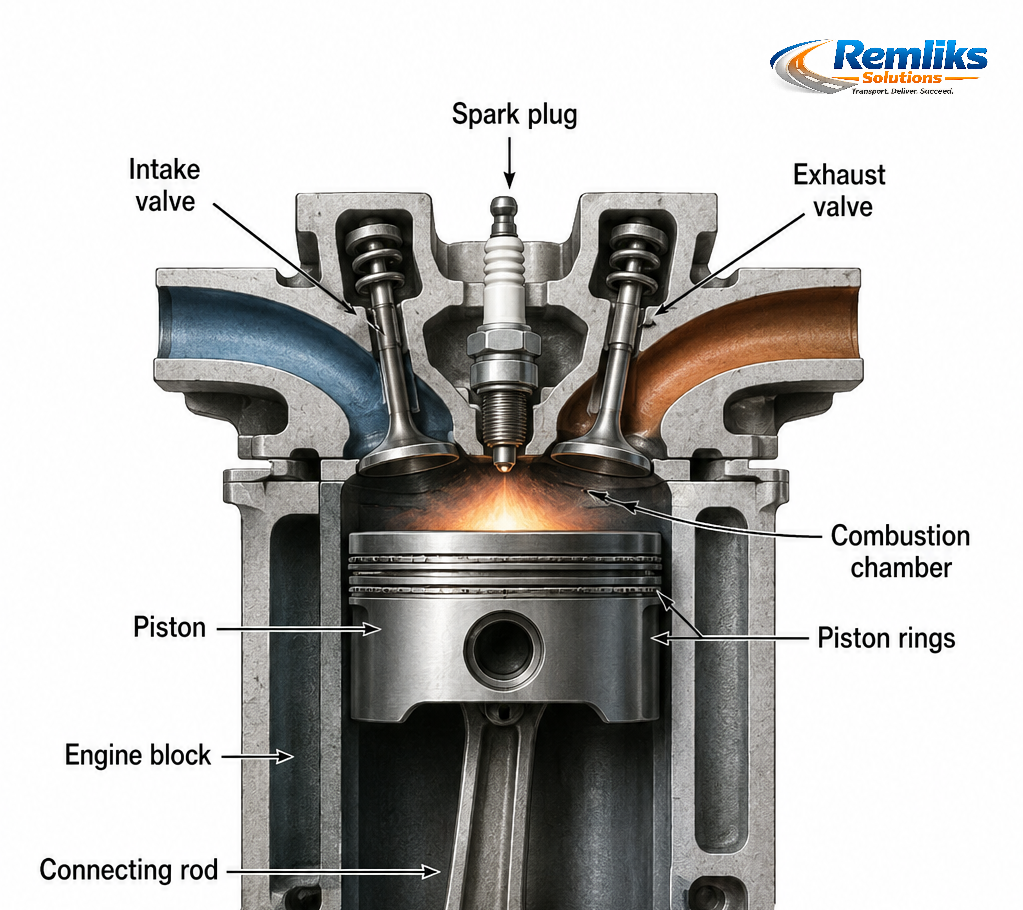
Cylinder Head Component Overview
| Aspect | Details |
|---|---|
| Definition | A removable casting that seals the top of the cylinders and forms the combustion chamber |
| Function | Contain the combustion process, house the valvetrain, provide mounting points for spark plugs and fuel injectors, and channel air/fuel mixture in and exhaust gases out |
| Mechanism | The cylinder head bolts to the engine block with a head gasket between them to seal the combustion chambers and coolant/oil passages. It contains ports for intake and exhaust flow, as well as chambers where combustion occurs |
| Common Materials | Aluminum alloy (lightweight with good heat dissipation), cast iron (more durable but heavier) |
| Common Issues | Warping from overheating, cracking (especially between valves), valve seat damage, gasket surface damage, camshaft bearing wear (in overhead cam designs) |
| How to Fix | Minor warping may be corrected by resurfacing. Cracks can sometimes be repaired by specialized welding. Severe damage requires replacement. Always use proper torque sequences and specifications when reinstalling |
The design of the cylinder head’s intake and exhaust ports significantly affects engine breathing efficiency. Performance cylinder heads often feature optimized port shapes and sizes to improve airflow.
Omar and Bilal Workshop Scenario
Bilal: What causes cylinder heads to warp, and how do technicians detect it?
Omar: Warping typically results from overheating. When the head gets too hot, the metal can distort, preventing a proper seal with the engine block. This often leads to head gasket failure. To detect warping, technicians use a precision straightedge and feeler gauges to check the flatness of the gasket surface. If the warping exceeds specifications, the head must be resurfaced on a specialized machine to restore flatness.
Engine valves control the flow of air/fuel mixture into the combustion chamber and the exit of exhaust gases after combustion. They must open and close precisely at the right times and seal completely when closed.
Valves Component Overview
| Aspect | Details |
|---|---|
| Definition | Precision-engineered components that open and close passages in the cylinder head to control gas flow into and out of the combustion chamber |
| Function | Regulate the intake of air/fuel mixture and the expulsion of exhaust gases with precise timing to optimize engine performance |
| Mechanism | Camshaft lobes push on valve lifters or followers, which then push the valve stem to open the valve against spring pressure. When the cam lobe rotates away, valve springs close the valve and maintain a seal |
| Common Materials | Intake valves often use steel alloys with good wear resistance. Exhaust valves require heat-resistant materials like stainless steel or Inconel due to exposure to hot exhaust gases |
| Common Issues | Valve face or seat wear causing poor sealing, bent valves from timing belt failure or piston contact, burned valves from overheating or lean fuel mixture, stem wear or galling |
| How to Fix | Worn valve seats can be refaced. Bent or burned valves require replacement. Valve stem seals can be replaced without removing the head in some designs. Always check valve clearances and adjust as needed |
There are two types of valves in each cylinder:
Exhaust valves typically run hotter than intake valves because they’re exposed to combustion gases, requiring more heat-resistant materials.
Omar and Bilal Workshop Scenario
Bilal: I’ve heard about “valve clearance” or “lash.” What does this mean, and why is it important?
Omar: Valve clearance refers to the small gap between the valve stem and the rocker arm or cam follower when the valve is fully closed. This gap is necessary because metal expands as it heats up. Without proper clearance, the valve might not close completely when the engine is hot, leading to poor compression and burned valves. If the clearance is too large, you’ll hear clicking noises and experience reduced performance. Many modern engines use hydraulic lifters that automatically maintain proper clearance, but older designs require periodic adjustment.
Engine Components Relationship Diagram
The following diagram illustrates how these components work together within the engine:
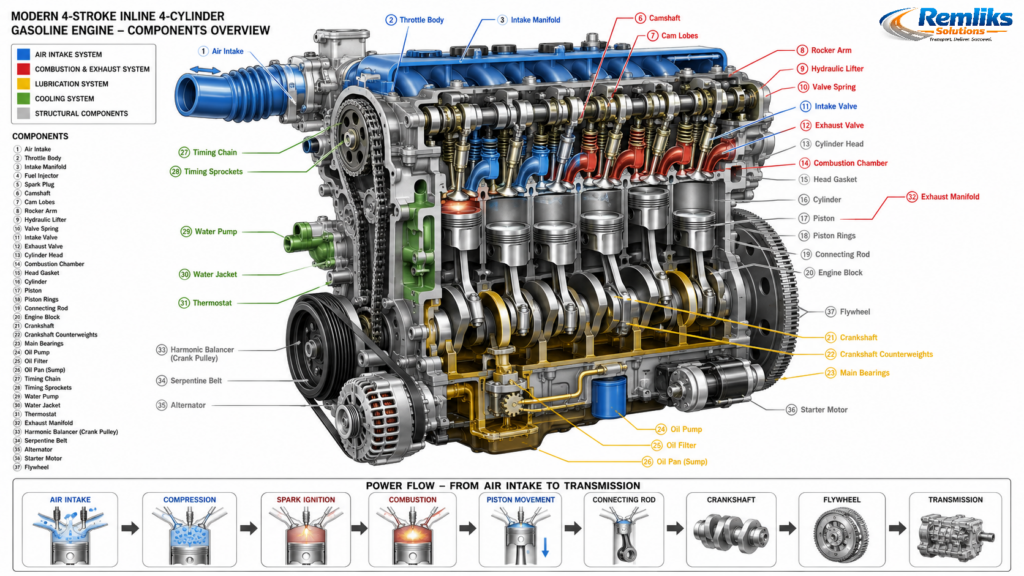
While each component has its specific problems, several issues can affect multiple engine parts:
Omar and Bilal Workshop Scenario
Bilal: Is there a way to prevent these common engine component failures?
Omar: While no engine component lasts forever, you can significantly extend their life through proper maintenance. Regular oil changes with the correct oil specification protect against wear. Maintaining the cooling system prevents overheating damage. Using quality fuel and keeping the air intake system clean ensures proper combustion without harmful deposits. Finally, following the manufacturer’s maintenance schedule for timing components prevents catastrophic failures.
When engine component problems are suspected, technicians use several diagnostic approaches:
5.Diagnostic Trouble Codes
Modern vehicles may set codes related to engine mechanical problems, such as misfire codes that could indicate valve or piston issues.
For more information on diagnostic procedures, you can explore our diagnostic terminology guide.
Regular maintenance can help prevent premature failure of engine components. Use this checklist to keep your engine in good condition:
What are the most critical engine components?
While all engine components are important for proper operation, the most critical in terms of potential damage and repair costs are typically the pistons, connecting rods, and crankshaft. These components form the core of the engine’s power generation system, and their failure often requires complete engine rebuilding or replacement.
How long do engine components typically last?
The lifespan of engine components varies greatly based on design, materials, operating conditions, and maintenance. With proper care, many modern engines can exceed 200,000 miles before major component failure. However, some high-performance or heavily worked engines may require earlier intervention.
Can I replace individual engine components, or do I need to rebuild the entire engine?
In some cases, individual components can be replaced without a full rebuild. For example, a single cylinder head can be removed and repaired or replaced. However, when dealing with bottom-end components like pistons or connecting rods, the engine typically needs complete disassembly. Additionally, if one component has failed due to a systemic issue (like oil starvation), other components may also be damaged.
What causes engine knocking, and is it always serious?
Engine knocking can have several causes with varying severity. Light, occasional knocking under load might be controlled detonation (spark knock), which can often be addressed with higher octane fuel or ignition timing adjustments. However, a deep, rhythmic knocking sound, especially at idle, often indicates bearing wear or connecting rod issues, which are serious and require immediate attention.
How do I know if my engine has a valve problem?
Common signs of valve problems include:
A compression test and leak-down test can help confirm valve issues before disassembling the engine.
What’s the difference between a timing belt and a timing chain, and does it matter for my engine components?
Both timing belts and chains serve the same purpose—synchronizing the crankshaft and camshaft(s). Timing belts are made of reinforced rubber and require periodic replacement (typically 60,000-100,000 miles). Timing chains are metal and generally last longer, though they may still require replacement eventually. If a timing belt breaks, it can cause catastrophic valve-to-piston contact in “interference” engines. Timing chains usually stretch before failing, often producing noise that serves as a warning. Following the manufacturer’s replacement schedule is critical for preventing damage to valves, pistons, and other components.
Can engine component problems affect other vehicle systems?
Yes, engine component problems can affect other systems. For example, poor compression from worn piston rings can lead to increased blow-by, which contaminates the oil and can affect the crankcase ventilation system. Worn camshaft lobes can affect valve timing, which impacts the ignition system timing and overall engine performance.
Understanding these core engine components helps you appreciate the complexity of your vehicle’s power plant and recognize potential problems before they become major repairs. Regular maintenance and prompt attention to warning signs can help extend the life of these critical components and keep your vehicle running reliably.
For more information on related topics, explore our engine system section or our comprehensive automotive terms glossary to better understand the technical language used in automotive repair.
