Physical Address
304 North Cardinal St.
Dorchester Center, MA 02124
Physical Address
304 North Cardinal St.
Dorchester Center, MA 02124

Disclaimer: This article provides general information only. It does not replace professional mechanical advice. Always consult a qualified technician for specific vehicle issues.
Throughout this guide, you may see Bilal and Omar discussing vehicle systems, maintenance procedures, and troubleshooting situations. They are fictional educational characters created by Remliks Solutions to help explain automotive and truck concepts in a practical and engaging way.
Ignition coils play a crucial role in your vehicle’s engine performance. These small but powerful components transform low voltage from the battery into the high voltage needed to create sparks in the spark plugs. Without properly functioning ignition coils, your engine may run poorly, waste fuel, or fail to start altogether. This comprehensive guide will help you understand how ignition coils work, identify problems, and maintain them properly.
Ignition coils are electrical transformers that form a critical part of your vehicle’s ignition system. They convert the 12-volt electrical power from your battery into the 20,000 to 50,000 volts needed to jump the gap in your spark plugs and ignite the fuel-air mixture in the engine’s cylinders.
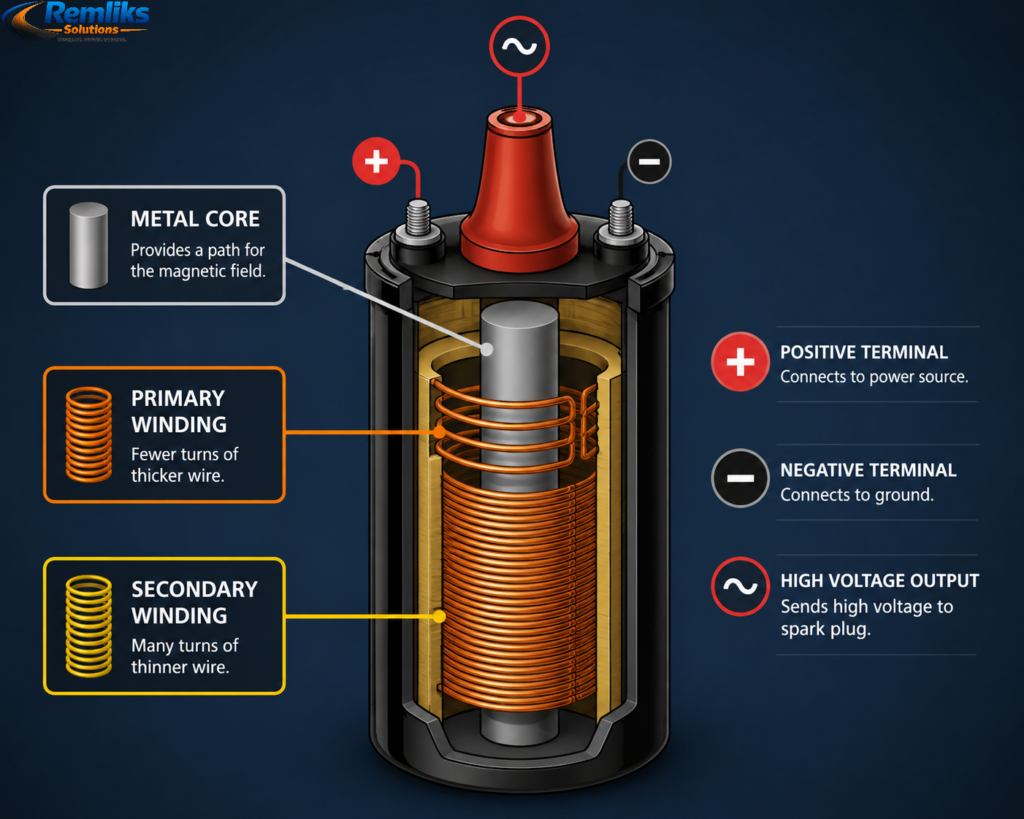
The primary function of ignition coils is to step up voltage. When you turn the key or press the start button, the battery sends low-voltage electricity to the ignition coil. Inside the coil, this electricity flows through a primary winding of wire, creating a magnetic field. When this current is suddenly interrupted, the magnetic field collapses, inducing a much higher voltage in a secondary winding of wire. This high voltage then travels to the spark plug to create the spark.
Ignition coils directly affect:
For a deeper understanding of how ignition coils fit into the broader ignition system, check out our ignition system components guide.
Understanding the technical operation of ignition coils helps in diagnosing problems and appreciating their importance in engine performance.
Bilal: How does a small ignition coil create such high voltage from just 12 volts?
Omar: Think of the ignition coil as a transformer with two separate wire windings around a metal core. The primary winding has fewer turns of thicker wire, while the secondary winding has many more turns of thinner wire.
Bilal: So the voltage increases because of the different number of turns?
Omar: Exactly. When current flows through the primary winding, it creates a magnetic field. When this current is suddenly cut off, the magnetic field collapses rapidly. This change induces a voltage in the secondary winding. Because the secondary has many more turns than the primary, the voltage is stepped up significantly—often 1,000 times or more.
Bilal: That’s why we get such high voltage at the spark plug?
Omar: Yes. This high voltage is necessary because the air-fuel mixture inside the cylinder is under high pressure, which makes it harder for electricity to jump across the spark plug gap. The higher the pressure, the higher the voltage needed to create a spark.
Ignition coils have evolved significantly over the years. Different engine designs require different ignition coil configurations.
These are the oldest style of ignition coils, commonly found in vehicles built before the 1980s. They are large, cylindrical components usually mounted in the engine compartment.
Characteristics:
Similar to can-type coils but often smaller, these work with electronic ignition systems that still use a distributor to direct the high voltage to the correct cylinder.
Characteristics:
The most common type in modern vehicles, COP ignition coils sit directly on top of each spark plug, eliminating the need for spark plug wires.
Characteristics:
These contain multiple ignition coils in a single unit, typically serving two cylinders each through a waste spark system.
Characteristics:
A variation of COP coils, pencil coils are narrower and longer, allowing them to fit into tight spaces in modern engine designs.
Characteristics:
| Type | Era | Configuration | Advantages | Disadvantages |
|---|---|---|---|---|
| Can-Type | Pre-1980s | Single coil | Simple design, durable | Less efficient, requires distributor |
| Distributor-Based | 1980s-1990s | Single coil | Better spark control than can-type | Still requires distributor |
| Coil Packs | 1990s-2000s | Multiple coils per unit | More compact, better efficiency | Can be expensive to replace entire unit |
| Coil-On-Plug | 2000s-Present | One per cylinder | Best efficiency, precise control | More expensive per unit |
| Pencil Coils | 2000s-Present | One per cylinder | Compact, high output | Can be difficult to access |
Ignition coils are subjected to high temperatures, vibration, and electrical stress, making them susceptible to various issues over time.
Bilal: Why do ignition coils fail so often in modern cars compared to older ones?
Omar: It’s partly because modern engines run higher compression ratios and leaner fuel mixtures, which require higher voltage to ignite. This puts more stress on the coils. Also, modern coil-on-plug designs are more compact, which makes heat dissipation more challenging.
Bilal: So the higher performance demands lead to more failures?
Omar: That’s one factor. Another is that in older cars with a single coil, if it failed, you replaced one component. In modern cars with individual coils, you might replace them one by one as they fail, making it seem like they fail more often. The actual failure rate per coil might be similar, but you notice it more because there are more of them.
Recognizing the signs of failing ignition coils can help you address problems before they cause more serious engine damage or leave you stranded.
| Code | Description | Meaning |
|---|---|---|
| P0300 | Random/Multiple Cylinder Misfire | Engine is misfiring, but not isolated to one cylinder |
| P0301-P0312 | Cylinder Specific Misfire | Indicates which cylinder is misfiring (last digit = cylinder number) |
| P0350-P0362 | Ignition Coil Primary/Secondary Circuit | Indicates a problem with a specific ignition coil circuit |
| P2300-P2309 | Ignition Coil Control Circuit | Indicates a problem with the coil’s control signal |
For more information on diagnostic trouble codes, check out our automotive diagnostic terminology guide.
Proper diagnosis is essential before replacing ignition coils to avoid unnecessary expenses and ensure the actual problem is addressed.
Bilal: The scan tool shows a P0304 code. Does that mean cylinder 4’s ignition coil is bad?
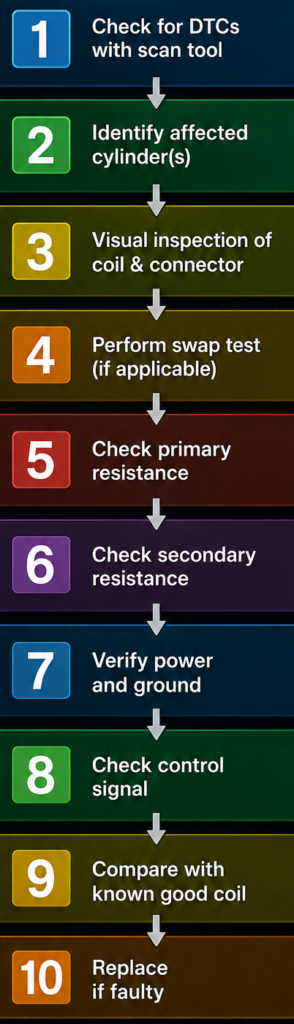
Omar: Not necessarily. A P0304 code tells us cylinder 4 is misfiring, but doesn’t identify the cause. It could be the ignition coil, spark plug, fuel injector, or even a mechanical issue like a burned valve. We need to diagnose further.
Bilal: What’s the best way to isolate the ignition coil as the problem?
Omar: One effective method is the swap test. If your vehicle has identical ignition coils on each cylinder, you can move the coil from cylinder 4 to another cylinder, clear the code, and see if the misfire follows the coil. If the misfire code changes to the new cylinder, the coil is likely faulty.
Bilal: Are there other tests we can perform?
Omar: Yes. We can measure the coil’s primary and secondary resistance with a multimeter and compare it to specifications. We can also check for proper power and ground to the coil, and use an oscilloscope to examine the coil’s waveform if available. These tests help confirm the diagnosis before replacing parts.
For more information on electrical testing, see our electrical fundamentals guide.
While ignition coils are generally considered maintenance-free components, proper care can help extend their life and prevent premature failure.
| Maintenance Task | Frequency | Notes |
|---|---|---|
| Visual inspection | Every 30,000 miles | Check for cracks, damage, or oil contamination |
| Spark plug replacement | As per manufacturer | Typically 30,000-100,000 miles depending on plug type |
| Electrical connector cleaning | Every 60,000 miles | Use electrical contact cleaner |
| Coil resistance testing | Every 100,000 miles | Compare to manufacturer specifications |
Bilal: Is there any way to make ignition coils last longer?
Omar: The most important thing is to maintain your spark plugs according to the manufacturer’s schedule. Worn spark plugs increase the voltage required to create a spark, which puts more stress on the coil. Also, if you’re replacing spark plugs, take care not to over-tighten them, as this can damage the coil’s boot or the spark plug well.
Bilal: What about aftermarket ignition coils? Are they as good as OEM?
Omar: Quality varies significantly among aftermarket coils. Some may perform as well as or better than OEM, while others may fail prematurely. It’s generally best to stick with OEM or high-quality aftermarket brands with good reputations. Saving a few dollars on a cheap coil often costs more in the long run.
When an ignition coil fails, replacement is usually the only option, as they are typically not repairable. Proper replacement ensures reliable operation and prevents future issues.
Choosing the right replacement ignition coil can be confusing with the many options available. This guide helps you make an informed decision.
| Factor | OEM Coils | Aftermarket Coils |
|---|---|---|
| Quality | Consistent, meets manufacturer specs | Varies by brand, some exceed OEM |
| Price | Typically higher | Varies widely, often lower than OEM |
| Warranty | Usually 1 year | Varies, some offer longer warranties |
| Availability | May need to order from dealer | Widely available at parts stores |
| Performance | As designed by manufacturer | Some offer improved performance |
| Selection | Limited to original specifications | Many options for different needs |
When selecting aftermarket coils, look for these quality indicators:
While it might be tempting to choose the cheapest option, ignition coils are critical to engine performance. Extremely low-priced coils may use inferior materials and construction, leading to premature failure. However, the most expensive option isn’t always necessary either. Mid-priced options from reputable brands often provide the best balance of quality and value.
Use this checklist to help maintain your vehicle’s ignition coils and prevent problems:
Here is the text extracted from the code block, formatted for easy reading:
IGNITION COIL MAINTENANCE CHECKLIST
A: It’s not recommended. Driving with a failing ignition coil can cause further damage to your engine, catalytic converter, and other components. It also reduces fuel efficiency and increases emissions. If you must drive, limit your trips and avoid putting the engine under heavy load.
A: The lifespan of ignition coils varies widely depending on the vehicle, driving conditions, and coil quality. On average, ignition coils last between 80,000 and 120,000 miles, but some may fail earlier or last much longer.
A: You can replace just the faulty coil. However, if your vehicle has high mileage (over 100,000 miles) and one coil has failed, others may be nearing the end of their life as well. Some technicians recommend replacing all coils as preventive maintenance in this situation.
A: Not necessarily. While extremely cheap coils may be of poor quality, the most expensive options aren’t always necessary for standard driving conditions. Mid-priced options from reputable brands typically offer the best balance of quality and value for most drivers.
A: Yes. Worn or incorrectly gapped spark plugs require higher voltage to create a spark, putting additional stress on the ignition coil. This can lead to premature coil failure. Following the manufacturer’s spark plug replacement schedule helps protect your coils.
A: Diagnostic trouble codes like P0301-P0312 indicate which specific cylinder is misfiring. For example, P0304 indicates a misfire in cylinder 4. However, proper diagnosis is needed to confirm the coil is the cause, not just the cylinder affected.
A: Basic visual inspection and the swap test (moving coils between cylinders) can be done without special tools. However, for more thorough testing, a multimeter and possibly an oscilloscope are needed for accurate diagnosis.
A: Most ignition coils are plug-and-play and don’t require programming. However, some high-end or specialized vehicles may require coil programming or adaptation using a scan tool after replacement. Check your vehicle’s service information for specific requirements.
A: Extreme heat can accelerate coil degradation, while moisture intrusion from rain or car washing can cause short circuits. Proper sealing and avoiding exposure to excessive moisture help prevent weather-related issues.
A: Ignition coils are typically covered by the vehicle’s powertrain warranty for the duration of that warranty. Aftermarket coils come with their own warranties, which vary by manufacturer.
Ignition coils are essential components in your vehicle’s ignition system, responsible for transforming low voltage into the high voltage needed to ignite the fuel-air mixture in your engine. Understanding how they work, recognizing symptoms of failure, and following proper maintenance practices can help keep your engine running smoothly and efficiently.
When problems do occur, proper diagnosis is crucial before replacing parts unnecessarily. With the information in this guide, you’ll be better equipped to understand ignition coil issues, communicate effectively with your mechanic, and make informed decisions about maintenance and repairs.
For more information on related components, check out our guides on spark plugs and the complete ignition system. You can also explore our engine system section for more articles about your vehicle’s critical systems.
Remember, this article provides general information only and does not replace professional mechanical advice. Always consult a qualified technician for specific vehicle issues.
