Physical Address
304 North Cardinal St.
Dorchester Center, MA 02124
Physical Address
304 North Cardinal St.
Dorchester Center, MA 02124

Disclaimer: The information provided in this guide is for educational and general informational purposes only. Working with automotive electrical systems—including 12V, 24V, and especially high-voltage hybrid/electric vehicle (HV) systems—poses serious safety risks, including fire, severe burns, or electrocution. Always follow the specific safety protocols outlined in your vehicle’s service manual. Remliks Solutions strongly recommends consulting a certified automotive technician for any complex diagnostics, high-voltage repairs, or procedures you are not fully trained to perform.
Understanding electrical fundamentals is the key to fixing modern vehicles. Today, Bilal and Omar—our two expert technicians—agree on one truth: you cannot repair a car or truck if you do not understand its electrical heart. Electricity powers everything from the starter motor to the advanced sensors in your engine system.
Throughout this guide, you may see Bilal and Omar discussing vehicle systems, maintenance procedures, and troubleshooting situations. They are fictional educational characters created by Remliks Solutions to help explain automotive and truck concepts in a practical and engaging way.
Electrical fundamentals are the basic rules that explain how electricity moves and works in a vehicle. Before you pick up a multimeter or scan tool, you must know these core concepts. Also, understanding these rules helps you safely troubleshoot problems without causing more damage.
Every electrical circuit in your vehicle relies on three main forces. Bilal always teaches new mechanics to remember the “Water Pipe Analogy” to make these terms simple.
| Electrical Term | What It Means | Water Pipe Analogy | Measured In |
|---|---|---|---|
| Voltage | The electrical pressure pushing electrons. | Water pressure from the pump. | Volts (V) |
| Current | The actual flow of electricity. | The amount of water flowing through the pipe. | Amps (A) |
| Resistance | The restriction that slows down the flow. | A narrowed pipe or clog in the line. | Ohms (Ω) |
When you grasp these electrical fundamentals, you can understand why a car fails to start or why a light dims.
If voltage, current, and resistance are the actors, Ohm’s Law is the script they follow. Georg Ohm discovered that these three forces are mathematically connected.
The Formula: Voltage (V) = Current (I) x Resistance (R)
How does this help you in the garage? Omar explains it with a real-world scenario.
Omar’s Scenario: “Imagine a truck’s headlights are very dim. You measure the battery, and it reads 12.6 volts (good voltage). So, the pressure is fine. But the light is dim, meaning the current (flow) is low. According to Ohm’s Law, if Voltage is normal but Current is low, Resistance must be high. You now know you are looking for a bad ground connection or corroded wire causing too much resistance.”
To make math easier, mechanics use a simple triangle. Cover the value you want to find, and the math reveals itself.

A circuit is the complete path that electricity travels. If the path is broken, the electricity stops. This is called an “open circuit.” Every automotive circuit needs four basic parts to work.
Vehicles use different wiring layouts. Understanding the difference is a core part of electrical fundamentals.
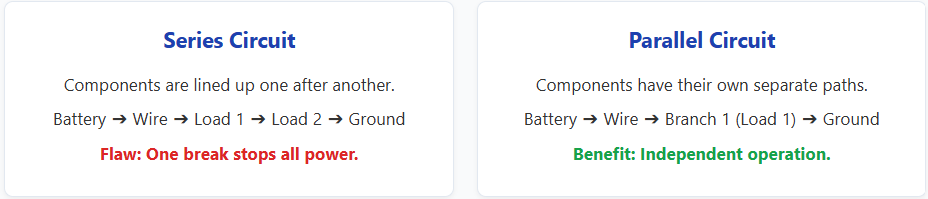
When things go wrong, it usually falls into one of three categories. Bilal and Omar face these issues every day in the shop.
An open circuit happens when the path is broken. A wire is cut, a connector is loose, or a switch is turned off. Electricity cannot flow at all.
Bilal’s Discovery: “We had a truck in the shop where the radio and cabin lights suddenly stopped working. The driver thought the radio was broken. However, I checked the wiring diagram. I discovered a single 15-amp fuse in the fuse box had blown. The blown fuse created an ‘open.’ Replacing the fuse restored the path, but I also had to find out why it blew to prevent a fire. A chafed wire under the dash was shorting out.”
A short circuit happens when electricity takes a shortcut and skips the load. For example, if a wire rubs against the metal chassis, the current jumps to the ground before reaching the intended component. This causes a massive flow of current, which blows fuses or melts wires.
Sometimes the path is not broken, but it is restricted. Corroded battery terminals or loose pins in a connector add resistance. This drops the voltage before it reaches the load. A starter motor with high resistance in the positive cable will crank slowly or just click.
Your vehicle’s electrical system relies on a delicate balance between the battery and the alternator.
The battery is the storage tank. It provides the heavy burst of voltage needed to start the engine. It also powers electronics when the engine is off. A standard car battery is 12.6 volts when fully charged. Truck systems often use multiple batteries linked together to provide higher cranking power for large diesel engines.
Once the engine starts, the alternator takes over. The alternator is an engine-driven generator. It creates electricity to run the vehicle’s systems and recharge the battery. If the alternator fails, the battery will drain quickly, and the engine will stall.
Modern vehicles are basically computers on wheels. The Electrical System relies heavily on sensors and complex wiring networks.
Sensors monitor things like engine temperature, oxygen levels in the exhaust, and wheel speed. They take a physical measurement and convert it into an electrical signal. The Engine Control Module (ECM) reads these signals and adjusts the engine accordingly. Most sensors operate on a 5-volt reference signal from the ECM.
In the past, cars had simple point-to-point wiring. Today, vehicles use a Controller Area Network (CAN bus). This is a digital highway where modules (like the ABS module and the ECM) talk to each other over just two wires. This saves weight and space, but it requires a deep understanding of electrical fundamentals to diagnose properly.
You cannot see electricity; you can only measure its effects. Using the right tools safely is essential.
A DMM is the most important tool for electrical work. It measures Voltage, Current, and Resistance.
While a multimeter tests the hardware, a scan tool reads the software. It plugs into the OBD2 port and talks to the vehicle’s computer. It can pull error codes and show live data from sensors. If you want to learn more about these devices, visit our Diagnostic & Scan Tools section.
Working with electricity can be dangerous. Car batteries hold a massive amount of energy. A shorted battery can melt tools or cause severe burns. Furthermore, hybrid and electric vehicles use high-voltage systems (often 300+ volts) that can be lethal.
When an electrical problem appears, do not guess. Follow a logical process. Omar uses this exact method to find faults quickly.
Step 1: Verify the Complaint
Turn on the faulty circuit. See the problem for yourself. Do not rely on someone else’s description.
Step 2: Check the Basics
Are the fuses good? Is the battery fully charged? Are the ground connections clean and tight? Many complex problems stem from a simple bad ground.
Step 3: Check for Voltage
Use your DMM. Is voltage reaching the load? If yes, the power side is good. If no, trace the power wire back toward the battery until you find the break.
Step 4: Check the Ground
If power reaches the load but the device does not work, test the ground side. Put your red lead on the battery positive, and your black lead on the ground terminal of the component. If you read battery voltage, your ground is broken.
Omar and Bilal Fix a Truck: “A delivery truck came in with a completely dead right rear brake light. The bulb was fine. Bilal put his DMM on the bulb socket. He had 12 volts on the power pin when the brakes were pressed. Next, he checked the ground pin. It showed high resistance. Omar traced the ground wire and found the ring terminal had snapped off the chassis. They crimped a new terminal, cleaned the mounting spot to bare metal, and screwed it back down. Light worked perfectly. No guessing, just solid electrical fundamentals.”
To truly master automotive electricity, you must understand that electricity and magnetism are linked. This is called electromagnetism.
When electricity flows through a wire, it creates a small magnetic field. If you coil that wire around an iron core, the magnetic field becomes very strong. This is how starter solenoids and fuel injectors work. The magnetic field pulls a metal plunger to open a valve or engage a gear.
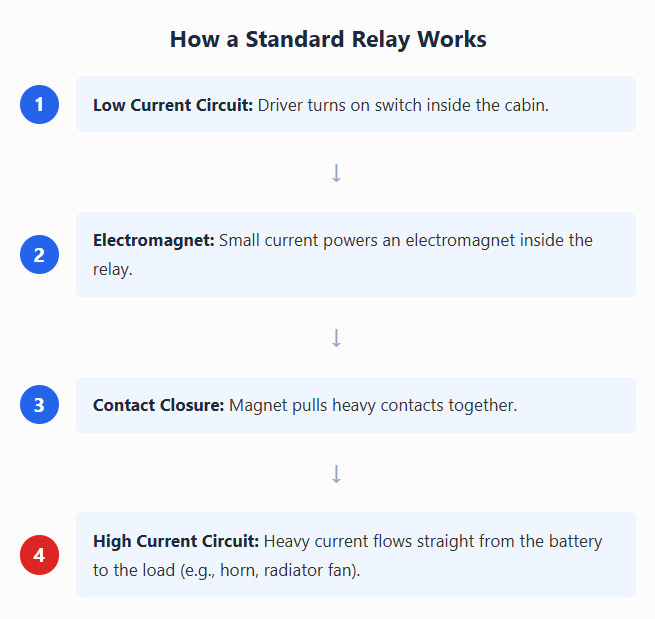
A relay is an electrically controlled switch. Some components (like the horn or the cooling fan) require a huge amount of current. If that high current ran through the switch on your dashboard, the switch would melt. Instead, a relay uses a small amount of current from the switch to power an electromagnet. The magnet pulls a heavy-duty contact closed, allowing high current to flow directly from the battery to the load.
Heavy-duty trucks share the same electrical fundamentals as cars, but the scale is different.
If you work on heavy vehicles, check out our detailed guides in the Truck Systems section.
Preventive maintenance keeps electrons flowing smoothly. Follow these tips from our Maintenance Guides:
Having reliable tools is important. However, remember that tools are just tools—they are not magic solutions. You still need the knowledge to use them. For more details, visit our Product Reviews & Buying Guides.
Before you start testing, keep this quick reference chart handy. You can find more charts and calculators in our Resource Center.
| Test Type | Meter Setting | Where to Place Leads | Good Reading |
|---|---|---|---|
| Battery Voltage | DC Volts | Red to battery +, Black to battery – | ~12.6V (Engine off) |
| Charging Voltage | DC Volts | Red to battery +, Black to battery – | 13.8V – 14.8V (Engine on) |
| Voltage Drop (Power) | DC Volts | Red to battery +, Black to load + | Less than 0.5V |
| Voltage Drop (Ground) | DC Volts | Red to battery -, Black to load – | Less than 0.2V |
| Continuity | Ohms / Beep | One lead on each end of wire | Near 0 Ohms (or steady beep) |
Before you begin any electrical repair, run through this safety and preparation checklist:
Electrical fundamentals in a car refer to the basic principles of voltage (electrical pressure), current (flow of electricity), and resistance (opposition to flow). These rules govern how the battery, alternator, sensors, and wiring work together to run the vehicle.
A dying battery often points to a “parasitic draw.” This happens when a light stays on (like a glovebox light) or an electrical module fails to shut down, continuing to pull current from the battery while the car is off. A multimeter can measure this draw.
Yes. A bad ground is one of the most common causes of electrical issues. It creates high resistance, which leads to dim lights, slow motors, and erratic sensor readings. Always check your ground connections first.
Voltage drop is the loss of electrical pressure as current flows through a wire or connection. High resistance (like corrosion) causes a larger voltage drop. This means the component does not get the full 12 volts it needs to work correctly.
It can be safe if you follow precautions. Always disconnect the battery before repairing wires. However, hybrid and electric vehicle (EV) high-voltage systems are extremely dangerous and should only be serviced by trained professionals with proper safety gear.
Wiring diagrams look complex, but they are just roadmaps of the circuits. Visit our Learning Center for beginner guides on how to read these diagrams, and explore our Troubleshooting Center for step-by-step electrical repair guides.
Mastering electrical fundamentals transforms you from a parts-changer into a true diagnostic thinker. By understanding how voltage, current, and resistance interact, you can find the root cause of any electrical fault. Remember Bilal and Omar’s approach: do not guess, measure carefully, and always respect the power of electricity. For more help with tricky warning lights, visit our Warning Lights & Error Codes library.
