Physical Address
304 North Cardinal St.
Dorchester Center, MA 02124
Physical Address
304 North Cardinal St.
Dorchester Center, MA 02124

Disclaimer: This article provides general information only. It does not replace professional mechanical advice or service. Always consult qualified technicians for specific vehicle issues.
Throughout this guide, you may see Bilal and Omar discussing vehicle systems, maintenance procedures, and troubleshooting situations. They are fictional educational characters created by Remliks Solutions to help explain automotive and truck concepts in a practical and engaging way.
Connecting rods are vital engine components that transfer force from the piston to the crankshaft. These precision-engineered parts convert the linear (up-and-down) motion of the pistons into the rotational motion that ultimately drives your vehicle’s wheels.
In internal combustion engines, connecting rods experience extreme forces during each combustion cycle. They must withstand thousands of pounds of pressure while rotating at high speeds, making their design and material critical to engine reliability.
Connecting rods serve as the critical link between the piston assembly and the crankshaft. When fuel and air combust in the cylinder, the expanding gases push the piston downward. The connecting rod transfers this force to the crankshaft, causing it to rotate.
This conversion of linear to rotational motion is fundamental to how all piston engines work. Without properly functioning connecting rods, the engine cannot transform combustion energy into usable mechanical power.
Bilal: I understand that connecting rods connect the piston to the crankshaft, but how do they handle all that pressure from combustion?
Omar: Good question. Connecting rods are designed with specific geometry and materials to handle these extreme forces. They undergo a complex loading pattern – first compression during the power stroke, then tension during the intake stroke. The I-beam or H-beam design provides strength while keeping weight to a minimum.
Bilal: Why is weight important for connecting rods?
Omar: Because the rod and piston assembly must accelerate and decelerate with each engine revolution. Heavier components create more inertia, which can limit maximum engine speed and increase wear. This is why high-performance engines often use lighter connecting rods made from specialized materials.
Understanding the parts of a connecting rod helps in identifying problems and performing proper maintenance. A typical connecting rod consists of several key components:
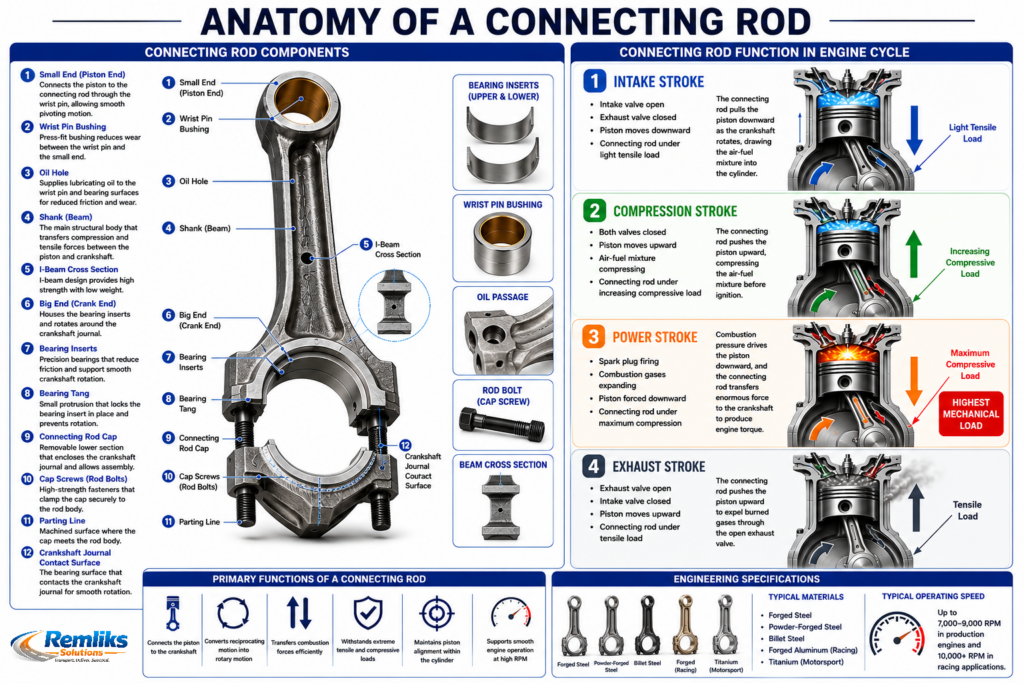
Manufacturers design different types of connecting rods based on the engine’s intended use, performance requirements, and cost considerations. Understanding these types helps in identifying what might be in your vehicle and what alternatives exist for specific applications.
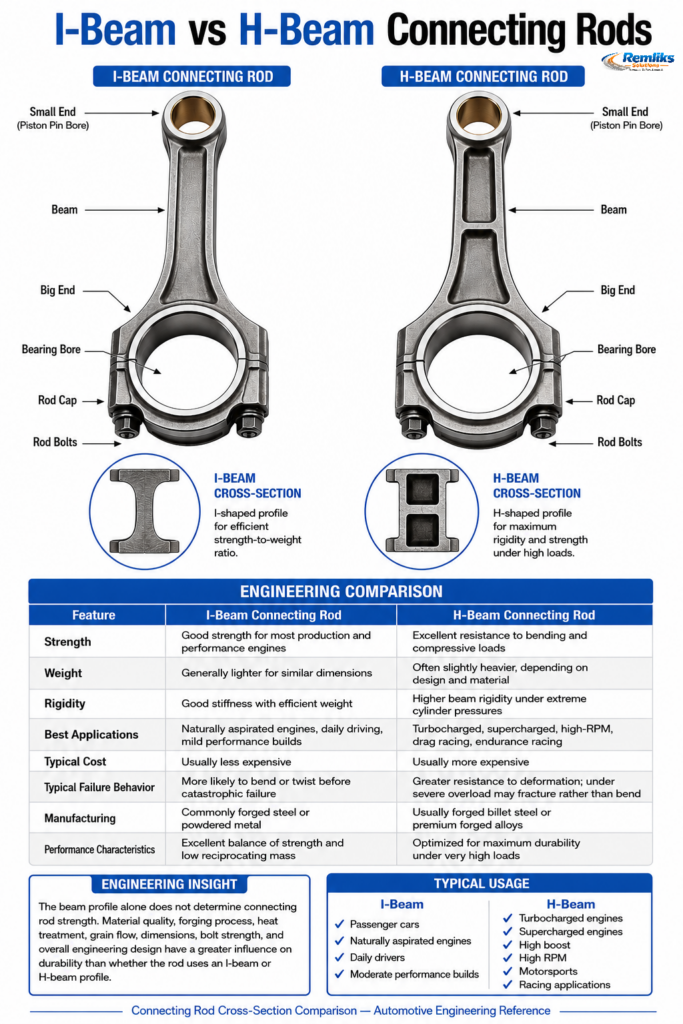
I-beam connecting rods have a cross-section resembling the letter “I” when viewed from the end. This design provides excellent strength-to-weight ratio for most street applications. The vertical web resists bending forces, while the flanges at top and bottom resist twisting.
Most production vehicles use I-beam connecting rods because they offer a good balance of strength, weight, and manufacturing cost. They perform well in standard operating conditions but may not be ideal for extreme high-rpm or high-boost applications.
H-beam connecting rods feature a cross-section that resembles the letter “H.” This design offers greater resistance to bending forces compared to I-beams, making them popular in high-performance and racing applications.
The H-beam design typically has more material in critical stress areas, which increases strength but also adds weight. Many aftermarket performance connecting rods use this design for turbocharged, supercharged, or high-compression engines that generate extreme cylinder pressures.
The material composition of connecting rods significantly affects their strength, durability, and weight. Manufacturers select materials based on the intended application and performance requirements.
Many standard production engines use cast iron connecting rods. Cast iron offers good wear resistance and adequate strength for normal driving conditions at a lower manufacturing cost. However, cast iron rods are heavier and less durable under extreme conditions compared to forged alternatives.
Forged steel connecting rods undergo a process where the metal is shaped under high pressure, aligning the grain structure of the metal for improved strength. This process creates connecting rods that are stronger and more resistant to fatigue than cast versions.
Most performance-oriented vehicles and many modern production engines use forged steel connecting rods. They offer an excellent balance of strength, weight, and cost for demanding applications.
Powdered metal connecting rods represent a newer manufacturing technique where metal powder is compressed and heated to form the final shape. This process allows for precise control of the material properties and can create connecting rods with excellent strength-to-weight ratios.
Many modern engines, including those from major manufacturers, now use powdered metal connecting rods due to their consistent quality, reduced material waste, and good performance characteristics.
For high-performance and racing applications, some connecting rods are made from titanium or aluminum alloys. These materials offer significant weight reduction, which can improve engine response and allow higher maximum rpm.
However, these specialized materials come with considerable drawbacks. Titanium connecting rods are extremely expensive and can be brittle. Aluminum rods have excellent strength-to-weight ratios but have limited fatigue life and may require frequent replacement in racing applications.
To fully appreciate the function of connecting rods, it’s helpful to understand their role throughout the four-stroke engine cycle.
Bilal: I’m still not completely clear on how the connecting rod works during each stroke of the engine. Can you explain that?
Omar: Certainly. Let’s go through each stroke and what happens to the connecting rod. During the intake stroke, the piston moves down the cylinder as the intake valve opens. The connecting rod experiences tension as it pulls the crankshaft around.
Bilal: And during compression?
Omar: The piston moves up to compress the fuel-air mixture. The connecting rod continues to experience tension as it transfers the upward force from the piston to the crankshaft. The tension actually increases as the piston approaches top dead center because of the angularity of the rod.
Bilal: What about the power stroke? That must be when the most force is applied.
Omar: Exactly right. When the spark plug fires, the rapidly expanding gases push the piston down with tremendous force. Now the connecting rod experiences extreme compression rather than tension. This is when the rod must be strongest to transfer this power to the crankshaft without deforming or failing.
Bilal: And the exhaust stroke?
Omar: The piston moves up again to push out the burnt gases. The connecting rod returns to experiencing tension as it transfers this upward force to the crankshaft. This cycle repeats thousands of times per minute when the engine is running.
Like all engine components, connecting rods can develop issues that affect engine performance and reliability. Recognizing these problems early may help prevent more serious engine damage.
The bearing inserts that sit between the connecting rod and crankshaft journal can wear out or fail over time. This often results from inadequate lubrication, contamination in the oil, or normal wear over high mileage.
Symptoms of bearing failure include:
Connecting rods can bend if they experience forces beyond their design limits. This might occur from hydrolocking (liquid entering the combustion chamber), over-revving the engine, or pre-ignition/detonation events.
Symptoms of a bent connecting rod include:
In severe cases, connecting rods can break completely. This catastrophic failure often results from fatigue, material defects, or extreme forces beyond the rod’s capacity.
A broken connecting rod typically causes:
The bolts that hold the connecting rod cap to the rod body can stretch over time, especially if they were not properly torqued during assembly or if the engine has been subjected to high loads.
Symptoms include:
Proper diagnosis of connecting rod problems requires a systematic approach and often specialized tools. Here are some methods technicians use to identify connecting rod issues.
A classic symptom of connecting rod bearing wear is a knocking sound that increases with engine RPM and load. This “rod knock” typically sounds deeper and more metallic than other engine noises.
To identify rod knock:
Low oil pressure can indicate bearing wear, including connecting rod bearings. Connect a mechanical oil pressure gauge to verify the engine’s oil pressure against manufacturer specifications.
If oil pressure is low and increases when engine speed increases, this may indicate worn bearings, including connecting rod bearings.
Sending a sample of engine oil for analysis can reveal metal particles that indicate wear of engine components. High levels of iron or other bearing metals in the oil may suggest connecting rod bearing wear.
A compression test can help identify if a connecting rod is bent. If one cylinder shows significantly lower compression than others, and the issue isn’t related to valves or the head gasket, a bent connecting rod might be the cause.
Bilal: I’m hearing a knocking sound from my engine that gets louder when I accelerate. How can I tell if it’s a connecting rod issue?
Omar: First, we should perform a systematic diagnosis rather than guessing. Let’s connect a mechanical oil pressure gauge to check if the pressure is within specifications. Low oil pressure often accompanies connecting rod bearing wear.
Bilal: What if the oil pressure is normal?
Omar: Then we can use a mechanic’s stethoscope to isolate exactly where the noise is coming from. We’ll listen at each cylinder along the oil pan rail where the connecting rods are located. If the noise is loudest at a specific point corresponding to a connecting rod, that gives us a strong indication.
Bilal: Is there any other test we should do?
Omar: Yes, we can also try disabling cylinders one at a time by removing the spark plug wire or fuel injector connector. If the knock changes significantly when a specific cylinder is disabled, that cylinder’s connecting rod bearing is likely the culprit.
While connecting rods are internal engine components that aren’t part of routine maintenance, proper engine care can help extend their life. When an engine is disassembled, thorough inspection of connecting rods is essential.
Although you can’t directly maintain connecting rods, these practices help ensure their longevity:
When an engine is disassembled, each connecting rod should be carefully inspected:
Precision measurements help determine if connecting rods are within serviceable limits:
During engine rebuilding, connecting rods often require reconditioning:
Deciding when to replace connecting rods depends on several factors including the engine’s condition, intended use, and budget.
Connecting rods typically require replacement when:
When modifying an engine for increased power, stock connecting rods may not be adequate. Consider upgrading to stronger aftermarket connecting rods when:
Replacing connecting rods typically requires complete engine disassembly, making it a significant expense. Consider:
For enthusiasts seeking to increase engine power output, performance connecting rods offer increased strength and sometimes reduced weight compared to stock components.
Upgrading to performance connecting rods may provide:
When choosing performance connecting rods, consider:
Installing performance connecting rods requires:
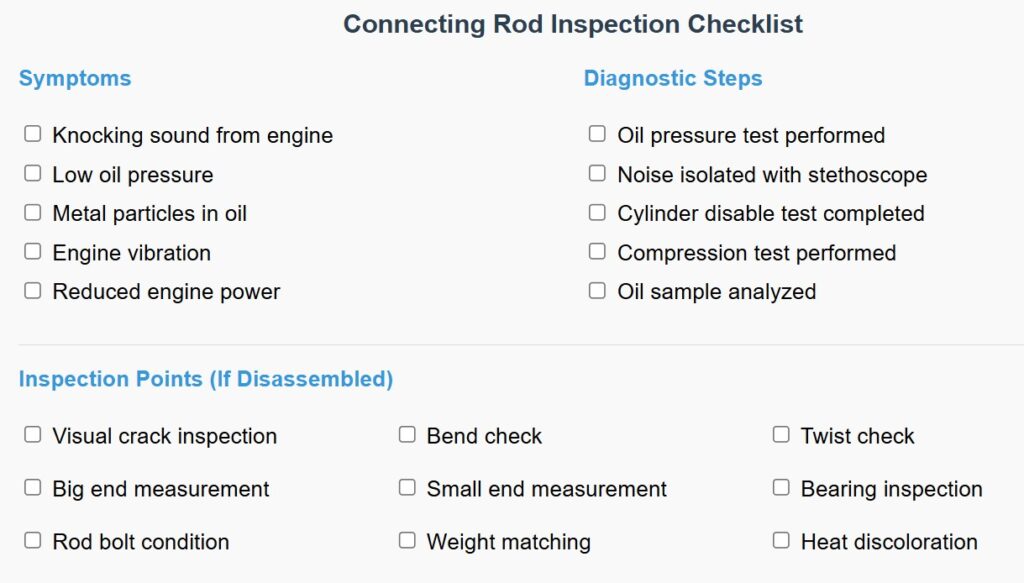
Use this checklist when diagnosing potential connecting rod issues:
Under normal driving conditions with proper maintenance, connecting rods typically last the life of the engine. Most connecting rod failures result from abuse, lack of lubrication, or manufacturing defects rather than normal wear. In high-performance applications, connecting rods may have a shorter service life due to increased stresses.
Driving with a damaged connecting rod is not recommended. A failing connecting rod can cause catastrophic engine failure, potentially leaving you stranded and resulting in much more expensive repairs. If you suspect connecting rod issues, have the vehicle inspected by a qualified technician as soon as possible.
Common causes of connecting rod failure include:
The cost to replace connecting rods varies widely depending on the vehicle, labor rates in your area, and whether you’re using OEM or aftermarket parts. Generally, expect the total cost (including labor) to range from $1,500 to $4,000 or more for most passenger vehicles. High-performance or luxury vehicles may cost significantly more.
While it’s technically possible to replace just one connecting rod, it’s generally not recommended. Connecting rods should be matched in weight to maintain engine balance. Additionally, if one rod has failed, others may be close to failure as well. Most professionals recommend replacing all connecting rods when one fails, especially in high-mileage engines.
Performance connecting rods typically feature:
Stock connecting rods are designed for the engine’s original power output and may not be adequate for significantly modified engines.
Connecting rods are balanced by removing material from specific areas to ensure all rods in an engine have the same weight. This is typically done at both the big end and small end separately. Proper balancing reduces engine vibrations and improves smoothness, especially at higher RPMs.
Minor issues like bearing wear can be addressed by replacing the bearing inserts. However, bent, cracked, or otherwise damaged connecting rods generally cannot be reliably repaired and should be replaced. Some specialized machine shops may be able to recondition certain types of damage, but replacement is usually the safer option.
Connecting rods play a crucial role in your engine’s operation, converting the linear motion of pistons into the rotational force that powers your vehicle. Understanding their function, types, and potential problems helps you maintain your engine properly and recognize issues before they become serious.
While connecting rods are built to withstand tremendous forces, they can fail due to lack of maintenance, abuse, or manufacturing defects. By following proper maintenance schedules, using quality lubricants, and addressing unusual engine sounds promptly, you can help ensure your connecting rods last as long as possible.
If you’re considering performance modifications that increase engine power, evaluating your connecting rods’ capacity to handle the additional stress is essential. Upgrading to stronger connecting rods may be necessary to ensure reliability.
Remember that connecting rod issues often require professional diagnosis and repair. The information in this article provides general knowledge but should not replace the expertise of a qualified automotive technician when dealing with specific engine problems.
For more information about engine components and related systems, explore our other educational resources in the Learning Center.
