Physical Address
304 North Cardinal St.
Dorchester Center, MA 02124
Physical Address
304 North Cardinal St.
Dorchester Center, MA 02124

Disclaimer: This article provides general information only. Always consult your vehicle’s manufacturer manual and seek professional assistance for specific diagnostic or repair tasks.
Throughout this guide, you may see Bilal and Omar discussing vehicle systems, maintenance procedures, and troubleshooting situations. They are fictional educational characters created by Remliks Solutions to help explain automotive and truck concepts in a practical and engaging way.
Understanding the Fuel Filters in your vehicle is essential for keeping your engine healthy and efficient. Fuel filters act as the first line of defense for your engine’s delicate internal components. They catch dirt, rust, and other contaminants before they can reach the fuel system. When you maintain clean fuel filters, you protect your fuel injectors and fuel pumps from early wear and failure.
This guide explains how fuel filters work, why they matter, and how to maintain them. We will explore the different types, common symptoms of a clogged filter, and practical steps for replacement. Let us break down the science of fuel filtration so you can make informed maintenance decisions.
Fuel filters are simple but vital components in your vehicle’s fuel delivery system. Their main job is to clean the fuel before it enters the engine. Unfiltered fuel often contains tiny particles of dirt, paint chips, or rust from the gas station’s storage tanks or your own vehicle’s fuel tank.
If these hard particles enter the engine, they can scratch the precision machined surfaces inside the fuel injectors. They can also damage the internal gears of the fuel pump. Therefore, fuel filters serve as a protective barrier.
To understand where fuel filters fit in the broader system, you can read our guide on car fuel system components. When the fuel filter is clean, the engine receives a steady, clean supply of fuel. However, when the filter clogs, the engine starves for fuel.
Modern engines rely on exact amounts of fuel sprayed at exact pressures. The fuel injectors have tiny nozzles, often smaller than a pinhole. Even a microscopic piece of dirt can block this nozzle. A blocked nozzle causes a misfire, rough idle, and poor fuel economy. By trapping this dirt, the fuel filter ensures the injectors spray a fine, even mist of fuel. This fine mist mixes perfectly with air for efficient combustion.
In most modern cars, the fuel pumps sit inside the fuel tank. The pump pushes liquid fuel toward the engine. If a clogged fuel filter blocks this flow, the pump must work harder. This extra effort creates high back-pressure, which can overheat the pump and cause it to fail early. Replacing the fuel filter on time may help extend the life of the fuel pump.
Fuel filtration relies on a simple physical principle: passing a liquid through a porous material to trap solid contaminants. The filter media (the material inside the filter) consists of tightly packed fibers, usually made of cellulose, synthetic glass, or a blend of both.
As fuel flows through the filter, it must pass through the tiny gaps between these fibers. Fuel, being a liquid, flows through easily. However, solid particles are too large to fit through the gaps. They get trapped on the outside of the media or within its layers.
Filters are rated by “microns.” A micron is one-millionth of a meter. Human eyes can usually only see particles larger than 40 microns. However, fuel injectors can be damaged by particles as small as 10 microns. Therefore, most modern fuel filters are designed to trap particles between 5 and 10 microns in size.
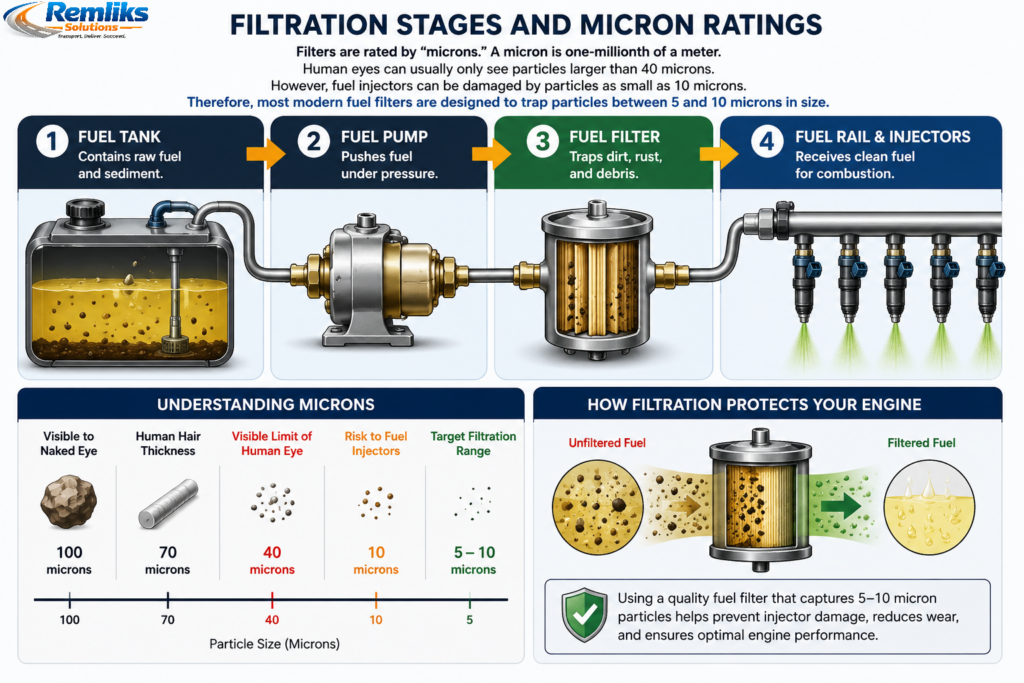
The material inside the filter determines its efficiency and lifespan.
Fuel filters come in several shapes and sizes depending on the vehicle’s design. The type of fuel filter your car uses depends on the fuel system architecture and the manufacturer’s engineering choices.
In-line fuel filters sit in the fuel line between the tank and the engine. Mechanics can usually spot them under the car, along the frame rails, or near the firewall. They have an inlet and an outlet port. They are easy to access and replace. However, they require proper installation to avoid leaks.
Many modern vehicles combine the fuel filter with the fuel pump assembly inside the fuel tank. This design protects the filter from external damage and weather. Also, placing the filter in the tank keeps the fuel pump submerged, which helps cool the pump. However, replacing an in-tank fuel filter requires removing the fuel tank or accessing it through a service port in the floor, which makes the job more labor-intensive.
Cartridge filters consist of a permanent metal housing and a replaceable internal filter element. Instead of replacing the whole unit, you only replace the paper or synthetic media inside. This design reduces waste and is environmentally friendly. Diesel engines frequently use cartridge-style filters because they often include a water-separation feature.
A clogged fuel filter restricts the flow of fuel to the engine. When the engine does not get enough fuel, it shows clear signs of distress. Recognizing these symptoms early may help prevent costly repairs.
Here are the most common signs of a restricted fuel filter:
| Symptom | What The Driver Feels | Possible Underlying Cause |
|---|---|---|
| Hesitation | Delayed response when accelerating | Fuel flow drops; engine runs lean temporarily |
| Power Loss | Speed drops on inclines | Filter cannot supply enough fuel for high demand |
| Hard Start | Long cranking time | Fuel pressure drops when the engine is off |
| Stalling | Engine dies at stops | Insufficient fuel to maintain low idle speed |
If you experience these symptoms, it is important to perform proper diagnostics. Other components, such as the fuel pressure regulators, can cause similar issues.
Here is a simple mind map to help you troubleshoot engine hesitation related to fuel supply:
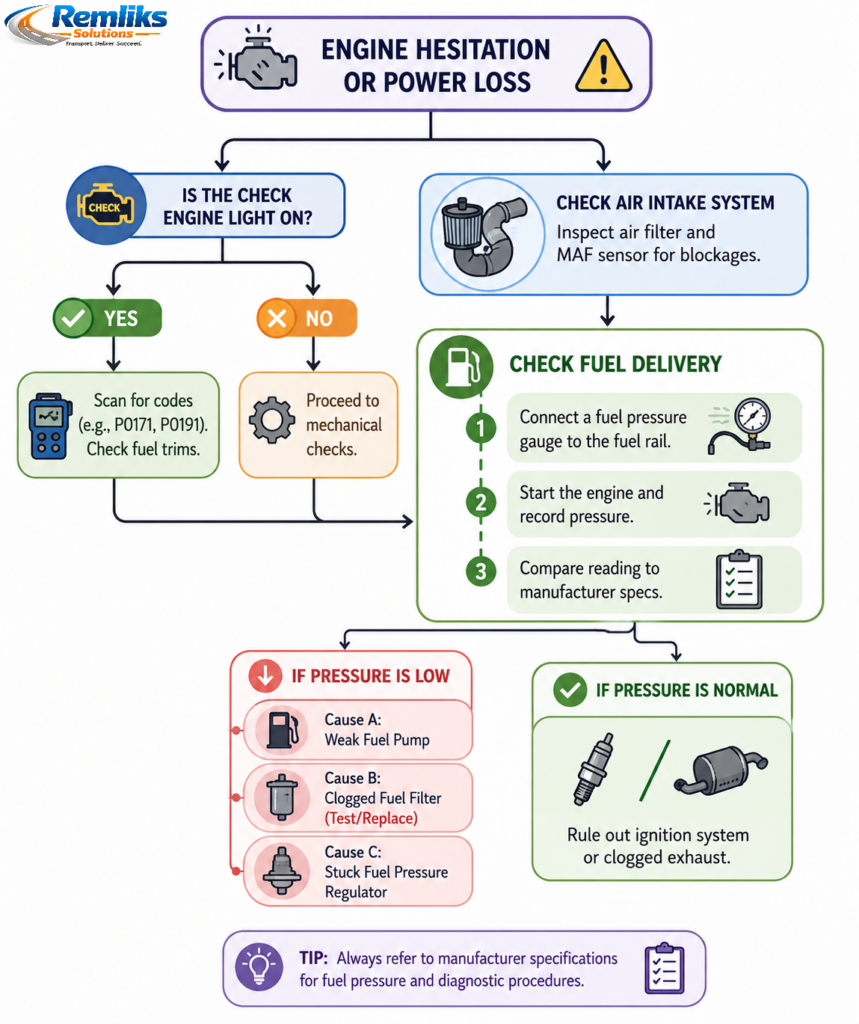
Bilal and Omar are working on a sedan that lacks power during highway driving. Let us listen to their diagnostic conversation.
Bilal: The engine cranks normally, but the car loses power when I try to accelerate past 60 mph. I think the spark plugs are bad. Should I replace them?
Omar: Before we replace any parts, we must avoid guessing. Loss of power under load often points to a fuel delivery issue rather than an ignition issue. Let us verify the fuel pressure first.
Bilal: Why not just replace the spark plugs to see if it fixes the problem?
Omar: Because professional diagnostics rely on testing before replacing parts. Spark plugs usually cause misfires at all speeds. However, a fuel system problem often appears when the engine demands more fuel, like during high-speed acceleration. A clogged fuel filter may cause exactly this symptom.
Bilal: I see. How do we test the fuel filter?
Omar: We connect a fuel pressure gauge to the Schrader valve on the fuel rail. We start the engine and watch the pressure. Then, we snap the throttle. If the pressure drops significantly, the filter or the pump is restricted. We can also test volume by seeing how much fuel flows into a graduated container in a set time.
Bilal: That makes sense. Testing prevents unnecessary expenses and ensures we fix the actual problem. What is the next step if the pressure is low?
Omar: If the pressure is low, we inspect the fuel filter. If the filter is old or clogged, we replace it and retest. If the pressure remains low after a new filter, we must investigate the fuel pump or the pressure regulator. Proper diagnosis saves money and prevents waste.
Maintaining your fuel filters is one of the most effective ways to protect your engine. Over time, the filter media fills with trapped particles. When it reaches its maximum capacity, it restricts fuel flow.
Manufacturers specify replacement intervals based on mileage. However, your driving environment also plays a big role. If you frequently drive on dusty roads or use fuel from stations with older underground storage tanks, your filter may clog faster.
Most mechanics recommend replacing the fuel filter every 30,000 to 50,000 miles (about 48,000 to 80,000 kilometers). However, always check your owner’s manual. Some manufacturers claim their fuel filters last 100,000 miles.
In our professional opinion, waiting 100,000 miles can put unnecessary strain on the fuel pump. Changing the filter earlier may help extend the life of the entire fuel system. It is a low-cost maintenance task that prevents high-cost repairs.
You should consider replacing your fuel filter before the scheduled interval if you notice:
Fuel filtration works differently depending on the fuel type. Diesel fuel requires much more aggressive filtration than gasoline. Understanding these differences is crucial, especially for those working with truck systems or diesel vehicles.
Gasoline is highly refined. It burns cleanly and contains fewer heavy impurities. A standard gasoline fuel filter focuses on trapping solid particles like dirt and rust. The micron rating is usually around 10 microns. The filter media is simple, and the housing does not need to handle extreme water separation.
Diesel fuel is less refined and is more prone to contamination from water. Water in diesel fuel is dangerous because it destroys the internal components of the high-pressure fuel pump and ruins the fuel injectors. Therefore, diesel fuel filters have two jobs: filtering solid dirt and separating water.
Diesel filters often feature a water drain valve at the bottom. Mechanics and drivers must periodically open this valve to drain the collected water. If water passes the filter, it can also promote the growth of microbes (algae and bacteria) in the fuel system, which creates a thick sludge.
| Feature | Gasoline Fuel Filter | Diesel Fuel Filter |
|---|---|---|
| Primary Job | Trap dirt, rust, and debris | Trap dirt AND separate water |
| Micron Rating | Usually 10 to 15 microns | Usually 2 to 5 microns (much finer) |
| Water Drain Valve | Rarely present | Almost always present at the bottom |
| Replacement Interval | 30,000 – 50,000 miles | 15,000 – 30,000 miles (more frequent) |
| Heated Elements | No | Some modern diesels have heated filters to prevent waxing in cold weather |
When it is time to replace your fuel filter, choosing the right part is essential. Not all filters are built to the same standards. A cheap, low-quality filter may allow dirt to pass through, which defeats its purpose.
When choosing a filter, look for reputable brands. Treat the fuel filter as a critical safety tool, not an area to save money. Using a high-quality filter may help protect your expensive fuel injectors.
Always match the filter to your specific engine size and year. Even within the same car model, different engines require different filters due to varying fuel pressures and line sizes. Check the inlet and outlet sizes to ensure the fuel lines connect securely.
Replacing a fuel filter requires care and attention to safety. Gasoline is highly flammable. Before you begin, ensure you have the correct automotive tools and equipment, including safety glasses, jack stands, and the correct line wrenches.
Warning: If you are not comfortable working with flammable fluids, please seek professional help. Do not smoke or use open flames near the vehicle.
Here is a general guide to replacing an in-line fuel filter. The exact steps may vary depending on your vehicle.
There is a lot of misinformation about car maintenance. Let us clear up a few common myths regarding fuel filters.
Myth 1: Premium fuel does not need filtering.
Fact: Premium fuel refers to the octane rating, not the cleanliness of the fuel. All fuel, regardless of grade, travels through the same pipelines and trucks. It can pick up dirt along the way. All fuels require filtering.
Myth 2: Fuel filters last the lifetime of the car.
Fact: While some manufacturers market “lifetime” filters, no filter media can hold infinite dirt. Eventually, the filter will clog. Changing it is part of routine maintenance guides.
Myth 3: You can clean a clogged fuel filter instead of replacing it.
Fact: Blowing compressed air through a filter backwards might push some dirt out, but it also tears the delicate filter media. A damaged filter will let dirt pass straight into your injectors. Always replace, never clean, a clogged filter.
When a fuel filter is clogged, the engine runs inefficiently. It burns more fuel than necessary and releases higher levels of harmful emissions into the air. By maintaining clean fuel filters, you reduce your fuel consumption, which saves resources and money. Also, you reduce pollution, which protects the community and the environment.
Furthermore, when replacing a fuel filter, you must dispose of the old filter and the spilled fuel responsibly. Pouring old fuel down a drain or throwing the filter in a regular trash bin harms the earth and poses a fire hazard. Instead, collect the old fuel in a sealed container and take it to a local hazardous waste disposal facility. Acting responsibly ensures safety for yourself and those around you.
Use this simple checklist to keep your fuel system healthy:
Q1: Can a bad fuel filter damage my engine?
A: Yes, indirectly. A severely clogged filter makes the fuel pump work harder, which can cause the pump to fail. If dirt bypasses a torn filter, it can clog the fuel injectors, leading to engine misfires and poor performance.
Q2: How much does it cost to replace a fuel filter?
A: The cost varies depending on your vehicle. An in-line filter is usually inexpensive, while an in-tank filter requires more labor. Generally, the part costs between $15 and $70, with labor adding $50 to $150 if done at a shop.
Q3: Can I drive with a clogged fuel filter?
A: It is not recommended. Driving with a clogged filter can cause the engine to stall unexpectedly, which is dangerous in traffic. Also, it forces the fuel pump to operate under high stress, which may lead to a costly pump replacement.
Q4: Does a new fuel filter improve gas mileage?
A: If your old filter was partially clogged, the engine might have been running lean or struggling. Replacing it restores proper fuel flow and optimal combustion, which may help improve fuel economy back to normal levels.
Q5: Is the fuel filter the same as the air filter?
A: No. The fuel filter cleans the liquid fuel going into the engine. The air filter cleans the air entering the engine. You can learn more about the air side of the equation in our engine air filters guide.
Fuel filters are small components with a massive responsibility. They protect your engine’s precise fuel system from destructive contaminants. By understanding how they work and recognizing the symptoms of a clogged filter, you can prevent breakdowns and expensive repairs.
Always follow your manufacturer’s maintenance schedule, but also stay alert to changes in your vehicle’s performance. Regular replacement of your fuel filters is a simple, responsible practice that keeps your engine running efficiently, saves you money, and respects the environment.
For more detailed terminology, visit our automotive terms glossary, or explore our complete troubleshooting center for more automotive guides.
