Physical Address
304 North Cardinal St.
Dorchester Center, MA 02124
Physical Address
304 North Cardinal St.
Dorchester Center, MA 02124

Disclaimer: This article provides general information only. Always consult your vehicle’s official service manual or a certified professional for specific diagnostic and repair advice.
First and foremost, fuel pressure regulators play a vital role in keeping your engine running smoothly. Specifically, they ensure the engine receives the exact amount of fuel needed for combustion, regardless of how hard the engine is working. Consequently, when fuel pressure regulators fail, they can cause poor performance, bad fuel economy, and potential engine damage.
Furthermore, throughout this guide, you may see Bilal and Omar discussing vehicle systems, maintenance procedures, and troubleshooting situations. Indeed, they are fictional educational characters created by Remliks Solutions to help explain automotive and truck concepts in a practical and engaging way.
To begin with, to understand fuel pressure regulators, we must first look at how modern fuel systems work. Generally, modern fuel pumps deliver more fuel to the engine than it actually needs. Therefore, the fuel pressure regulator acts as a gatekeeper. Specifically, it holds the fuel inside the fuel rail at a steady pressure. However, if the pressure gets too high, the regulator opens a valve. As a result, this allows the extra fuel to flow back to the gas tank.
When the pressure is correct, the fuel injectors can spray a perfect, fine mist into the engine. Consequently, this mist mixes easily with air. However, if the pressure is too low, the fuel comes out as a weak stream. As a result, this causes a lean mixture. On the other hand, if the pressure is too high, the engine gets too much fuel, causing a rich mixture. To learn more about the whole system, you can read our guide on Car Fuel System Components.
First, the main job of fuel pressure regulators is to maintain a constant pressure difference. Specifically, this difference exists between the fuel rail and the intake manifold.
Additionally, the intake manifold has a vacuum. Consequently, this vacuum changes depending on how hard the engine works. For example, when you accelerate, the vacuum drops. Therefore, the regulator must adjust the fuel pressure to match this change. Ultimately, this ensures the fuel injectors always spray the correct amount of fuel.
First of all, engines need a precise air-fuel ratio. In fact, this is the exact mix of air and fuel needed for perfect combustion. Therefore, the Engine Control Unit (ECU) calculates this ratio constantly.
Meanwhile, the ECU relies on the fuel pressure regulators to keep the baseline pressure steady. Consequently, if the regulator fails, the ECU cannot make accurate calculations. As a result, the engine will run poorly. Furthermore, proper fuel delivery is just as important as proper air delivery. Therefore, you can read more about air delivery in our Air Intake Components Guide.
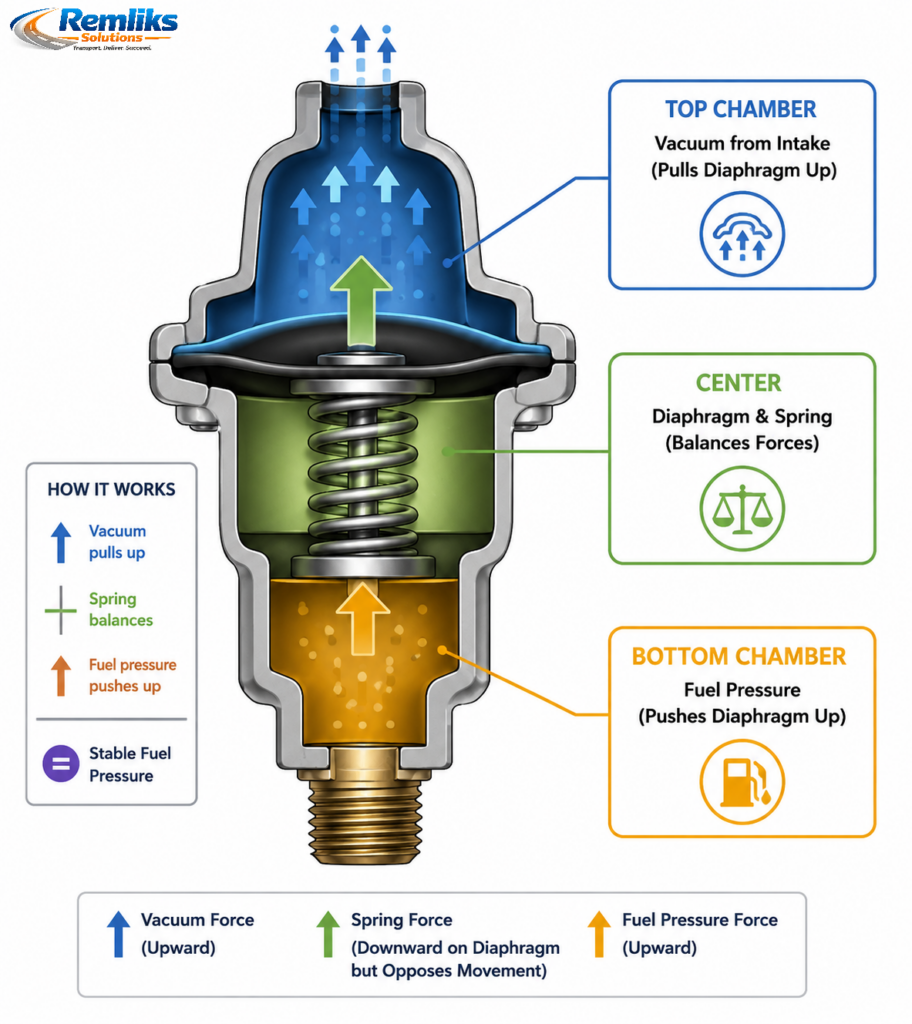
Essentially, a fuel pressure regulator is a simple but precise device. Inside, it contains a few main parts: (see the image below )
First, understanding the mechanics of fuel pressure regulators helps you diagnose problems later. Basically, the system uses a balance of forces. On one side of the diaphragm, there is fuel pressure. Meanwhile, on the other side, there is a spring and engine vacuum.
First, when you turn the key, the fuel pump starts pushing fuel into the fuel rail. Then, the fuel pushes against the diaphragm. Subsequently, when the fuel pressure overcomes the force of the spring, the diaphragm moves. As a result, this movement opens the return valve. Consequently, extra fuel flows back to the tank.
For example, when the engine idles, it creates a strong vacuum. Therefore, this vacuum pulls the diaphragm, making it easier for the valve to open. As a result, this lowers the fuel pressure. However, when you accelerate, the vacuum drops. Consequently, the spring pushes the diaphragm back, closing the valve. Ultimately, this raises the fuel pressure to match the engine’s higher demand.
First, the ECU uses a mathematical map to decide how long to open the fuel injectors. Specifically, this is called the injector pulse width. Furthermore, the ECU assumes the fuel pressure is always steady.
However, if the fuel pressure regulators are broken, the pressure fluctuates. Consequently, the ECU gets confused. For instance, it might open the injector for a short time, but because the pressure is too high, too much fuel enters the engine. As a result, this disrupts the air-fuel ratio completely.
Below is a visual scheme showing how forces balance inside the regulator. Specifically, this flexbox layout shows the dynamic relationship between vacuum, spring force, and fuel pressure.
First, fuel injectors are like timed faucets. Specifically, the amount of fuel they spray depends on two things: how long they stay open, and how high the fuel pressure is.
For instance, if the fuel pressure regulators keep the pressure high, the injector sprays more fuel in less time. Conversely, if the pressure drops, the injector sprays less fuel. Therefore, this is why a steady pressure is critical. Consequently, you can learn more about this in our guide on Fuel Injectors.
Generally, there are two main types of fuel pressure regulators used in modern vehicles. Specifically, the type used depends on the age and design of your vehicle’s fuel system.
First, older vehicles and some performance cars use return-style fuel systems. In these systems, the fuel pump sends fuel to the engine. Then, the fuel pressure regulators sit at the end of the fuel rail. Additionally, a vacuum hose connects the regulator to the intake manifold.
Subsequently, when the regulator opens, it sends extra fuel back to the tank through a return line. Overall, these systems are simple and very reliable. However, they can heat the fuel in the tank because the fuel travels past the hot engine before returning.
In contrast, most modern cars and trucks use returnless fuel systems. In these systems, the fuel pressure regulator is located inside the gas tank, right at the fuel pump. Consequently, there is no return line.
Instead, the ECU controls the fuel pump speed electronically. Specifically, the ECU reads sensors and adjusts the pump to send only the exact amount of fuel needed. As a result, this reduces fuel temperature and lowers the risk of vapor lock. Furthermore, it also reduces emissions. Therefore, for more on how modern pumps work, see our Fuel Pumps Guide.
Furthermore, some high-performance vehicles use adjustable fuel pressure regulators. Specifically, these allow mechanics to manually change the baseline fuel pressure.
However, adjusting these regulators requires special tools and knowledge. For instance, if you set the pressure too high, you risk flooding the engine. Conversely, if you set it too low, the engine starves for fuel. Therefore, we do not recommend adjusting these without professional guidance.
Meanwhile, Bilal and Omar are looking at a car that lacks power and has poor fuel economy. Let us listen to their conversation about fuel pressure regulators.
Omar and Bilal Workshop Scenario
Bilal: First, the engine runs rough, and the exhaust smells like raw fuel. Could the fuel pressure regulators be failing?
Omar: Indeed, it is possible. Specifically, the smell of raw fuel often points to a rich mixture. Therefore, the fuel pressure regulator may be stuck closed, causing too much fuel to enter the engine.
Bilal: In that case, should we replace the fuel injectors first?
Omar: No. Instead, professional diagnostics rely on testing before replacing parts. First, we should connect a fuel pressure gauge to the rail. Then, if the pressure is too high, we test the regulator. Ultimately, if the regulator is bad, replacing the injectors will not fix the problem.
Bilal: I understand. Therefore, we must find the root cause before spending money on parts.
Omar: Exactly. Also, we must check the vacuum line connected to the regulator. For instance, if there is fuel inside the vacuum line, the diaphragm is broken. Consequently, this allows raw fuel to enter the intake manifold directly.
Naturally, when fuel pressure regulators fail, they give clear warning signs. Consequently, recognizing these symptoms early may help you avoid costly engine damage.
First, a failing regulator often causes drivability problems. For instance, you might notice the engine hesitating when you press the gas pedal. Also, the engine might stall at idle or stop suddenly when coming to a red light. Ultimately, this happens because the fuel mixture is too lean or too rich.
Additionally, if the internal diaphragm tears, fuel can leak. Specifically, in return-style systems, fuel gets sucked into the vacuum line and directly into the engine. As a result, this creates a very rich mixture. Consequently, you might see black smoke from the exhaust.
Specifically, black smoke means the engine is burning too much fuel. Therefore, when the fuel pressure regulators stick closed, pressure builds up. As a result, the injectors spray too much fuel. Consequently, the engine cannot burn it all, so it comes out as black smoke. Ultimately, this will also cause you to fail an emissions test.
Sometimes, a clogged fuel pressure regulator restricts fuel return. Consequently, the fuel pump has to work much harder to push fuel past the blockage. As a result, this can cause the fuel pump to make a loud whining noise from the gas tank.
| Symptom | Possible Cause | Action to Take |
|---|---|---|
| Black smoke from exhaust | Regulator stuck closed (Rich mix) | First, test fuel pressure immediately |
| Hard starting when hot | Fuel boiling in rail (Vapor lock) | Then, check for restricted return line |
| Fuel in vacuum line | Torn regulator diaphragm | Immediately replace the fuel pressure regulator |
| Engine stalls at idle | Low fuel pressure (Lean mix) | Next, test pump and regulator output |
| Poor fuel economy | High fuel pressure | Finally, inspect electronic regulator control |
Although fuel pressure regulators are durable, they do not last forever. Consequently, several factors can cause them to fail.
First, the internal rubber diaphragm gets hard and brittle as it ages. Specifically, after many heat cycles, the rubber can crack or tear. Also, the spring can lose its tension over time. As a result, this causes the regulator to open too early, lowering fuel pressure.
Furthermore, dirt and rust are enemies of fuel pressure regulators. For instance, if you drive with a dirty fuel filter, small particles can pass through. Consequently, these particles jam the regulator valve open or closed. Therefore, using high-quality fuel and replacing the fuel filter regularly can prevent this. For more details, check our Maintenance Guides.
On the other hand, in returnless systems, the regulator relies on the ECU and sensors. Therefore, if the fuel rail pressure sensor sends the wrong data, the ECU might command the wrong pressure. Consequently, this is not a mechanical failure of the regulator, but it acts like one. Thus, proper testing is needed to tell the difference. To understand these terms better, read our Automotive Diagnostic Terminology Guide.
Overall, testing fuel pressure regulators is a straightforward process. However, you must always prioritize safety. Specifically, gasoline is highly flammable. Therefore, always work in a well-ventilated area away from open flames.
First, before you start, gather the correct tools:
First, locate the Schrader valve on the fuel rail. Specifically, it looks like a tire air valve. Then, attach the fuel pressure gauge to this valve. Next, turn the ignition key to the “ON” position without starting the engine. After that, note the pressure reading.
Subsequently, start the engine. Then, watch the gauge. Normally, the pressure should drop slightly when the engine idles. However, if the pressure is zero or very low, the fuel pump or regulator might be bad.
Alternatively, if your vehicle has a vacuum-operated regulator, perform this test. First, with the engine running, carefully remove the vacuum hose from the regulator. Then, watch the fuel pressure gauge. Consequently, the pressure should jump up by about 4 to 8 psi.
Also, inspect the vacuum hose. Specifically, if there is liquid fuel inside the hose, the regulator diaphragm is leaking. Therefore, you must replace it immediately.
Furthermore, modern vehicles monitor fuel pressure constantly. Therefore, if the pressure is out of range, the ECU triggers a Check Engine Light. Consequently, you can use an OBD2 scanner to read the codes. For instance, common codes include P0190 (Fuel Rail Pressure Sensor Circuit) or P0087 (Low Fuel Pressure). For more on scanners, visit our Diagnostic & Scan Tools section.
Obviously, you cannot maintenance a fuel pressure regulator directly. However, you can protect it by taking care of the whole fuel system.
First, always buy fuel from busy, reputable gas stations. Consequently, this ensures the fuel is fresh and clean. Otherwise, dirty fuel introduces particles that destroy the regulator valve. Also, avoid using old or stale gas, especially in seasonal equipment.
Furthermore, the fuel filter is the main defense for your fuel pressure regulators. Therefore, check your owner’s manual for the replacement schedule. Usually, mechanics recommend replacing it every 30,000 to 50,000 miles. Otherwise, a clogged filter starves the regulator and the fuel injectors.
Additionally, using a high-quality fuel system cleaner once a year may help remove deposits. However, do not overuse these chemicals. Specifically, strong cleaners can sometimes damage rubber seals inside older fuel pressure regulators. Therefore, always follow the instructions on the bottle. For safe options, visit our Automotive Fluids & Chemicals section.
Overall, replacing fuel pressure regulators varies greatly between vehicles. Because this job involves high-pressure flammable fuel, we recommend professional installation. However, understanding the process helps you know what to expect.
First, fuel pressure regulators are sealed units. Consequently, you cannot open them to replace a single spring or diaphragm. Therefore, if the regulator fails the pressure test or leaks fuel, you must replace the whole unit.
Before starting the replacement, you must relieve the fuel pressure. For example, you can do this by removing the fuel pump fuse and running the engine until it dies. Then, disconnect the battery. Also, wrap a shop rag around the fuel line connections to catch any spilled fuel. Ultimately, always wear safety glasses.
Consequently, here is a general overview for return-style systems:
Conversely, for returnless systems, the process is much harder because the regulator is inside the fuel tank. Therefore, this requires removing the fuel tank or accessing the pump through the rear seat. If you need new parts, check our Product Reviews & Buying Guides.
Meanwhile, trucks have different demands than passenger cars. Specifically, heavy loads and long distances require robust fuel systems.
First, truck fuel systems operate at higher pressures and volumes. Consequently, the fuel pressure regulators in trucks must handle extreme stress. In particular, diesel trucks use very high-pressure systems to atomize diesel fuel properly.
In comparison, diesel fuel pressure regulators are often more complex. Specifically, they deal with pressures that can exceed 30,000 psi in common rail systems. Conversely, gasoline regulators operate at much lower pressures, usually between 30 and 80 psi. Therefore, you can learn more about heavy-duty systems in our Truck Systems section.
Furthermore, for fleet managers, failing fuel pressure regulators cause downtime. Therefore, regular fuel filter changes are critical for trucks. Also, fleet mechanics often use dual fuel filters with water separators to protect the regulators and injectors. Ultimately, this extends the life of the entire fuel system.
When you face a fuel issue, a logical approach saves time and money. Therefore, let us review a simple troubleshooting flowchart for fuel pressure regulators.
First, confirm the problem. For instance, does the engine stall only when cold? Also, does it hesitate at full throttle? Therefore, write down the exact symptoms. Consequently, this helps narrow down the cause.
Next, before blaming the fuel pressure regulators, check the basics.
Then, plug in an OBD2 scanner. Interestingly, even if the Check Engine Light is off, there might be pending codes. Consequently, a pending code can point you directly to a fuel pressure issue.
Finally, connect the fuel pressure gauge. Then, compare your readings to the factory service manual. Specifically, if the pressure is too high, the regulator is likely stuck closed. Conversely, if the pressure is too low, the regulator might be stuck open, or the fuel pump is weak.
If you need more help diagnosing engine issues, visit our Troubleshooting Center.
Indeed, a bad fuel pressure regulator does not just affect the engine. Consequently, it can damage other parts of your vehicle.
Specifically, when the regulator allows too much fuel into the engine, the extra fuel enters the exhaust system. However, the catalytic converter is designed to clean emissions, not burn raw fuel. As a result, the raw fuel overheats the converter. Consequently, this can melt the internal parts, requiring a very expensive replacement.
Also, a rich mixture causes black, sooty deposits on the spark plugs. Specifically, this is called fouling. Consequently, fouled spark plugs cannot create a strong spark. Therefore, this leads to misfires, rough idling, and further engine damage.
Furthermore, in rare cases, if the regulator leaks badly, excess fuel can wash down the cylinder walls. Then, the fuel mixes with the engine oil. As a result, this dilutes the oil, reducing its ability to lubricate the engine. Consequently, this can cause rapid engine wear. Therefore, if you suspect this, change your oil immediately after fixing the regulator. For more info, learn more in our Lubrication System section.
In summary, fuel pressure regulators are the unsung heroes of the fuel system. Specifically, they work constantly to balance fuel and air. Therefore, keeping them healthy requires simple, consistent care.
Ultimately, do not ignore engine performance issues. Specifically, a small fuel leak or a slight hesitation can signal a failing fuel pressure regulator. Therefore, addressing the problem early may help you avoid expensive repairs later.
Ultimately, fuel pressure regulators act as the silent guardians of your engine’s fuel system. Specifically, they ensure the engine receives the exact amount of fuel it needs, no more and no less. Consequently, when they fail, the entire engine suffers, leading to poor performance, bad fuel economy, and potential damage to expensive parts like catalytic converters. However, with regular maintenance and early diagnosis, you can prevent most of these problems.
As we saw in the workshop scenario with Bilal and Omar, the most important rule of automotive repair is to test before replacing parts. Indeed, guessing wastes money and time. Therefore, a simple fuel pressure gauge test can tell you exactly what is happening inside your fuel rail.
Furthermore, by using high-quality fuel, replacing your fuel filters on schedule, and paying attention to warning signs like black smoke or rough idling, you may help extend the life of your fuel pressure regulators.
Finally, if you want to learn more about how fuel interacts with other engine parts, we encourage you to read our guide on Fuel Injectors and Fuel Pumps. Also, for routine upkeep tips, visit our Maintenance Guides.
