Physical Address
304 North Cardinal St.
Dorchester Center, MA 02124
Physical Address
304 North Cardinal St.
Dorchester Center, MA 02124

Disclaimer: This article provides general information only. It is not professional mechanical or legal advice. Always consult a certified technician for specific vehicle issues and safety concerns.
Throughout this guide, you may see Bilal and Omar discussing vehicle systems, maintenance procedures, and troubleshooting situations. They are fictional educational characters created by Remliks Solutions to help explain automotive and truck concepts in a practical and engaging way.
When a vehicle operates, its engine burns fuel to create power. This process generates massive amounts of heat. If the cooling system fails to manage this heat, the vehicle suffers from engine overheating. This condition can severely damage engine components, warp metal parts, and lead to costly repairs. However, understanding the causes and symptoms of engine overheating can help you act quickly and prevent permanent damage.
At Remliks Solutions, we believe that understanding your vehicle systems is the first step toward safe and responsible driving. In this guide, we will explore how the cooling system works, why engines overheat, and what steps you should take when it happens. You can explore more foundational topics in our Learning Center.
Before diagnosing problems, we must understand how the engine manages heat. The cooling system is a network of parts that work together to transfer heat away from the engine block.
When the engine runs, it burns air and fuel. This combustion can reach temperatures over 2,000 degrees Fahrenheit. The cooling system constantly circulates liquid to absorb this heat and move it to the radiator, where outside air cools it down.
If you want to understand how the engine produces this heat, you can read our detailed guide on Engine Components. For a broader view of how the engine manages temperature, visit our Cooling System section.
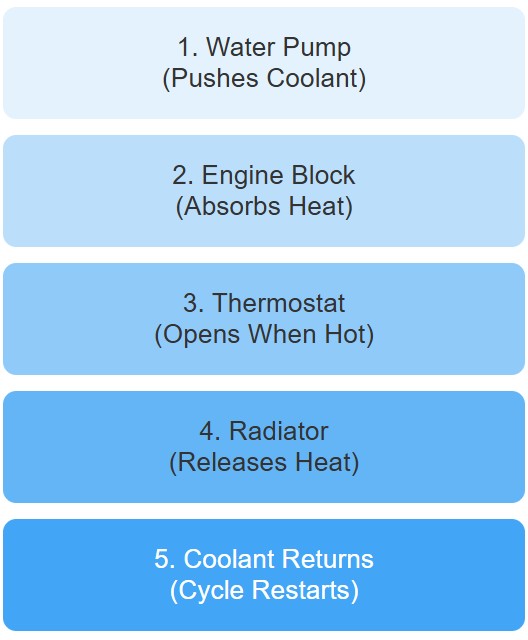
The cooling system relies on several key components working in harmony. Here is a simple breakdown of the process:
Below is a simple layout showing how coolant moves through the system to prevent engine overheating.
Engine overheating happens when this careful balance of heat and fluid flow breaks down. The problem usually stems from a lack of coolant, poor airflow, or a mechanical failure.
Low coolant is the most frequent cause of engine overheating. If the system does not have enough liquid, it cannot absorb heat. Coolant levels drop because of leaks. Hoses can crack, radiator caps can fail, and water pump gaskets can wear out.
If you notice puddles under your car (often green, orange, or pink liquid), you likely have a leak. Also, a blown head gasket can allow coolant to enter the engine cylinders and burn off, creating white smoke from the exhaust.
The thermostat controls the flow of coolant. If it sticks closed, hot coolant remains trapped inside the engine block. The radiator never gets a chance to do its job. This mechanical failure will cause rapid engine overheating.
Conversely, if the thermostat sticks open, the engine may run too cold, which reduces fuel efficiency. However, a stuck-closed thermostat is the dangerous scenario that leads to overheating.
The water pump must spin continuously to move the coolant. It is usually driven by the engine’s serpentine belt or the Timing Belts.
Over time, the bearings inside the water pump can wear out, or the impeller (the spinning blade) can corrode. If the pump seizes, coolant stops moving immediately. This stoppage will trigger severe engine overheating. You can learn more about drive components in our Automotive Tensioners Guide.
The radiator must allow air to pass through it. Sometimes, bugs, dirt, and road debris block the fins. When airflow stops, the coolant stays hot.
Also, old coolant can rust and form sludge. This sludge blocks the thin tubes inside the radiator. When the radiator is clogged internally, fluid cannot circulate properly. Regular maintenance of your Automotive Fluids & Chemicals can prevent this issue.
When you drive at highway speeds, natural airflow cools the radiator. However, when you sit in traffic, the cooling fans must pull air through the radiator.
If an electric fan motor burns out, or if a fan relay fails, the engine temperature will spike while idling. Also, if your engine uses a mechanical fan clutch, it may wear out and fail to engage. Electrical issues are common here; you can explore our Electrical System guides for more information.
Vehicles give several warning signs before catastrophic failure occurs. Recognizing these symptoms of engine overheating can save your engine.
The most obvious sign is the temperature gauge on your dashboard. Normally, the needle sits near the middle. If it creeps toward the “H” (Hot) mark, you must take action. Do not ignore this gauge.
Modern vehicles also display warning lights or chimes. If you see a red thermometer icon, pull over safely as soon as possible. Check our Warning Lights & Error Codes section for more dashboard light meanings.
If coolant boils over, it turns into steam. This steam usually escapes from under the hood near the radiator cap or the overflow tank.
If you see white smoke pouring from your engine bay, stop the vehicle immediately. Driving with boiling coolant can severely warp the engine cylinder head.
A hot engine produces distinct odors.
When an engine gets too hot, it loses power. This condition is called pre-ignition or engine knock. The fuel ignites before the spark plug fires due to the excess heat. The engine may sound like it is rattling or pinging.
| Symptom | Possible Cause | Immediate Action Required |
|---|---|---|
| Temperature gauge near “H” | Thermostat stuck, low coolant | Turn off AC, turn on heater, pull over safely |
| Steam from hood | Boiling coolant, radiator cap failure | Stop vehicle immediately, turn off engine |
| Sweet smell inside cabin | Coolant leak from heater core | Check coolant levels, inspect for leaks |
| Ticking/knocking noise | Low oil or extreme engine heat | Reduce speed, stop and check fluid levels |
Let us look at a practical example of how to diagnose engine overheating safely and logically.
Omar and Bilal Workshop Scenario
Bilal: Omar, my car’s temperature gauge started rising toward the red zone while I was stuck in traffic. When I started driving on the highway, it cooled down again. What could be the problem?
Omar: That is a very common pattern, Bilal. If the car overheats while idling but cools down at highway speeds, the issue is usually related to airflow. The first thing we should check is the cooling fans. When the car sits still, it relies on electric fans to pull air through the radiator.
Bilal: Should I just replace the fan motor immediately?
Omar: No, we should avoid guessing. First, let us use a diagnostic tool to check the system. We need to see if the engine computer is actually sending power to the fan when the temperature rises.
Bilal: I see. So, if the computer sends power but the fan does not spin, the motor is bad. But what if the fan works fine?
Omar: Then we need to look at other airflow restrictions. Is the radiator blocked by debris? Also, we must verify the coolant level. However, because the temperature drops at highway speeds, we know the water pump and thermostat are likely functioning, because natural airflow is cooling the fluid effectively.
Bilal: That makes sense. Test before replacing parts.
Omar: Exactly. Professional diagnostics rely on logical steps. We can use a simple multimeter or an advanced OBD2 scanner to check live data before we spend money on parts.
Note: You can learn more about diagnostic tools in our Diagnostic & Scan Tools section.
If you experience engine overheating while driving, follow these safe steps. Acting calmly can prevent permanent damage.
The air conditioning system creates extra load on the engine. Turning it off reduces the heat the engine must manage.
This may sound uncomfortable, but it works. The heater core is a small radiator located inside the dashboard. Turning the heater to maximum and the blower to high speed pulls heat away from the engine and vents it into the cabin. This may help lower the engine temperature slightly while you find a safe place to stop.
Do not continue driving an overheating engine. Find a safe spot, turn off the engine, and put the car in park. Engage your parking brake.
Safety must come first.
Prevention is always better than repair. Responsible vehicle maintenance keeps the cooling system in good shape.
Check your coolant level every month. Look at the transparent overflow tank under the hood. Ensure the fluid is between the “Min” and “Max” lines.
Also, follow the manufacturer’s schedule for coolant flushes. Over time, coolant loses its anti-corrosion properties. Flushing the system removes rust and debris. Visit our Maintenance Guides for routine checklists.
Rubber degrades over time. Squeeze the radiator hoses (when the engine is cold). They should be firm, not rock-hard, spongy, or cracked.
Check the engine belts. If the serpentine belt that drives the water pump is frayed or loose, it can slip. A slipping belt means the water pump spins slower, reducing coolant flow. You can review our guide on Timing Chains to understand how engine timing components interact with the cooling system.
Make it a habit to glance at your dashboard. The temperature gauge should always rest in the middle after the engine warms up. If it starts trending upward, address the issue before it reaches the red zone.
Here is a general guide to cooling system maintenance. Always refer to your vehicle’s specific manual.
| Component | Action | Typical Interval |
|---|---|---|
| Coolant | Check Level | Monthly |
| Coolant | Flush and Replace | Every 30,000 to 60,000 miles |
| Radiator Hoses | Visual/Squeeze Inspection | Every oil change |
| Thermostat | Inspection/Replacement | If overheating occurs |
| Water Pump | Replace | At timing belt service interval |
Use this checklist to perform a basic, safe inspection of your cooling system.
Can I drive my car if it is slightly overheating?
No. You should never drive a vehicle that is showing signs of engine overheating. Even slight overheating can warp the cylinder head and blow the head gasket. Pull over, let the engine cool, and call for assistance.
Why does my car overheat only in traffic?
This usually points to a cooling fan issue. When you drive at speed, natural air pushes through the radiator. In traffic, the car relies on electric or mechanical fans. If the fan motor, relay, or fuse is broken, the engine will overheat while stationary.
Can low engine oil cause overheating?
Yes. Engine oil lubricates moving parts, which reduces friction. Friction creates heat. If oil levels are very low, the engine generates extra heat that the cooling system may struggle to manage. Check your Engine Lubrication System Guide for more details.
How much does it cost to fix an overheating engine?
The cost varies widely based on the cause. Replacing a thermostat might cost $200, while replacing a blown head gasket can cost over $1,500. Proper diagnosis is essential to avoid replacing unnecessary parts.
Is it safe to add water to the radiator?
In an emergency, you can add water to reach home or a repair shop. However, water alone boils quickly and lacks rust inhibitors. You should always use a proper 50/50 mix of coolant and distilled water for long-term protection.
Engine overheating is a serious issue, but it is highly preventable. By understanding the cooling system, recognizing the symptoms, and acting calmly, you can protect your engine from permanent damage.
Always prioritize safety. Never open a hot radiator cap, and never ignore a rising temperature gauge. Regular maintenance, like checking coolant levels and inspecting hoses, goes a long way in keeping your vehicle on the road.
For more troubleshooting advice, visit our Troubleshooting Center. If you need tools to diagnose your vehicle, explore our Automotive Tools & Equipment reviews. At Remliks Solutions, we are committed to providing honest, clear information to help you maintain your vehicle safely and responsibly.
