Physical Address
304 North Cardinal St.
Dorchester Center, MA 02124
Physical Address
304 North Cardinal St.
Dorchester Center, MA 02124

Disclaimer: This article provides general information only. For specific vehicle repairs or modifications, consult a qualified professional mechanic. Vehicle specifications vary by make, model, and year.
Ignition timing refers to the precise moment when the spark plug fires in relation to the piston’s position in the cylinder. This critical aspect of engine operation directly impacts performance, fuel efficiency, and emissions. When properly set, ignition timing ensures that the combustion process occurs at the optimal moment during the engine’s power stroke, maximizing the force applied to the piston while minimizing harmful effects like engine knock or incomplete combustion.
Throughout this guide, you may see Bilal and Omar discussing vehicle systems, maintenance procedures, and troubleshooting situations. They are fictional educational characters created by Remliks Solutions to help explain automotive and truck concepts in a practical and engaging way.
Ignition timing is measured in degrees of crankshaft rotation before the piston reaches top dead center (TDC) on its compression stroke. For example, if your vehicle’s ignition timing is set to 10 degrees before TDC (often written as 10° BTDC), it means the spark plug fires when the crankshaft has rotated 10 degrees before the piston reaches the highest point in its travel.
Bilal: I’ve heard mechanics talking about “timing” but I’m confused about what exactly they’re adjusting. Can you explain what ignition timing really means?
Omar: Think of it this way – when you push a child on a swing, you don’t push when they’re already moving away from you. You push just before they reach the highest point of their backswing. Similarly, the spark needs to fire just before the piston reaches the top of its stroke, allowing time for the fuel-air mixture to start burning and create maximum pressure at the right moment.
Bilal: So why not just fire the spark exactly at the top?
Omar: Because combustion isn’t instant. It takes time for the flame to spread through the combustion chamber. If we waited until the piston was at the top, the pressure wouldn’t build up until the piston was already moving down, reducing the force applied to the crankshaft.
To understand ignition timing fully, we need to examine the combustion process in detail. When the spark plug fires, it doesn’t create an explosion but rather a controlled burn that propagates through the fuel-air mixture.
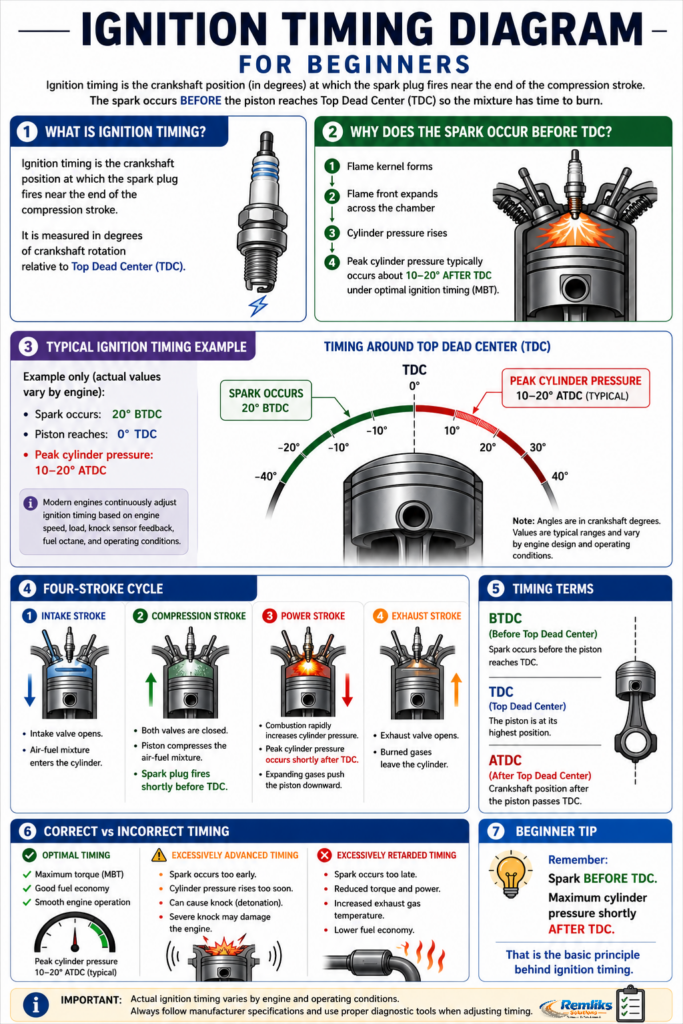
The goal of proper ignition timing is to have peak cylinder pressure occur at the optimal crank angle (typically 10-20° after TDC) to maximize the leverage applied to the crankshaft while preventing harmful conditions like detonation.
Ignition timing control has evolved significantly over automotive history. Let’s examine the main types:
The earliest ignition systems used fixed timing that didn’t change with engine speed or load. These simple systems worked adequately at one specific operating condition but performed poorly across the engine’s full range.
This system uses weights and springs inside the distributor to advance timing as engine speed increases. At higher RPMs, the weights are thrown outward by centrifugal force, rotating the breaker plate and advancing the timing.
A vacuum diaphragm connected to the intake manifold advances timing during light-load conditions when manifold vacuum is high. This improves fuel efficiency during cruising.
These systems use electronic control modules to determine optimal timing based on various inputs. They eliminated the mechanical wear issues of distributors while providing more precise control.
Today’s engines use the engine control module (ECM) or powertrain control module (PCM) to precisely control ignition timing. These systems adjust timing thousands of times per second based on:
| System Type | Advantages | Disadvantages | Common Applications |
|---|---|---|---|
| Fixed Timing | Simple, inexpensive | Poor performance across operating range | Very early automobiles, small engines |
| Mechanical Advance | Self-adjusting with RPM, no electronics needed | Limited adjustment parameters, mechanical wear | Classic cars, some small engines |
| Vacuum Advance | Improved fuel economy, adapts to load | Complex linkage, sensitive to vacuum leaks | Vehicles from 1950s-1980s |
| Electronic Ignition | More precise, reduced maintenance | Still limited adjustment capability | Vehicles from 1970s-1990s |
| Computer-Controlled | Extremely precise, adapts to all conditions, self-diagnosing | Complex, requires specialized equipment to service | All modern vehicles |
Proper ignition timing affects nearly every aspect of engine operation:
The right ignition timing ensures maximum cylinder pressure at the optimal crank angle, delivering the best possible power output. Advanced timing (firing earlier) typically increases power up to a point, while retarded timing (firing later) reduces power.
Optimal timing ensures complete combustion of the fuel-air mixture, extracting maximum energy from each drop of fuel. This directly translates to better fuel economy.
Proper timing helps ensure complete combustion, reducing unburned hydrocarbons and carbon monoxide emissions. However, overly advanced timing can increase nitrogen oxide (NOx) emissions due to higher combustion temperatures.
Incorrect timing can cause harmful conditions:
Proper timing ensures smooth idle, responsive acceleration, and consistent power delivery.
Ignition timing has a direct effect on engine power. When the spark fires too late, the fuel burns after the piston has already started moving down. This late burn reduces force on the piston. As a result, the engine produces less power and uses more fuel.
When timing is gradually advanced, power increases. The burning mixture creates peak pressure at the right moment, just after the piston passes top dead center. This ideal setting is called Maximum Brake Torque (MBT) timing. It gives the best balance of power and efficiency.
However, more advance does not mean more power. Beyond MBT timing, power drops for two reasons.
First, the mixture burns too early. The expanding gases push against the piston while it is still moving up. This works against the engine instead of helping it.
Second, excessive advance causes very high pressure and temperature inside the cylinder. The fuel-air mixture then ignites on its own before the spark reaches it. This uncontrolled ignition is called knock or detonation. It causes a sharp power loss and may damage the engine over time.
For these reasons, the best ignition timing is not the most advanced setting. Instead, it is the setting that creates peak pressure at the most effective crank angle without causing knock.
Bilal: If advancing the timing increases power, why don’t we just set it to maximum advance?
Omar: There are several reasons. First, each engine design has a specific timing curve that provides the best overall performance. Second, fuel quality limits how much advance an engine can tolerate before knock occurs. Third, driving conditions change – what’s optimal at sea level on a cool day might cause knock at high altitude on a hot day.
Bilal: So modern engines must adjust timing constantly?
Omar: Exactly. That’s why computer-controlled ignition systems can adjust timing many times per second based on numerous inputs. They can run closer to the optimal timing curve while avoiding knock by retarding timing only when necessary.
Recognizing the symptoms of improper ignition timing can help diagnose problems early:
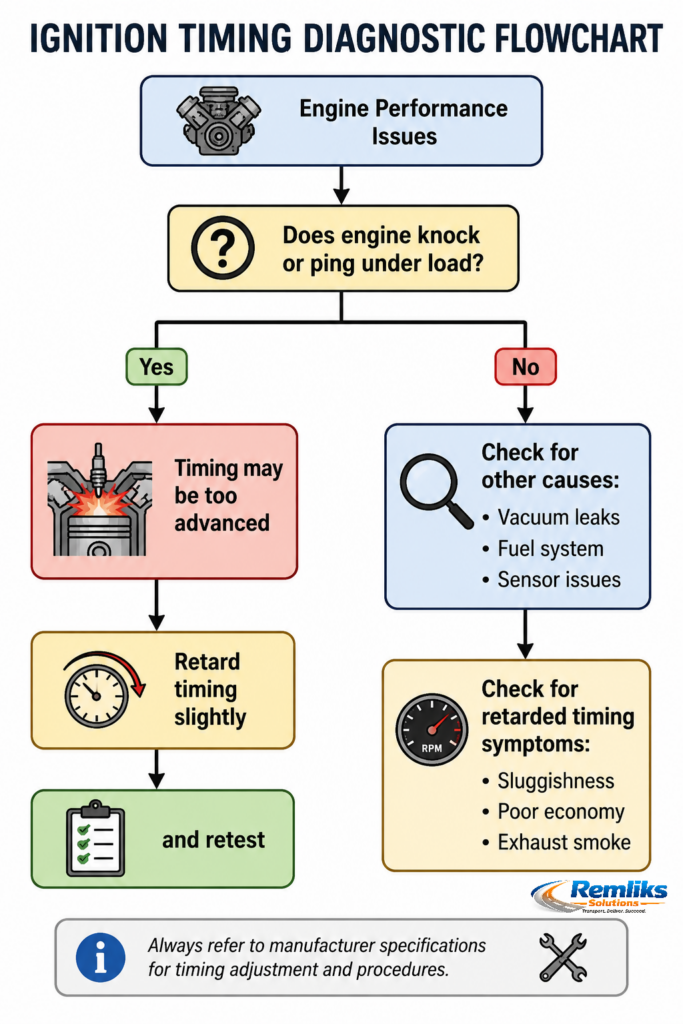
The method for checking and adjusting ignition timing depends on the type of system in your vehicle.
Modern vehicles typically don’t allow manual timing adjustment. Instead:
Bilal: I tried to check the timing on my 2018 sedan, but I can’t find any timing marks. Am I missing something?
Omar: Newer vehicles with coil-on-plug ignition systems and no distributor typically don’t have external timing marks. The timing is controlled entirely by the engine computer and can only be checked with a scan tool that displays live data.
Bilal: So there’s no way to adjust it myself?
Omar: Correct. The computer determines the optimal timing based on numerous inputs. If there’s a timing issue, it’s usually due to a sensor problem, mechanical issue, or computer reprogramming need, not a simple adjustment. This requires professional diagnostic equipment.
For those seeking a deeper understanding, let’s explore some advanced concepts:
Modern engines use knock sensors (typically piezoelectric accelerometers) to detect the high-frequency vibrations characteristic of detonation. When knock is detected, the engine control module immediately retards timing, usually in small steps (2-4°), then gradually advances it again until knock reoccurs or the maximum allowed advance is reached.
Some advanced engine management systems use sophisticated algorithms to continuously optimize timing based on:
In engines with variable valve timing (VVT), the ignition timing must work in concert with valve timing changes. As the intake valve closing point changes, the effective compression ratio changes, requiring timing adjustments to maintain optimal combustion phasing.
Cause: Distributor was removed and reinstalled incorrectly, or timing adjustment slipped.
Solution:
Cause:
Solution:
Cause:
Solution:
Cause:
Solution:
Proper maintenance can help ensure your ignition timing system functions correctly:
When modifying an engine for increased performance, ignition timing often needs adjustment:
For engines with increased compression ratio, camshaft changes, or improved breathing:
Turbocharged or supercharged engines have special timing considerations:
Higher octane fuel allows more advanced timing without knock:
Use this checklist to ensure proper ignition timing function:
A: Over-advanced timing can cause engine knock or pinging, especially under load. This knocking sound is actually the fuel-air mixture detonating unevenly rather than burning smoothly. Prolonged operation with excessive advance can damage pistons, rings, and bearings. In severe cases, it may cause holes in pistons or broken ring lands.
A: Yes, both over-advanced and over-retarded timing can potentially damage the catalytic converter. Over-retarded timing causes unburned fuel to enter the exhaust, where it can burn in the converter and cause overheating. Over time, this can melt the catalyst substrate. Over-advanced timing can increase NOx emissions, which may also affect converter efficiency over time.
A: For distributor-based systems, checking timing annually or whenever you perform a tune-up is good practice. For computer-controlled systems, timing is constantly monitored and adjusted by the engine computer, but you should still verify proper operation if you notice performance issues. After any engine work that involves removing the distributor or timing chain, timing should always be rechecked.
A: In some cases, slightly advancing the timing (within safe limits) can improve fuel economy by ensuring more complete combustion. However, this must be done carefully to avoid knock. For computer-controlled vehicles, the engine computer already optimizes timing for fuel economy under light-load conditions. Manually advancing timing beyond factory specifications may cause more harm than good.
A: Yes, higher altitudes with lower air density generally allow more ignition advance without knock. This is why some older vehicles had altitude compensators on their distributors. Modern engine control systems automatically adjust for altitude changes using the MAP or MAF sensor readings.
A: Base timing refers to the initial timing setting with the advance mechanisms disconnected or disabled. Total timing is the sum of base timing plus all advance (mechanical, vacuum, and computer-controlled) at a given RPM and load condition. For example, an engine might have 10° base timing and 30° total timing at 3,000 RPM.
A: Absolutely. The knock sensor is a critical input for timing control in modern engines. If the knock sensor fails or provides incorrect signals, the engine computer may retard timing excessively, causing poor performance and fuel economy. Conversely, if the computer can’t detect knock due to a faulty sensor, it may maintain too much advance, potentially leading to engine damage.
A: In older distributor-based systems, timing is essentially the same for all cylinders since they all fire from the same distributor. However, in modern coil-on-plug systems with sophisticated engine management, the computer can vary timing slightly between cylinders to compensate for manufacturing variations, fuel distribution differences, or to optimize emissions.
A: Ignition timing significantly impacts emissions. Over-advanced timing can increase NOx emissions due to higher combustion temperatures. Over-retarded timing can increase hydrocarbon (HC) and carbon monoxide (CO) emissions due to incomplete combustion. Proper timing helps ensure all emissions are within acceptable ranges during testing.
A: Most modern vehicles don’t allow manual timing adjustment. Instead, performance gains are typically achieved through engine computer reprogramming (chipping or tuning) that modifies the ignition timing maps along with fuel delivery and other parameters. This should only be done by professionals with proper equipment and knowledge of your specific engine.
Understanding ignition timing is essential for anyone interested in how engines work or how to maintain them properly. From the simple fixed timing of early automobiles to the sophisticated computer-controlled systems of today, the goal has remained the same: to ignite the fuel-air mixture at precisely the right moment for optimal performance, efficiency, and longevity.
Whether you’re maintaining a classic vehicle with a distributor or diagnosing a modern engine with computer-controlled timing, the principles outlined in this guide provide a foundation for understanding this critical aspect of engine operation. Remember that while basic timing checks can be performed by knowledgeable enthusiasts, complex timing issues on modern vehicles often require professional diagnostic equipment and expertise.
By recognizing the symptoms of incorrect timing and understanding the underlying principles, you can better communicate with your mechanic and make informed decisions about your vehicle’s maintenance and repair needs.
For more information about related topics, explore our Engine System section or check out our Ignition System Components Guide for a comprehensive look at the entire ignition system.
