Physical Address
304 North Cardinal St.
Dorchester Center, MA 02124
Physical Address
304 North Cardinal St.
Dorchester Center, MA 02124

Disclaimer: This article provides general information only. Always consult a certified mechanic or professional for specific diagnostic and repair advice.
Throughout this guide, you may see Bilal and Omar discussing vehicle systems, maintenance procedures, and troubleshooting situations. They are fictional educational characters created by Remliks Solutions to help explain automotive and truck concepts in a practical and engaging way.
When you turn the key in your car, you expect the engine to start. However, this simple action relies on a complex chain of events. At the center of this process are fuel pumps. These essential devices act like the heart of your vehicle, pushing fuel from the tank to the engine. Without a properly working pump, your vehicle cannot run.
In this guide, we will explore how these devices work, how to maintain them, and how to troubleshoot common problems. Whether you drive a daily commuter car or a heavy-duty truck, understanding this system helps you stay safe and avoid costly repairs. Before we dive in, you may want to review our basic Automotive Fundamentals to get familiar with basic vehicle terms.
A fuel pump is a mechanical or electrical device that moves fuel from the gas tank to the engine’s fuel injectors. Modern engines need fuel to be delivered at a very specific pressure. If the pressure is too low, the engine will starve and stall. If the pressure is too high, the engine will run too rich, wasting fuel and potentially causing damage.
The main job of the pump is to maintain steady fuel flow and pressure. Modern fuel injectors spray a fine mist of fuel into the engine cylinders. To create this mist, the fuel must arrive at high pressure. The pump works constantly while the engine is running to keep this pressure balanced.
There are two main types of pumps used in vehicles today. Understanding the difference helps you know how your vehicle operates.
To understand the system better, let us look at the components involved. The system is not just a single pump; it includes filters, lines, and pressure regulators.
Mechanical pumps operate like a diaphragm. As the engine spins, a lever pushes up and down. This motion pulls fuel from the tank on one stroke and pushes it toward the carburetor on the next stroke. Because they rely on engine rotation, they only pump fuel when the engine is running.
Electric pumps are more complex. When you turn the key to the “ON” position, the vehicle’s computer sends power to the pump for a few seconds to prime the system. Once the engine starts, the pump runs continuously.
The pump draws fuel through a sock filter (a coarse mesh screen) to catch large debris. Then, it pushes the fuel through the main Engine System lines. A fuel pressure regulator ensures the excess fuel returns to the tank, keeping the pressure perfectly steady.
Here is a simple table comparing the two types:
| Feature | Mechanical Fuel Pumps | Electric Fuel Pumps |
|---|---|---|
| Power Source | Engine rotation (mechanical) | Electric motor (battery/alternator) |
| Location | Outside the fuel tank (usually on engine) | Inside the fuel tank (mostly) |
| Pressure Output | Low (4 to 10 psi) | High (30 to 80 psi or more) |
| Common Use | Carbureted engines, older vehicles | Fuel-injected engines, modern vehicles |
Let us look at a practical scenario to understand how mechanics think about fuel delivery problems.
Omar and Bilal Workshop Scenario
Bilal: The engine cranks normally, but it takes a long time to start. Sometimes it stalls when I stop at a red light. Could this be a problem with the fuel pumps?
Omar: It certainly could be, Bilal. However, we must avoid guessing. A hard start or stalling can also be caused by a bad Mass Air Flow Sensor (MAF) or a clogged Air Filter. We need to test the fuel pressure first.
Bilal: How do we test the pressure safely? Can I just open the fuel line and see if fuel comes out?
Omar: Never do that. Fuel is highly flammable, and opening a pressurized line can cause a fire hazard. We use a specialized fuel pressure gauge connected to the test port on the fuel rail. This tells us exactly how much pressure the pump is generating. If the pressure is lower than the factory specification, we know the pump, the filter, or the pressure regulator is failing.
Bilal: I see. So we test before replacing parts.
Omar: Exactly. Professional diagnostics rely on data, not guesswork. This saves money and prevents unnecessary parts swapping.
Fuel pumps rarely fail instantly without warning. Most of the time, they give you clues before they completely stop working. Recognizing these signs early can prevent you from being stranded on the road.
If you are driving at highway speeds and the engine suddenly sputters or jerks, the pump may be failing. This happens because the pump cannot maintain the steady pressure required at high RPMs. The engine briefly starves for fuel.
When you accelerate hard, drive up a steep hill, or tow a heavy load, your engine demands more fuel. A weak pump cannot meet this demand. As a result, the vehicle will feel sluggish, and you will notice a significant loss of power.
Surging is the opposite of stalling. You are driving at a steady speed, but the car suddenly picks up speed on its own. This can happen if a failing fuel pump sends inconsistent bursts of fuel to the engine.
If the pump fails completely, the engine will crank, but it will not start. This is because no fuel is reaching the combustion chamber. If you turn the key to the “ON” position and do not hear a quiet humming sound from the rear of the car for two seconds, the pump may be dead.
Replacing a fuel pump can be expensive because it often involves dropping the fuel tank. Fortunately, proper maintenance can greatly extend the life of the pump.
This is the most important rule for electric fuel pumps. The pump relies on the surrounding fuel to act as a coolant and a lubricant. If you frequently drive with the tank near empty, the pump runs hotter and wears out faster. Keeping the tank at least a quarter full is a simple, cost-effective way to protect the pump.
Dirty fuel is a pump’s worst enemy. Always buy fuel from reputable stations. Furthermore, you must replace the fuel filter according to the manufacturer’s schedule. A clogged filter forces the pump to work harder, which overheats the electric motor and shortens its life. You can find more routine tips in our Maintenance Guides.
Sometimes, using a high-quality fuel system cleaner may help remove deposits from the fuel lines and injectors. However, remember that additives are just tools, not magic solutions. They cannot fix a mechanically broken pump. Always follow the instructions on the bottle and do not overuse them. For a broader understanding of these liquids, visit our section on Automotive Fluids & Chemicals.
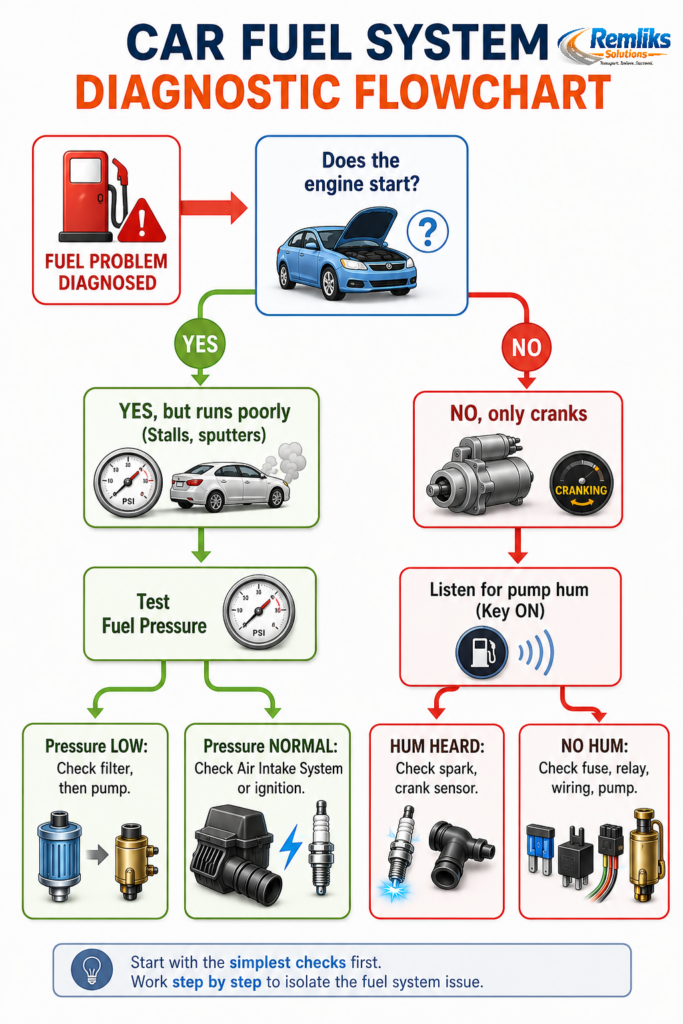
When a fuel issue arises, a systematic approach is necessary. Jumping to conclusions wastes money. Here is a logical troubleshooting path.
Turn the key to the “ON” position without starting the engine. Listen carefully near the fuel tank or the back seat. You should hear a low hum for about two seconds. If you hear nothing, check the fuel pump fuse and relay first.
If the pump makes noise but the car still runs poorly, connect a fuel pressure gauge to the Schrader valve on the fuel rail. Compare your reading to the vehicle’s service manual. If the pressure is low, the issue could be the pump, a clogged filter, or a bad pressure regulator.
Corroded or loose wiring can cause the pump to receive insufficient voltage. Before replacing the pump, inspect the electrical connector at the top of the fuel tank. A multimeter can verify if the pump is receiving the correct voltage (usually 12 volts).
Here is a troubleshooting mind map to help you visualize the diagnostic flow:
If your diagnostic tests confirm that the pump is dead, you will need a replacement. Choosing the right part is critical for safety and reliability.
| Option | Pros | Cons |
|---|---|---|
| OEM Pump | Perfect fit, reliable, meets factory specs | Higher price |
| High-Grade Aftermarket | Good balance of price and quality | Must verify brand reputation |
| Low-Cost Aftermarket | Very cheap | High failure rate, may leave you stranded |
Never compromise on safety. A failing low-cost pump can leak or stop working in dangerous traffic situations. Always read Product Reviews & Buying Guides before purchasing automotive parts.
Working with fuel is dangerous.
Gasoline vapor is highly explosive. If you are working near the fuel tank, disconnect the battery to prevent accidental sparks. Keep a fire extinguisher nearby. Never smoke or use open flames near fuel system repairs.
preserving the environment and avoiding harm is a key value. When replacing fuel pumps, you must dispose of the old fuel and contaminated parts properly. Do not pour fuel down drains or onto the ground. Take it to a certified recycling center.
If you are not comfortable working with flammable liquids or electrical wiring, please seek professional help. There is no shame in hiring a certified mechanic. Safety always comes first. You can learn more about identifying issues in our Troubleshooting Center.
To help you stay organized, we have created a practical checklist and a diagnostic chart for your convenience.
Use this list every few months to ensure your fuel system stays healthy.
| Symptom | Possible Cause | Immediate Action |
|---|---|---|
| Engine Sputters at High Speed | Weak fuel pump, clogged fuel filter | Replace filter; if problem persists, test pump pressure. |
| Vehicle Surges Forward | Failing pump relay, erratic pump motor | Check electrical relay; test pump voltage. |
| Loss of Power Going Uphill | Pump cannot meet high fuel demand | Verify fuel pressure under load. |
| Car Cranks but Will Not Start | Dead fuel pump, blown fuse, no fuel | Check fuses; listen for pump priming; add fuel if empty. |
| Whining Noise from Rear | Pump motor bearings wearing out | Plan for pump replacement soon to avoid breakdown. |
Q1: How long do fuel pumps usually last?
A: Electric fuel pumps generally last between 100,000 and 150,000 miles. However, frequent driving on a low tank can cause them to fail much earlier.
Q2: Can a bad fuel filter ruin a good fuel pump?
A: Yes. A clogged filter restricts flow. The pump must work harder and draw more electrical current to push fuel through the blockage. This extra stress overheats the pump and burns it out.
Q3: Is it safe to drive with a noisy fuel pump?
A: A loud whining noise usually means the pump’s internal bearings are failing. While the car may still drive, the pump could stop working at any time. It is best to replace it before it leaves you stranded.
Q4: Will using premium fuel make my fuel pump last longer?
A: Not necessarily. Premium fuel has a higher octane rating, which prevents engine knocking, but it does not clean the pump better than regular fuel. The key to pump longevity is keeping the tank full and using Top Tier detergent fuels to keep the system clean.
Q5: Are fuel pump problems different in diesel trucks?
A: Yes. Diesel engines use highly precise injection pumps and lift pumps. Diesel fuel also lubricates the pump internally. If a diesel truck runs out of fuel, the system needs to be bled of air before it will start again. Learn more in our Truck Systems section.
Fuel pumps are vital components that require respect and proper care. By understanding how they work, recognizing the signs of failure, and keeping up with routine maintenance, you can ensure your vehicle runs smoothly for years. Always remember to keep your fuel tank above a quarter full and replace your fuel filters on time.
When diagnosing problems, follow a logical, step-by-step process like Omar and Bilal. Never guess when it comes to fuel systems, and always prioritize safety. If you suspect a fuel pump issue and feel unsure, consult a trusted professional. Stay safe, maintain your vehicle responsibly, and enjoy a reliable driving experience.
