Physical Address
304 North Cardinal St.
Dorchester Center, MA 02124
Physical Address
304 North Cardinal St.
Dorchester Center, MA 02124

Disclaimer: This article is for general informational purposes only . Always consult a certified technician for specific vehicle issues.
Welcome to Remliks Solutions. Understanding how your vehicle runs can save you time and prevent unnecessary expenses. The ignition system components are the heart of your engine’s power generation. Without them, fuel cannot burn, and your car cannot move.
Throughout this guide, you may see Bilal and Omar discussing vehicle systems, maintenance procedures, and troubleshooting situations. They are fictional educational characters created by Remliks Solutions to help explain automotive and truck concepts in a practical and engaging way.
The ignition system is a highly coordinated network of parts. Its main job is to create a perfectly timed electric spark. This spark ignites the air-fuel mixture inside the engine’s combustion chamber.
When the system works correctly, your engine runs smoothly. However, when one part fails, the engine may misfire, lose power, or fail to start entirely. To understand this better, you can explore our Learning Center Automotive Fundamentals.
The system must do three specific things perfectly:
Modern cars rely on precise computers to manage this. Older cars used mechanical distributors. Today, we will focus on the three most critical elements: spark plugs, ignition coils, and ignition timing.
Spark plugs are small but mighty components. They screw directly into the engine cylinder head. Their tips sit inside the combustion chamber.
When high voltage reaches the spark plug, electricity jumps a small gap. This jump creates the spark that burns the fuel. Proper maintenance of these parts prevents many engine problems.
The spark plug has a center electrode and a ground electrode. High voltage travels down the center electrode. It jumps across a small gap to the ground electrode. This jumping electricity is the visible spark.
The gap size is very important. If the gap is too wide, the spark may be weak. If it is too narrow, the spark might be too small to ignite the fuel properly.
Drivers can choose from several types of spark plugs. Each type uses different metals for the electrodes.
1. Copper Spark Plugs
Copper plugs are the oldest design. They have a solid copper core. They conduct electricity very well. However, they wear out faster than other types. They usually need replacement every 30,000 miles.
2. Platinum Spark Plugs
Platinum plugs use a platinum disc on the tip. Platinum is harder than copper. Therefore, these plugs last longer. They often survive up to 60,000 miles. They are a good balance between cost and lifespan.
3. Iridium Spark Plugs
Iridium plugs are the most advanced. Iridium is an extremely hard and durable metal. These plugs can last over 100,000 miles. They require less voltage to create a spark. Most modern vehicles come with iridium plugs from the factory.
Table: Spark Plug Comparison
| Type | Material | Average Lifespan | Cost | Best For |
|---|---|---|---|---|
| Copper | Solid copper core | 30,000 miles | Low | Older vehicles |
| Platinum | Platinum tipping | 60,000 miles | Medium | Standard daily drivers |
| Iridium | Iridium tipping | 100,000+ miles | High | Modern, high-efficiency cars |
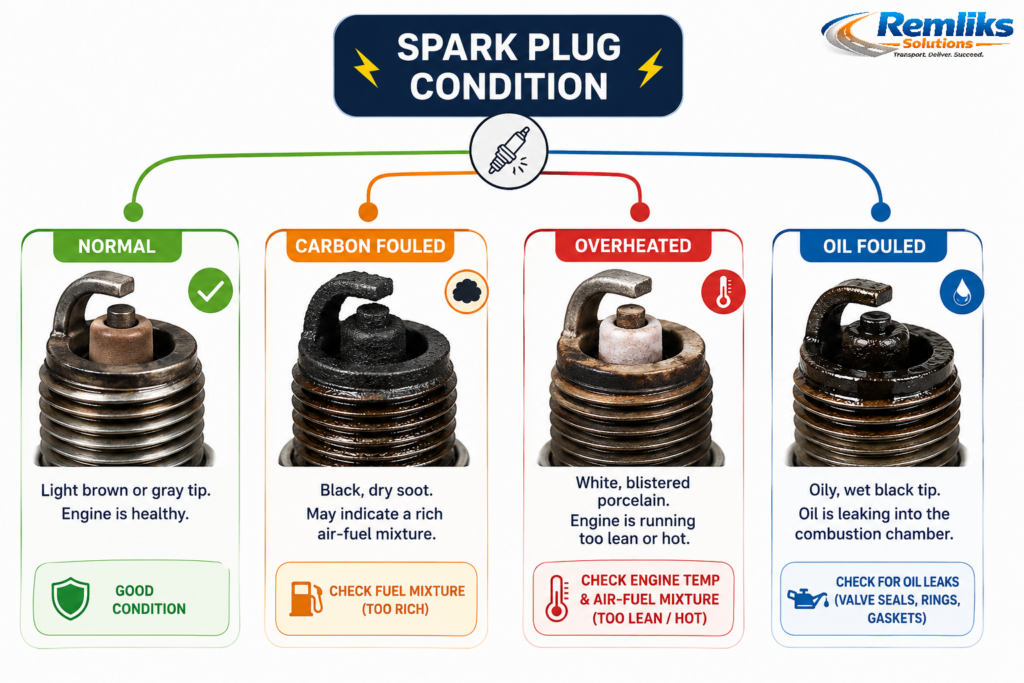
Experienced mechanics “read” spark plugs to diagnose engine problems. The color and condition of the plug tip tell a story. For example, a black, sooty plug means the engine is running rich. A white, blistered plug means the engine is running lean.
Spark Plug Condition Mind Map
Spark plugs need a massive amount of electricity to create a spark. However, a car battery only provides 12 volts. The ignition coil solves this problem. It transforms 12 volts into 10,000 to 40,000 volts.
The ignition coil acts as a step-up transformer. It uses the principle of electromagnetic induction. When low-voltage electricity flows through the primary winding, it creates a magnetic field. When this flow stops suddenly, the magnetic field collapses. This collapse generates a huge voltage spike in the secondary winding. That spike travels to the spark plug.
Car manufacturers use different designs to mount and connect coils.
1. Distributor Coil System
Older cars use a single, large ignition coil. A mechanical distributor spins and routes the high voltage to each spark plug wire in the correct firing order. This system has many moving parts that can wear out.
2. Coil Pack System
Many cars from the late 1990s and early 2000s use coil packs. A coil pack contains multiple coils in one unit. It fires two spark plugs simultaneously. This system is called a “wasted spark” system because one spark fires during the power stroke, and the other fires during the exhaust stroke.
3. Coil-on-Plug (COP) System
Most modern vehicles use the COP system. Here, one small ignition coil sits directly on top of each spark plug. This design removes the need for spark plug wires. It provides the strongest, most direct spark. It also allows the engine computer to monitor each cylinder individually.
Table: Ignition Coil System Comparison
| System Type | Number of Coils | Spark Plug Wires | Common Era | Pros & Cons |
|---|---|---|---|---|
| Distributor | 1 Central Coil | Yes | Pre-1990s | Simple, but high maintenance. Mechanical parts wear out. |
| Coil Pack | 1 Pack per 2 Cylinders | Yes | 1990s-2000s | Fewer moving parts. Wasted spark design. Wires still degrade. |
| Coil-on-Plug (COP) | 1 per Cylinder | No | Modern | Most efficient. Computer controlled. Expensive to replace all at once. |
Having a strong spark is not enough. The spark must happen at the exact right moment. This is called ignition timing.
The piston moves up and down in the cylinder. When the piston reaches the top of its stroke (Top Dead Center), the air-fuel mixture is highly compressed. The spark must fire slightly before the piston reaches the very top. This gives the burning fuel time to expand and push the piston down with maximum force.
If the spark fires too early, the expanding fuel fights the rising piston. This causes engine knock, which can damage pistons. If the spark fires too late, the fuel burns as the piston is already moving down. This wastes energy and reduces power.
Modern engines constantly adjust timing based on speed, load, and temperature. For more on how sensors help manage this, read our guide on the Mass Air Flow Sensor MAF.
Engine knock (or pinging) sounds like marbles in a tin can. It happens when fuel ignites unevenly or too early. Modern vehicles have knock sensors. When the sensor detects a knock, the engine computer retards (delays) the ignition timing to protect the engine.
Bilal: The engine cranks normally, but it does not start. I can smell unburned fuel at the exhaust. Where should we begin?
Omar: First, we should avoid guessing. An engine needs air, fuel, compression, and proper ignition timing. Let’s verify each requirement step by step. Since we smell fuel, the fuel delivery system is likely working.
Bilal: Why not replace the fuel pump immediately to ensure we have enough fuel pressure?
Omar: Because professional diagnostics rely on testing before replacing parts. Replacing good parts wastes money, which goes against our principle of avoiding waste (Israf). Instead, let’s test the ignition system components. We will check for spark at the plugs.
Bilal: How do we test the spark without fancy equipment?
Omar: We can use a calibrated spark tester. We plug it into the ignition coil and crank the engine. If there is no spark, we test the coil for power and ground. If the coil is good, we might have an issue with the engine speed sensor or the main computer.
Bilal: I see. So, testing the ignition system components first saves us from buying parts we do not need.
Omar: Exactly. Proper diagnosis is safe, responsible, and respectful of the resources we have.
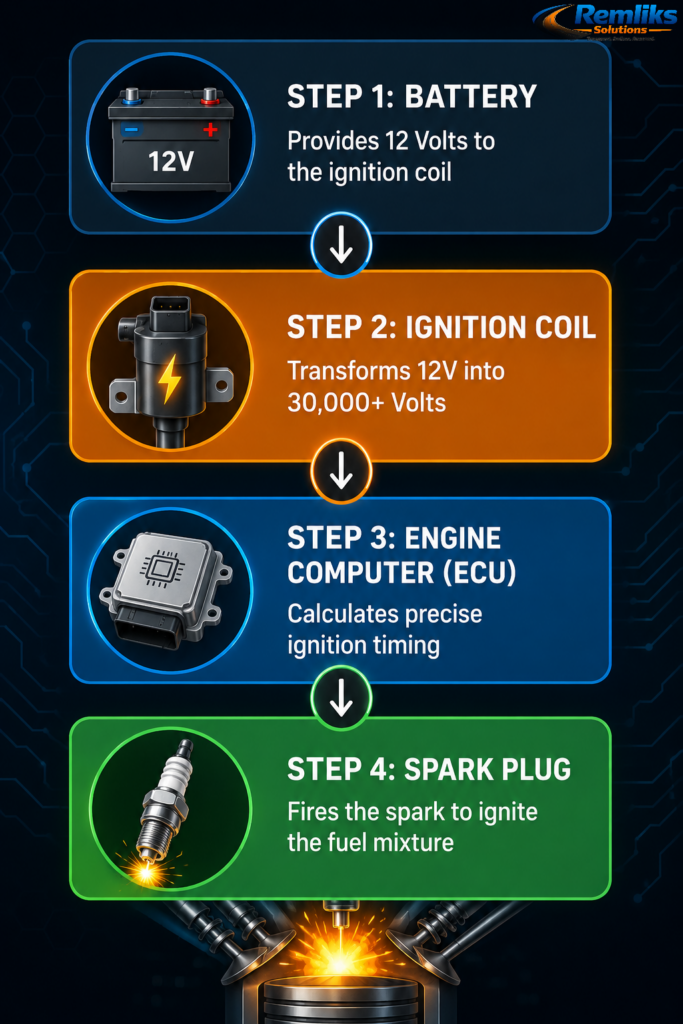
To help you visualize how these parts work together, here is a simple flow diagram of the ignition process.
Flexbox Layout: Ignition Process Flowchart
Ignition problems are common as vehicles age. Recognizing the symptoms early can prevent costly repairs. If you suspect issues, visit our Troubleshooting Center for more detailed guides.
1. Worn Spark Plugs
Over time, the electrodes burn away. The gap widens. This makes it harder for the coil to fire the spark.
2. Bad Ignition Coils
Heat and vibration damage the internal windings of the coil. A bad coil will not produce enough voltage.
3. Fouled Spark Plugs
Oil or carbon buildup blocks the spark. This is often a symptom of a deeper engine problem, like worn piston rings or a faulty Fuel Injector.
Taking care of your ignition system is simple. It requires following a routine schedule. Always consult your vehicle’s manual for exact intervals.
Do not wait for spark plugs to fail completely. Replace them according to mileage. Copper plugs need changing at 30,000 miles. Iridium plugs can go 100,000 miles. When replacing plugs, always use the type recommended by the manufacturer.
Ignition coils generally do not have a set replacement interval. You replace them when they fail. However, you can extend their life. Keep the engine clean. Fix oil leaks immediately. Oil degrades the rubber boots on Coil-on-Plug systems.
Older cars need manual timing adjustments using a timing light. Modern cars handle timing automatically. If your modern car has timing issues, a sensor is likely faulty.
When replacing parts, choose quality over price. Cheap spark plugs may not have the correct heat range. Cheap ignition coils may fail in a few months. Frame products as tools, not magic solutions. A premium iridium spark plug will not fix a burning oil problem. However, it will provide reliable service in a healthy engine.
Always weigh the pros and cons of any product. For example, expensive OEM (Original Equipment Manufacturer) coils fit perfectly but cost more. Aftermarket coils are cheaper but vary in quality. You can find reviews in our Product Reviews & Buying Guides.
Use this checklist to maintain your ignition system properly.
1. What are the main ignition system components?
The main parts are the spark plugs, ignition coils, and the engine computer (ECU) that controls the ignition timing. Spark plug wires are also present in older systems.
2. Can I drive with a bad ignition coil?
It is not recommended. Driving with a bad coil causes a misfire. Unburned fuel enters the exhaust system. This can overheat and damage the catalytic converter. It also reduces engine power and safety.
3. How often should I replace my spark plugs?
It depends on the plug type. Copper plugs need replacement every 30,000 miles. Platinum plugs last about 60,000 miles. Iridium plugs can last up to 100,000 miles or more. Check your owner’s manual.
4. Does cold weather affect ignition system components?
Yes. Cold weather makes the air denser. The engine requires a stronger spark to start. Weak spark plugs or coils may fail to ignite the dense mixture during a cold start.
5. What is a misfire code?
A misfire code (like P0301) means cylinder number 1 did not fire properly. The engine computer detected a drop in crankshaft speed for that specific cylinder. It usually points to a bad spark plug, coil, or fuel injector.
The ignition system components work together perfectly to power your vehicle. The battery provides power, the coil amplifies it, and the spark plug uses it to burn the fuel. Finally, the engine computer ensures the timing is perfect.
Maintaining these parts is simple. Follow your maintenance schedule. Test before you replace parts to avoid waste. By understanding these systems, you become a safer and more responsible vehicle owner. For more educational resources, visit our comprehensive Learning Center.
