Physical Address
304 North Cardinal St.
Dorchester Center, MA 02124
Physical Address
304 North Cardinal St.
Dorchester Center, MA 02124

Disclaimer: This article is for general information only. Consult a certified professional for any advice or repairs.
Have you ever wondered what actually happens to the fuel after you pump it into your car? The journey of gasoline or diesel from the gas tank to the exhaust pipe is called the fuel cycle. Understanding this process is the key to knowing why your vehicle runs smoothly, why it might stutter, and how to maintain it properly.
Throughout this guide, you may see Bilal and Omar discussing vehicle systems, maintenance procedures, and troubleshooting situations. They are fictional educational characters created by Remliks Solutions to help explain automotive and truck concepts in a practical and engaging way.
To make this journey easier to understand, we will follow two experienced mechanics.
Together, they will help us trace the fuel cycle step by step.
In simple terms, the fuel cycle is the complete path fuel takes to power your vehicle. It starts in the fuel tank and ends as exhaust gas out of the tailpipe. If any step in this cycle fails, your engine will not run correctly.
Let us look at a simple overview of the stages:
| Stage | Action | What Happens |
|---|---|---|
| 1. Storage | Holding | Fuel sits safely in the fuel tank. |
| 2. Delivery | Pumping | The fuel pump sends fuel toward the engine. |
| 3. Filtration | Cleaning | The fuel filter traps dirt and rust. |
| 4. Metering | Measuring | The ECU and injectors measure the exact amount of fuel needed. |
| 5. Combustion | Burning | Fuel mixes with air and burns to create power. |
| 6. Exhaust | Expelling | The leftover gases leave the engine. |
The journey begins in the fuel tank. The tank does more than just hold gas. It is carefully designed to prevent fires and manage vapors.
Modern fuel tanks are made of plastic or steel. They are shaped to fit safely under the vehicle. Inside the tank, there is a baffle. A baffle is a wall that stops the fuel from splashing around wildly when you drive.
Also, the tank handles fuel vapors. Gasoline evaporates easily. If those vapors escape into the air, they pollute the environment. Instead, the vapors flow into a charcoal canister. The canister stores the vapors and later sends them to the engine to be burned safely.
Bilal’s Tip: “Never run your car on an empty tank all the time. The fuel pump sits inside the tank. The cool fuel keeps the pump from overheating. Running on empty may shorten the pump’s life.”
Next, the fuel needs to reach the engine. This is the job of the fuel pump.
Most modern cars use an electric fuel pump. This pump is usually located inside the fuel tank. When you turn the key, the pump starts working. It pushes fuel through the fuel lines at high pressure.
Older cars with carburetors often use mechanical fuel pumps. These pumps are bolted to the engine. A rod inside the engine moves the pump up and down to pull fuel from the tank.
Scenario: The Stalling Car
Omar was driving a customer’s truck when it suddenly stalled at a traffic light. It would start again, but stall when he accelerated. Bilal connected a fuel pressure gauge. The pressure was very low. Omar checked the fuel filter, but it was clean. Bilal checked the fuel pump electrical circuit. It was fine. They realized the fuel pump was weak and could not keep up the pressure. They replaced the pump, and the truck ran perfectly again.
Fuel must be perfectly clean before it enters the engine. Even tiny bits of dirt can damage sensitive engine parts.
As fuel moves from the tank to the engine, it passes through the fuel filter. This filter catches rust, dirt, and debris. If the filter clogs, the fuel cannot flow. This causes the engine to lose power or stall.
There are two common types of fuel filters:
Omar’s Advice: “Change your inline fuel filter according to your owner’s manual. A clogged filter forces the fuel pump to work harder. This may cause the pump to fail early.”
Now the fuel is clean and under pressure. But how much fuel should enter the engine? This is called fuel metering.
The Engine Control Unit (ECU) is the brain of the car. It decides exactly how much fuel the engine needs. However, the ECU needs information first. It uses several sensors:
When the ECU knows how much fuel is needed, it commands the fuel injectors. A fuel injector is a small valve that opens and closes very fast. It sprays a fine mist of fuel into the engine. This mist mixes perfectly with the air.
Older cars used carburetors to mix fuel and air. However, modern vehicles use electronic fuel injection (EFI) because it is more precise and efficient.
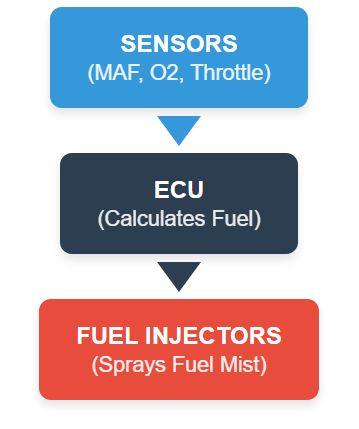
Mind Map: How the ECU controls the fuel cycle
This is where the real power is made. The fuel and air mixture is now inside the engine cylinder.
Most car engines use the four-stroke combustion cycle. Let us look at what happens inside one cylinder:
| Stroke | Piston Movement | Valves | Action |
|---|---|---|---|
| Intake | Down | Intake Open | Fuel/Air enters |
| Compression | Up | Both Closed | Mixture is squeezed |
| Power | Down | Both Closed | Spark fires, pushes piston |
| Exhaust | Up | Exhaust Open | Burned gas leaves |
Table: The Four-Stroke Combustion Cycle
Bilal’s Note: “The timing of the spark is critical. If the spark fires too early or too late, the engine will knock or lose power. The ECU constantly adjusts the ignition timing for the best performance.”
After the power stroke, the fuel has done its job. However, the leftover gas is not clean. It contains harmful chemicals like carbon monoxide, nitrogen oxides, and unburned hydrocarbons.
Before the exhaust gas leaves the tailpipe, it passes through the catalytic converter. This device looks like a small muffler. Inside, it contains precious metals like platinum, palladium, and rhodium. These metals create a chemical reaction. They change the harmful gases into safer emissions, like water vapor, carbon dioxide, and nitrogen.
Remember the charcoal canister from the fuel tank? That is part of the Evaporative Emission Control (EVAP) system. When the engine is running, the ECU opens a valve. This allows the engine to suck the stored fuel vapors from the charcoal canister and burn them. This ensures no raw fuel vapor escapes into the atmosphere.
Even with the best care, parts of the fuel cycle can fail. Here are some common issues Bilal and Omar see in their shop:
Over time, carbon deposits can build up on the injector nozzles. This stops the injector from spraying a fine, even mist. Instead, it might spray a solid stream. This causes the engine to run poorly, idle roughly, or misfire.
Solution: Using a high-quality fuel system cleaner in your gas tank may help clean light deposits. For severe clogs, a professional cleaning service is required.
Fuel pumps work hard. They can wear out, especially if you frequently drive on a low tank. A failing pump cannot maintain the correct pressure. The engine may hesitate during acceleration, or it might not start at all.
Solution: A mechanic must test the fuel pressure to confirm a bad pump. Replacing the pump is the only fix.
The MAF sensor sits in the air intake. If it gets dirty, it sends wrong information to the ECU. The ECU might add too much fuel, causing poor gas mileage and a rough idle.
Solution: A specialized MAF sensor cleaner can gently remove dirt. Never use regular brake cleaner on a MAF sensor, as it may damage the delicate wires.
O2 sensors sit in the exhaust. They live in a very harsh environment. When they fail, the ECU goes into “open loop” mode. It guesses the fuel amount instead of using real data. This wastes fuel and increases emissions.
Solution: A scan tool will show an O2 sensor error code. Replacing the sensor is usually straightforward.
Scenario: The Failed Emissions Test
A customer brought in a car that failed the state emissions test. Bilal hooked up the OBD2 scanner. It showed a code for a slow O2 sensor. Omar inspected the sensor and saw it was original and very old. They replaced the sensor, and Bilal reset the monitors. The car passed the retest easily.
So far, we have discussed gasoline engines. However, diesel engines power many trucks and some cars. How is their fuel cycle different?
| Feature | ⛽ Gasoline Engine | 🛢️ Diesel Engine |
|---|---|---|
| Ignition | Uses Spark Plugs | Uses Compression Heat |
| Fuel Mixing | Mixes with air before entering cylinder | Injected directly into compressed air |
| Fuel Type | Gasoline (highly volatile) | Diesel (less volatile, more oily) |
| Pressure | Lower fuel pressure | Extremely high fuel pressure |
Table: Gasoline vs. Diesel Fuel Cycle
In a diesel engine, there are no spark plugs. Instead, the piston squeezes the air so much that it becomes incredibly hot. Then, the fuel injector sprays diesel directly into this hot air. The heat ignites the fuel instantly. This process requires very high fuel pressure, often thousands of PSI.
Taking care of your fuel system is much cheaper than repairing it. Here are some practical tips to keep the fuel cycle running smoothly:
The automotive world is always changing. Engineers are constantly improving the fuel cycle to meet USA safety and emissions standards.
Modern gasoline engines often use Gasoline Direct Injection (GDI). In older systems, fuel was injected into the intake manifold, just outside the cylinder. In GDI systems, the injector sprays fuel directly into the cylinder, just like a diesel engine. This allows for much more precise fuel control, better fuel economy, and more power. However, GDI engines can suffer from carbon buildup on the intake valves because fuel no longer washes over them.
Some engines can shut down half of their cylinders when you are cruising on the highway. The ECU stops the fuel injectors and valves for those cylinders. This saves a lot of fuel. When you step on the gas pedal, the cylinders instantly wake up to provide full power.
If you suspect your vehicle has a fuel problem, do not guess. Diagnosing the issue properly saves time and money.
The first step is always to plug in an OBD2 scanner. Modern vehicles will often set a code if a fuel system sensor is out of range. (You can learn more about this in our Diagnostic & Scan Tools section).
When you turn the key to the “on” position (before starting the engine), you should hear a low hum from the back of the car for about two seconds. This is the fuel pump priming the system. If you hear nothing, the pump might be dead, or a fuse might be blown.
Connecting a fuel pressure gauge to the fuel rail is the best way to test the pump and filter. If the pressure is below the manufacturer’s specification, the engine will not run right. (Visit our Automotive Tools & Equipment section for pressure gauge recommendations).
A mechanic can use a tool called a “noid light” to check if the injectors are receiving an electrical signal. They can also listen to each injector with a stethoscope. A healthy injector makes a sharp, consistent ticking sound.
Bilal’s Diagnostic Rule: “Never assume the worst. A rough running engine is not always a bad fuel pump. It could be a $10 vacuum leak or a dirty sensor. Test before you replace parts.”
Burning fossil fuels affects the environment. However, the modern fuel cycle is designed to minimize this impact.
The EVAP system ensures raw fuel vapors do not escape into the atmosphere. When a gas cap is loose or faulty, the EVAP system fails, and vapors leak out. This triggers a check engine light. Always make sure your gas cap clicks when you tighten it.
By precisely controlling the air-fuel ratio (14.7 parts air to 1 part fuel for gasoline), modern engines burn fuel more completely. This reduces the amount of unburned hydrocarbons leaving the tailpipe.
Use this simple checklist to monitor your vehicle’s fuel health:
If you put diesel in a gasoline car, or gasoline in a diesel car, do not start the engine. Starting the engine circulates the wrong fuel through the entire fuel cycle. This can cause severe damage. Call a tow truck and have a mechanic drain the tank and fuel lines.
It depends on the vehicle. Some manufacturers recommend every 30,000 miles. Others claim the filter lasts the life of the car. Check your owner’s manual for the exact interval. If you drive in dusty areas, change it more frequently.
Yes. If the engine runs too “lean” (not enough fuel), it can run very hot. This may cause engine knocking and internal damage. If it runs too “rich” (too much fuel), it can wash the lubricating oil off the cylinder walls, causing premature wear. It can also ruin the catalytic converter.
Yes. Cold fuel does not vaporize as easily. To compensate, the ECU adds more fuel during a cold start. This is why engines run rich (use more fuel) on cold mornings until they warm up. This process is managed by the Engine Coolant Temperature (ECT) sensor.
They are not strictly necessary if you use high-quality Top Tier gasoline, which already contains detergents. However, if you use standard fuel, a periodic fuel injector cleaner may help prevent carbon buildup. Remember, additives are tools, not magic fixes. They may help maintain a clean system, but they cannot fix broken parts.
The fuel cycle is a remarkable journey. It transforms a liquid into a powerful force that moves your vehicle. From the safe storage in the tank, through the high-pressure pump and filter, to the precise injection and explosive combustion, every step must work in harmony.
By understanding how this system works, you can better maintain your vehicle. You can spot early warning signs, communicate clearly with your mechanic, and avoid costly repairs. Whether you are driving a small sedan or a heavy diesel truck like Omar and Bilal, respecting the fuel cycle is essential for safe and reliable driving.
For more information on engine components and maintenance, visit our learning center category and Maintenance Guides sections.
