Physical Address
304 North Cardinal St.
Dorchester Center, MA 02124
Physical Address
304 North Cardinal St.
Dorchester Center, MA 02124

Disclaimer: The information provided in this article is for general educational purposes only. It is not intended as professional mechanical advice. Always consult a qualified technician for specific vehicle repairs and follow your vehicle manufacturer’s guidelines and relevant USA safety standards.
Have you ever wondered what happens when you turn the key or press the start button? Understanding vehicle systems is the first step toward becoming a more responsible and informed driver. When you know how the different parts of a car work together, you can make better maintenance choices. Also, you may save money by avoiding unnecessary repairs.
Throughout this guide, you may see Bilal and Omar discussing vehicle systems, maintenance procedures, and troubleshooting situations. They are fictional educational characters created by Remliks Solutions to help explain automotive and truck concepts in a practical and engaging way.
In this article, we will explore the main systems inside your vehicle. We will look at how they function, why they matter, and how they connect. Whether you are a complete beginner or someone looking to refresh your knowledge, this guide will walk you through the basics step by step.
Knowing how your car works is not just for mechanics. It is useful for everyday drivers. When you hear a strange noise or see a warning light, basic knowledge helps you stay calm. Instead of guessing, you can understand what might be wrong.
Safety is the most important reason to learn about your car. Vehicles are heavy machines that travel at high speeds. They rely on many systems working perfectly to keep you safe. When you understand these systems, you are more likely to notice small problems before they become big ones.
For example, knowing how the brake system works reminds you to check your brake fluid. Regular checks may help prevent brake failure. Also, understanding the cooling system helps you see why driving with a broken radiator fan is a bad idea.
When you do not know how your car works, you might feel lost at the repair shop. However, when you understand the basics, you can talk to your mechanic with confidence. You can ask better questions. You can also make informed decisions about which services you actually need.
Learning about your vehicle systems does not mean you must fix everything yourself. Instead, it means you understand the value of the work being done. This knowledge protects you from paying for parts or services that your car does not need.
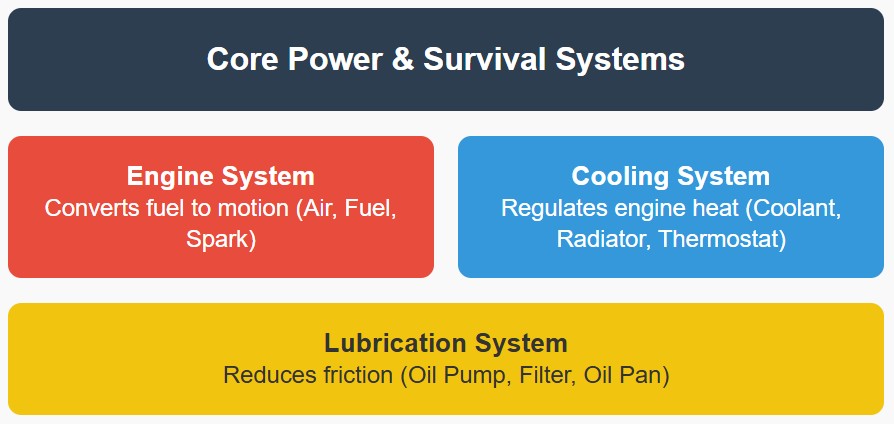
A vehicle is like a human body. It has a “heart” (the engine), “lungs” (the air intake), and “blood” (fluids). When understanding vehicle systems, it helps to group them by what they do. Let us look at the core systems that generate power and keep the engine running.
The engine converts fuel into motion. In most cars, this happens through internal combustion. Inside the engine, fuel and air mix together. Then, a spark plug ignites this mixture. The explosion pushes a piston down, which turns a crankshaft. This turning force is called torque.
Omar and Bilal Workshop Scenario
Bilal: I hear people talk about the “four-stroke cycle.” What does that actually mean?
Omar: It refers to the four steps the piston takes to create power: Intake, Compression, Power, and Exhaust. During Intake, the piston moves down and pulls in air and fuel. Then, it moves up to Compress the mixture. The spark plug fires during the Power stroke, pushing the piston down forcefully. Finally, the piston moves up again to push out the exhaust gases. This cycle repeats thousands of times per minute.
Bilal: So, if one of those strokes fails, the engine stops running?
Omar: Exactly. For example, if the fuel system fails to deliver fuel, the Intake stroke pulls in only air. Without fuel, there is no combustion, and the engine will not start. This is why proper diagnostics are so important before replacing parts.
The engine relies on several sub-systems. The air intake system brings in clean air. The fuel system delivers the right amount of gasoline or diesel. The ignition system provides the spark at the exact right time.
Engines generate a lot of heat. If this heat builds up too much, the metal parts can melt or warp. The cooling system keeps the engine at a safe operating temperature, usually around 195 to 220 degrees Fahrenheit.
Most modern cars use a liquid-cooled system. A water pump pushes a mixture of water and antifreeze (coolant) through channels inside the engine. The coolant absorbs heat. Then, it flows to the radiator at the front of the car. Air flowing through the radiator cools the fluid before it goes back into the engine.
A thermostat controls this flow. When the engine is cold, the thermostat stays closed so the engine warms up quickly. When it reaches the right temperature, the thermostat opens, allowing coolant to flow to the radiator.
Metal parts moving against each other create friction. Friction causes wear and more heat. The lubrication system solves this problem by pumping engine oil to all the moving parts. Oil creates a thin film between metal surfaces. This prevents them from touching directly.
The oil pump pulls oil from the oil pan at the bottom of the engine. It pushes the oil through a filter to remove dirt and metal shavings. Then, the oil travels through tiny passages to the crankshaft, camshaft, and pistons.
Checking your oil level regularly is a simple but vital task. Low oil levels may lead to severe engine damage over time. Always use the oil type recommended by your vehicle’s manufacturer.
The engine creates rotational power, but that power must reach the wheels. This is the job of the transmission and drivetrain. Without these systems, your engine would just spin loudly while the car sits still.
The transmission acts as a gear reducer. Engines run most efficiently at certain speeds (RPMs). The transmission lets the engine stay in its best range while the car speeds up or slows down. It does this by changing gear ratios.
There are two main types of transmissions: manual and automatic.
| Feature | Manual Transmission | Automatic Transmission |
|---|---|---|
| Operation | Driver uses a clutch pedal and gear stick. | Vehicle shifts gears automatically using fluid pressure or computers. |
| Pros | Often costs less to repair. Gives driver direct control over gear selection. | Easier to drive in heavy traffic. Smooth shifting without driver input. |
| Cons | Requires more driver skill and attention. Can be tiring in stop-and-go traffic. | Typically more expensive to buy and repair. May slightly reduce fuel economy in older models. |
| Best For | Drivers who want an engaged, hands-on driving experience. | Daily commuting, city driving, and those seeking convenience. |
After the transmission, the drivetrain sends the power to the wheels. In a front-wheel-drive car, this is simple. The transmission connects directly to the front wheels. In a rear-wheel-drive car, a long metal tube called a driveshaft connects the transmission to the rear axle. Four-wheel-drive vehicles have extra components to send power to all four wheels.
Moving fast is useless if you cannot steer or stop. The brake system and the suspension and steering systems are directly responsible for your safety on the road.
The brake system uses friction to slow down or stop the vehicle. When you press the brake pedal, you push a plunger inside a master cylinder. This forces brake fluid through thin pipes to the brakes at each wheel.
Most modern cars use disc brakes. A caliper squeezes a brake pad against a spinning metal disc (the rotor). This friction slows the wheel down. Some cars still use drum brakes on the rear wheels, where shoes push outward against the inside of a drum.
Omar and Bilal Workshop Scenario
Bilal: I was reading about ABS. What does it actually do, and is it just for icy roads?
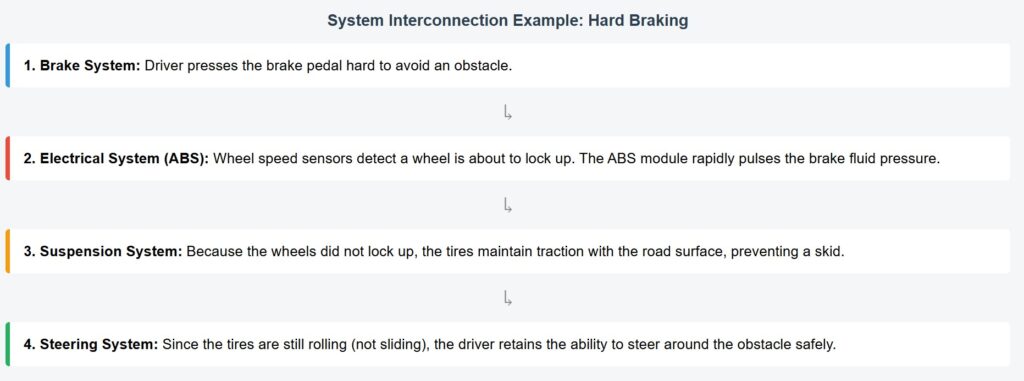
Omar: ABS stands for Anti-lock Braking System. It is a safety feature that prevents the wheels from locking up when you brake hard. If a wheel locks up, it stops rolling and starts sliding. A sliding tire cannot steer, and it takes longer to stop.
Bilal: How does the system know when a wheel is about to lock?
Omar: Each wheel has a speed sensor. If the sensor detects that a wheel is decelerating much faster than the others, the ABS control module rapidly pulses the brake pressure to that specific wheel. You might feel a pulsing vibration in the brake pedal when this happens. That is the system working correctly. It helps you maintain steering control while braking, which is useful on dry pavement as well as wet or icy surfaces.
The suspension system does two main jobs. First, it keeps the tires firmly on the road so you have traction. Second, it absorbs bumps in the road so you do not feel every small crack.
The suspension uses springs to support the weight of the car and absorb large bumps. It also uses shock absorbers (or struts) to control how quickly the springs compress and expand. Without shock absorbers, the car would bounce up and down uncontrollably after hitting a bump.
The steering system lets you direct the car. Most modern cars use power steering. A hydraulic pump or an electric motor assists your turning effort. This makes it easy to turn the steering wheel, even when the car is moving slowly or stopped.

Modern vehicles are highly electronic. The electrical system powers everything from the headlights to the engine control unit. Meanwhile, the HVAC system keeps the cabin comfortable in all weather conditions.
The electrical system has three main parts: the battery, the alternator, and the starter motor.
The battery provides the initial electrical push to start the engine. Once the engine is running, the alternator takes over. The alternator uses the engine’s mechanical power to generate electricity. It recharges the battery and powers all the electrical systems while you drive. The starter motor is a powerful electric motor that turns the engine over until it starts on its own.
Vehicles also have a complex network of sensors. Sensors measure things like engine temperature, oxygen in the exhaust, and wheel speed. They send this data to the Engine Control Module (ECM). The ECM is the computer brain of the car. It adjusts the fuel mixture and ignition timing based on sensor data to keep the engine running efficiently.
HVAC stands for Heating, Ventilation, and Air Conditioning. This system controls the temperature and air quality inside the cabin.
For heating, the system uses hot coolant from the engine. A small radiator called a heater core transfers heat from the coolant to the air blown into the cabin.
For air conditioning, a compressor pumps a special refrigerant gas. The system compresses the gas, which makes it hot. Then, it passes through a condenser at the front of the car to cool it down into a liquid. As this liquid evaporates inside the car, it absorbs heat from the cabin air, making the air cold.
The ventilation part uses a blower motor to push air through filters and ducts into the cabin. Replacing the cabin air filter regularly helps keep the air clean and free of dust and pollen.
Understanding vehicle systems means seeing how they connect. A car is not just a collection of separate parts. It is a highly integrated machine. When one system has a problem, it often affects other systems.
For example, consider the engine and the cooling system. If the cooling system fails, the engine overheats. The engine computer (electrical system) detects this high temperature. To protect the engine, the computer may cut power or shut the engine down entirely.
Another example is the electrical system and the transmission. Modern automatic transmissions rely on electrical solenoids to shift gears. If a speed sensor fails, the transmission may not know when to shift. It might get stuck in one gear, causing poor fuel economy and rough driving.
In the past, mechanics relied mostly on their senses. They listened for knocks, smelled for burnt fluids, and looked for smoke. Today, understanding vehicle systems heavily involves electronic diagnostics.
Since 1996, all cars sold in the USA must have an On-Board Diagnostics II (OBD2) system. This system constantly monitors the vehicle’s sensors and systems. If it detects a problem that could increase emissions, it saves a diagnostic trouble code (DTC) and turns on the “Check Engine” light.
You can read these codes using an OBD2 scan tool. This tool plugs into a port under the steering wheel. It talks to the car’s computer and displays the codes.
Omar and Bilal Workshop Scenario
Bilal: If I plug in a scan tool and it gives me a code, can I just replace the part the code names?
Omar: That is a common mistake. A code tells you which system has a problem, or which sensor is reporting out-of-range data. It rarely tells you exactly which part to replace. For example, a code for “P0171 System Too Lean” means the engine is getting too much air or not enough fuel. The cause could be a vacuum leak, a bad mass airflow sensor, or a weak fuel pump. You must test the system to find the actual cause before buying parts.
Bilal: So the scan tool is a starting point, not a final answer?
Omar: Exactly. It points you in the right direction. Professional technicians use the code as a roadmap, then perform electrical and mechanical tests to confirm the diagnosis. This approach saves time and money.
While scan tools read computer data, other tools test physical components. A digital multimeter measures voltage, resistance, and current. This tool is essential for diagnosing electrical system problems, like checking if a battery is holding a charge or if a wire is broken.
Other specialty tools include compression testers for the engine, fuel pressure gauges for the fuel system, and vacuum pumps for testing sensors. These tools help confirm what the computer codes suggest.
Regular inspections help you catch problems early. Here is a simple checklist you can follow once a month. Remember, this is for general information. Always refer to your owner’s manual for specific intervals and procedures.
1. What is the most important vehicle system to maintain?
All systems are important because they rely on each other. However, regular engine oil changes are often considered the most critical maintenance task. Oil lubricates moving parts and prevents severe engine damage.
2. Can a bad sensor stop my car from starting?
Yes. For example, the crankshaft position sensor tells the engine computer when to fire the spark plugs and fuel injectors. If this sensor fails completely, the engine will crank but will not start.
3. How do I know if my alternator is failing?
Common signs include dimming headlights, a dead battery (even after jumping), or a battery warning light on the dashboard. A failing alternator cannot recharge the battery while the car is running.
4. Is it safe to drive with the Check Engine light on?
It depends. If the light is solid and the car is driving normally, it may be a minor emissions issue. However, if the light is flashing, the engine is misfiring. Driving with a flashing light can damage the catalytic converter. It is best to have the codes read by a professional as soon as possible.
5. Why does my car pull to one side when I brake?
This usually indicates a problem with the brake system or suspension. One brake caliper may be stuck, causing that side to brake harder than the other. Alternatively, uneven tire pressure, a worn suspension component, or poor wheel alignment can cause pulling. Have a technician inspect the vehicle to ensure safe braking.
Understanding vehicle systems takes time, but it starts with basic concepts. Every car relies on the engine for power, the cooling and lubrication systems to keep the engine alive, and the transmission to move that power to the wheels. The brakes and suspension keep you safe, while the electrical and HVAC systems provide control and comfort.
When you view your car as a collection of connected systems, maintenance makes more sense. You understand why ignoring a small fluid leak can lead to bigger problems. You also see why professional diagnostics are so valuable. Tools like OBD2 scan tools and multimeters are helpful, but they require knowledge to use correctly.
By learning these basics, you become a more responsible vehicle owner. You can communicate better with repair shops, prioritize maintenance tasks, and enjoy a safer driving experience. Always remember to consult qualified professionals for complex repairs and adhere to your vehicle’s specific service manual.
