Physical Address
304 North Cardinal St.
Dorchester Center, MA 02124
Physical Address
304 North Cardinal St.
Dorchester Center, MA 02124

Disclaimer: This article is for general information only. Always consult a professional mechanic for specific automotive issues. Products mentioned are optional tools, not guaranteed fixes.
Building your first automotive toolkit is an exciting step. However, walking into an auto parts store can feel overwhelming because of the endless rows of equipment. If you are looking for the essential tools for beginners, you need a clear, honest guide that separates the “must-haves” from the “nice-to-haves.”
Throughout this guide, you may see Bilal and Omar discussing vehicle systems, maintenance procedures, and troubleshooting situations. They are fictional educational characters created by Remliks Solutions to help explain automotive and truck concepts in a practical and engaging way
Omar and Bilal are two experienced mechanics who have seen it all. Omar is the calm, methodical expert who insists on safety and doing things the right way. Bilal is the practical problem-solver who knows how to get the job done efficiently without wasting money. Together, they will help you understand exactly what belongs in your garage.(Omar and Bilal are fictional characters to help you understand in engaging way )
In this complete guide, we will break down the tools you need, explain how they work, and help you build a garage that is safe, organized, and ready for basic maintenance and troubleshooting.
Having the right tools is not just about making the job easier; it is about safety and respect for the machine. A stripped bolt or a slipping wrench can turn a simple oil change into a costly repair.
Bilal remembers his early days: “I once tried to remove a stubborn oil drain plug using regular pliers. I rounded off the bolt, and oil went everywhere. It took me three hours to fix a five-minute job.”
Omar nods in agreement. “A mechanic is only as good as their tools. But that does not mean buying the most expensive items. It means buying the right items and maintaining them well.” In Islamic tradition, we are taught to avoid waste (israf) and to act with responsibility. Buying tools you will never use is wasteful. Buying cheap tools that break and cause damage is irresponsible. We aim for balance.
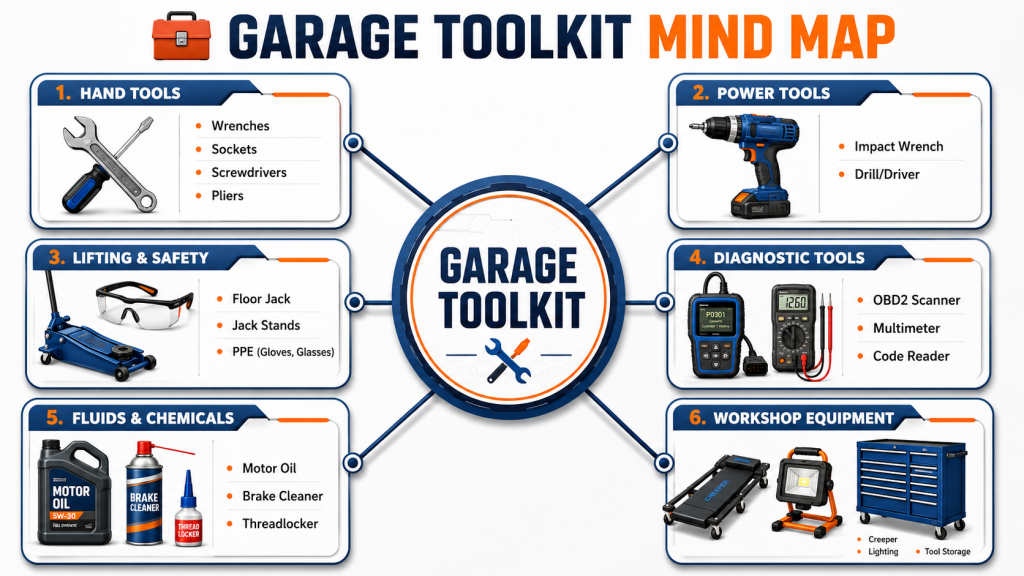
Before diving into the details, it helps to visualize how your garage toolkit is organized. Below is a simple mind map to help you understand the structure of a beginner’s garage.
| 🧰 Garage Toolkit Mind Map | . | . |
|---|---|---|
| 1. Hand Tools – Wrenches – Sockets – Screwdrivers – Pliers | 2. Power Tools – Impact Wrench – Drill/Driver | 3. Lifting & Safety – Floor Jack – Jack Stands – PPE (Gloves, Glasses) |
| 4. Diagnostic Tools – OBD2 Scanner – Multimeter – Code Reader | 5. Fluids & Chemicals – Motor Oil – Brake Cleaner – Threadlocker | 6. Workshop Equipment – Creeper – Lighting – Tool Storage |
Hand tools are the foundation of automotive work. They do not require electricity, and they give you the feel and control needed for delicate components. When you are shopping for essential tools for beginners, start here.
Wrenches and sockets do the same job—turning bolts and nuts—but they do it differently. You need both.
Combination Wrenches
These have an open end on one side and a closed (box) end on the other. The box end grips the bolt tightly and is less likely to slip.
Socket Sets
A socket set includes a ratchet handle and interchangeable sockets. This is the fastest way to remove or tighten bolts.
| Socket Type | Best Use Case | Beginner Necessity |
|---|---|---|
| Shallow Socket | Standard bolts in open areas | Must Have |
| Deep Socket | Bolts on studs or recessed areas | Must Have |
| Spark Plug Socket | Removing spark plugs | Highly Recommended |
Screwdrivers
You need a basic set of flathead and Phillips head screwdrivers. Avoid huge sets with 50 bits you will never use. A simple 6-piece set covers 90% of automotive needs.
Pliers
Pliers grip, cut, and bend.
Never use a steel hammer directly on car parts; you will damage them. Instead, use a rubber mallet or a dead-blow hammer. These deliver force without leaving dents. This is useful for loosening stuck brake rotors.
Hand tools are great for control, but power tools save time. When you are dealing with tight lug nuts or rusted bolts, power tools are essential tools for beginners who want to work efficiently.
An impact wrench uses sudden, rotational bursts of power to loosen bolts that a human hand cannot.
A standard power drill is useful for the garage, even if not directly for the car. You will use it to assemble workshop equipment, mix fluids, or clean parts with wire brush attachments.
Safety is not a suggestion; it is an obligation. Working under a vehicle is dangerous if done incorrectly. No repair is worth risking your life.
Floor Jack
A floor jack is a wheeled device with a long handle. You pump the handle to lift the car. Ensure the jack has a weight capacity that exceeds your vehicle’s weight.
Jack Stands
Never get under a car supported only by a floor jack. Floor jacks can fail. Jack stands are solid metal supports that lock in place.
These are wedges you place against the wheels on the opposite end of the car you are lifting. They prevent the car from rolling. Always use them.
| PPE Item | Purpose | When to Use |
|---|---|---|
| Safety Glasses | Protects eyes from debris, fluids | Always under the car or drilling |
| Mechanic Gloves | Protects hands from sharp edges and chemicals | Most repairs (remove for fine work) |
| Hearing Protection | Prevents damage from loud impact tools | Using air tools or impact wrenches |
| Fire Extinguisher | Puts out small electrical or fluid fires | Must be easily accessible at all times |
Modern cars are computers on wheels. You cannot rely only on your senses; you need tools that speak the car’s language.
OBD2 stands for On-Board Diagnostics (second generation). Every car sold in the USA after 1996 has an OBD2 port. When a warning light appears on your dashboard (like the Check Engine Light), the car stores a code.
A basic OBD2 scanner plugs into this port (usually under the steering wheel) and reads the code.
For a deeper dive into codes, you can visit the warning-lights-error-codes section of our Learning Center.
Electricity can be invisible and confusing. A digital multimeter measures voltage, current, and resistance. If your car’s battery is dead, or a sensor is not sending a signal, a multimeter helps you track down the issue.
Cars need fluids to survive. Keeping basic chemicals on hand is a core part of being a responsible car owner.
A clean, organized garage is a safe garage. Chaos leads to lost tools and accidents.
Mechanic’s Creeper
Lying on cold concrete is bad for your back and makes it hard to slide under a car. A creeper is a low platform with wheels. It keeps you off the floor and allows smooth movement.
Workbench
You need a solid surface to lay out parts, use a vise, or charge your power tools. A simple wooden or metal workbench is fine.
Drop Light / Headlamp
Garages are dark, and car parts cast shadows. A bright LED drop light or a headlamp keeps your hands free while illuminating the work area. Bilal never starts a job without his headlamp. “I can’t fix what I can’t see,” he says.
Tool Storage
A toolbox with drawers keeps your tools clean and organized. When a tool is missing, you will notice immediately. This prevents the nightmare of leaving a wrench inside the engine bay, which can cause severe damage when you start the car.
To understand how these tools work together, let us look at a scenario.
The Problem: Bilal notices his car is pulling to the left when he brakes, and he hears a squealing noise from the right front wheel. He suspects a brake issue.
The Process:
Omar checks Bilal’s work. “Clean, safe, and precise. That is how it should be done,” Omar says with a smile.
When shopping for essential tools for beginners, you will face a choice: buy a large pre-packaged tool set, or buy individual pieces.
| Factor | Tool Sets (Pre-packaged) | Individual Tools |
|---|---|---|
| Cost | Usually cheaper per tool | More expensive per tool |
| Quality | Varies; often includes filler pieces you won’t use | You control the quality of each piece |
| Customization | None; fixed contents | 100% customizable to your car |
| Replacement | Often hard to replace a single broken piece | Easy to swap out or upgrade one tool |
Our Recommendation: Start with a high-quality 3/8-inch socket and ratchet set (metric), a good combination wrench set (metric), and a reliable screwdriver set. Buy these individually or in small, focused sets. Avoid the massive 300-piece kits that are filled with low-quality bits you will never use. Over time, add individual specialty tools as you need them.
Tools are an investment. Taking care of them is a sign of respect for your craft and prevents waste.
Use this checklist to build your garage step by step. Do not buy everything at once. Start with the hand tools, and grow from there.
1. Do I really need an impact wrench, or can I just use a long breaker bar?
A long breaker bar (a long, non-ratcheting handle for sockets) gives you leverage to loosen tight bolts by hand. It is a great, inexpensive tool. However, an impact wrench makes the job much faster and requires less physical effort. If you are on a strict budget, buy a breaker bar first, and save up for the impact wrench.
2. What is the difference between SAE and Metric tools?
SAE (Society of Automotive Engineers) tools are measured in inches (like 1/2 inch). Metric tools are measured in millimeters (like 13mm). Most modern cars use metric fasteners. However, some older domestic (USA) cars or certain aftermarket parts may use SAE. As a beginner, prioritize a metric set, but a small SAE set is also good to have.
3. How much should I spend on my first tool set?
Quality matters, but you do not need professional-grade tools costing thousands of dollars. Mid-range brands (like DeWalt, Craftsman, or GearWrench) offer great value. Expect to spend between $200 and $400 to get a solid foundation of hand tools, a jack, and stands.
4. Are cheap, generic tools safe to use?
Be very careful. A cheap socket that shatters under pressure can cause severe injury. While you do not need the most expensive tools, avoid the lowest-priced options that feel light or poorly machined. Look for tools that meet ANSI standards, as this ensures a basic level of quality and safety testing.
5. Can I use an impact wrench to tighten my lug nuts?
You can use an impact wrench to snug the lug nuts initially, but you must never use it to fully tighten them. Impact wrenches can over-tighten lug nuts, which can warp your brake rotors or make it impossible to remove the tire later. Always finish tightening lug nuts with a torque wrench set to the vehicle’s exact specification.
6. Why do I need a multimeter if I don’t work on the electrical system?
Many common car problems are electrical or sensor-related. A multimeter helps you check if your battery is truly dead, if an alternator is charging, or if a fuse is blown. It saves you from guessing and replacing parts that are not broken.
7. Where is the OBD2 port located in my car?
In most vehicles, the OBD2 port is located under the dashboard on the driver’s side. It is usually above the brake pedal or near the steering column. It is a 16-pin, D-shaped connector.
Gathering the essential tools for beginners is a journey, not a race. Start with the basics: a good socket set, wrenches, safe lifting equipment, and a basic OBD2 scanner. As you perform more routine maintenance and simple repairs, you will naturally discover which specialty tools your garage needs.
Remember the lessons from Omar and Bilal. Work with patience, prioritize safety, and never compromise on the quality of your jack stands or PPE. By building your toolkit responsibly, you protect yourself, your vehicle, and your wallet.
For more information on maintaining your vehicle, visit our Maintenance Guides section. If you are dealing with a specific issue, the Troubleshooting Center is a great place to start your research.
