Physical Address
304 North Cardinal St.
Dorchester Center, MA 02124
Physical Address
304 North Cardinal St.
Dorchester Center, MA 02124

Disclaimer: This article provides general information only. Consult a certified professional for any advice or repairs.
Understanding automotive terminology is the first step to fixing and maintaining any vehicle. When you know the correct words, you can diagnose problems accurately, buy the right parts, and communicate clearly with mechanics.
Throughout this guide, you may see Bilal and Omar discussing vehicle systems, maintenance procedures, and troubleshooting situations. They are fictional educational characters created by Remliks Solutions to help explain automotive and truck concepts in a practical and engaging way
Today, our expert technicians—Bilal and Omar—are opening their garage doors to help you learn the language of cars and trucks.
Cars and trucks are complex machines. They contain thousands of parts, and each part has a specific name. If you do not know the correct automotive terminology, you might order the wrong part or misdiagnose a problem. Also, understanding these terms keeps you safe. When you know how a system works, you know the risks involved in repairing it.
Furthermore, mechanics use specific jargon. When a technician says your “MAF sensor is throwing a code,” you need to know what that means. Knowledge protects you from deceptive practices and empowers you to make informed, honest choices about your vehicle.
The engine is the heart of the vehicle. It turns fuel into motion. However, engine parts have specific names that can sound confusing. Let us break them down.
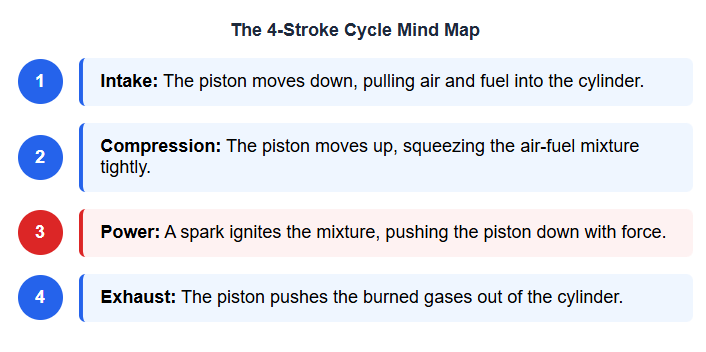
Most cars use an internal combustion engine. This means fuel burns inside the engine to create power. Bilal always reminds his students that understanding the four strokes is the foundation of all engine knowledge.
The engine creates power, but the drivetrain delivers that power to the road. The transmission is a vital part of this system. It uses gears to make sure the engine stays in its best power range, whether you are driving slowly or on the highway.
| Term | Simple Definition |
|---|---|
| Automatic Transmission | A gearbox that shifts gears by itself using fluid pressure and computers. The driver only selects Drive, Park, or Reverse. |
| Manual Transmission | A gearbox where the driver physically moves the gear stick and presses the clutch pedal to change gears. |
| Clutch | A mechanical coupling that connects and disconnects the engine from the transmission. This allows you to change gears or stop without stalling the engine. |
| Differential | A set of gears at the axle that allows the left and right wheels to rotate at different speeds. This is necessary when turning a corner, as the outside wheel travels further than the inside wheel. |
Omar & Bilal’s Discovery: “A customer brought in a truck complaining of a grinding noise when shifting into second gear,” Omar explains. “Bilal test-drove it and immediately recognized the symptom. Using proper automotive terminology, Bilal noted ‘synchronizer wear’ on the work order. The synchronizer is a small brass cone in a manual transmission that matches the gear speeds before they engage. Because Bilal knew the exact term, they ordered the correct rebuild kit instead of replacing the whole transmission.”
Modern vehicles rely heavily on computers and electronics. Therefore, electrical terms are some of the most important automotive terminology you can learn.
On-Board Diagnostics (Generation 2). The standardized computer system in all USA cars since 1996. It monitors emissions and engine health, allowing scan tools to read error codes.
Controller Area Network. A digital communication system that allows the vehicle’s different computers (like the engine, brake, and transmission modules) to share data without miles of wiring.
Diagnostic Trouble Code. A specific alphanumeric code stored in the ECU when a system fails. For example, P0301 means cylinder 1 has a misfire. Check our Warning Lights & Error Codes library for lookups.
Brakes are your primary safety system. Knowing how they work is a responsibility. Never ignore brake noises or warning lights. For detailed visuals, see our Brake System section.
ABS (Anti-lock Braking System): A safety feature that prevents the wheels from locking up during hard braking. If you slam on the brakes, ABS rapidly pumps the brakes for you. This allows you to maintain steering control. When ABS activates, you may feel a pulsing in the brake pedal—this is normal and means the system is working.
The suspension keeps the tires on the road and provides a smooth ride. The steering system allows you to control the direction. Both work together for safety and comfort.
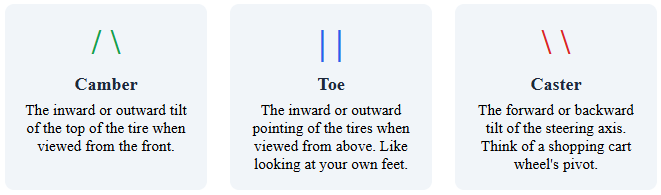
Alignment ensures the wheels point exactly where they should. Poor alignment causes uneven tire wear and pulling to one side.
Engines produce massive amounts of heat. The cooling system prevents the engine from melting, while the HVAC system keeps you comfortable. Learn more in our Cooling System and HVAC System centers.
Omar & Bilal’s Discovery: “A client’s car was overheating only in traffic,” Bilal recalls. “Omar noticed the cooling fans were not turning on when the AC was activated. By checking the Diagnostics data, they saw the ‘AC pressure switch’ was sending a false reading. The switch is a safety sensor that shuts off the AC if the refrigerant pressure gets dangerously high. Replacing this small, specific sensor fixed the overheating issue, saving the client from an unnecessary radiator replacement.”
Heavy-duty trucks share many parts with cars, but they also use specialized heavy-duty systems. If you work on commercial vehicles, our Truck Systems section is a valuable resource.
Unlike cars that use hydraulic fluid, large trucks use compressed air to apply their brakes.
Before you fix a problem, you must identify it. Using the correct automotive terminology for tools and diagnostics makes the job faster and safer. See our Tools & Equipment guides for buying advice.
Socket
A cylinder that fits over a nut or bolt head, turned by a wrench handle (ratchet).
Torque Wrench
A special wrench that clicks when you reach a precise tightness. Essential for engine and brake work to prevent stripping threads.
Dielectric Grease
An insulating grease applied to electrical connectors. It does not conduct electricity, but it prevents corrosion and keeps water out.
Jack Stand
A sturdy metal stand used to support a raised vehicle. Never work under a car supported only by a hydraulic floor jack.
Fluids are the lifeblood of a vehicle. Using the wrong fluid can destroy a system. Always check your owner’s manual before topping off. For more details, visit our Automotive Fluids & Chemicals page.
Knowing the terms is only half the battle. Using them properly keeps you safe and ensures your vehicle is repaired correctly.
When you describe a problem, be specific. Instead of saying, “My car makes a funny noise,” use descriptive terms. For example: “I hear a high-pitched squeal when I press the brake pedal at low speeds.” This points the mechanic directly to the brake wear indicators.
Mechanics are required by law to provide written estimates. Knowing automotive terminology helps you read these documents. If you see “Replace front struts and perform alignment,” you now know that “struts” are structural suspension parts, and the “alignment” is necessary because the suspension was dismantled.
Omar & Bilal’s Advice: “Honesty is our highest value,” says Omar. “If a mechanic uses a term you do not understand, ask them to explain it. A trustworthy technician will gladly take the time to teach you. Never feel pressured into approving work you do not understand.”
Before you visit a mechanic or start a DIY project, review this checklist to ensure you are prepared:
The automobile was invented over a century ago, and terms have evolved from different languages and engineering traditions. Also, as technology advances, new acronyms (like DPF or ECU) are added. Learning the basics removes the confusion.
A shock absorber only controls bouncing. A strut is a structural part that combines a shock absorber and a coil spring into one unit, and it serves as a pivot point for the steering. Both dampen movement, but a strut has a heavier, multi-purpose job.
OBD2 stands for On-Board Diagnostics, Generation 2. It is a standardized system in all cars sold in the USA since 1996. It monitors the engine and emissions systems, and it provides a universal port for mechanics to read error codes.
Yes, heavy-duty trucks use different systems. For example, cars use hydraulic brakes (fluid), while big trucks use air brakes (compressed air). Trucks also use specific emissions terms like DPF (Diesel Particulate Filter) and DEF (Diesel Exhaust Fluid).
Absolutely. When you describe a problem accurately, the mechanic spends less time diagnosing it. Also, you can avoid paying for unnecessary repairs because you understand exactly what is broken and what is not.
Mastering automotive terminology transforms the way you care for your vehicle. It turns confusing jargon into clear, understandable concepts. As Bilal and Omar always say, knowledge is the best tool in the garage. It empowers you to make safe, responsible, and honest choices. Continue your learning journey by exploring our Maintenance Guides and Troubleshooting Center to put your new vocabulary into practice.
