Physical Address
304 North Cardinal St.
Dorchester Center, MA 02124
Physical Address
304 North Cardinal St.
Dorchester Center, MA 02124

Disclaimer: This article provides general information about spark plugs for educational purposes only. Vehicle specifications vary by make and model. Always consult your vehicle’s manual and a qualified professional for specific maintenance recommendations.
Spark plugs are small but essential components in your vehicle’s engine that play a crucial role in the combustion process. These simple-looking devices create the electrical spark that ignites the air-fuel mixture in your engine’s cylinders, providing the power to move your vehicle. Understanding spark plugs, their function, types, and maintenance needs can help you keep your engine running efficiently and may prevent costly repairs down the road.
Throughout this guide, you may see Bilal and Omar discussing vehicle systems, maintenance procedures, and troubleshooting situations. They are fictional educational characters created by Remliks Solutions to help explain automotive and truck concepts in a practical and engaging way.
Spark plugs are electrical devices that fit into the cylinder head of an internal combustion engine. Their primary function is to deliver an electrical current from the ignition system to the combustion chamber, creating a spark that ignites the compressed air-fuel mixture.
Omar and Bilal Workshop Scenario
Bilal: Why are spark plugs so important? Can’t the engine run without them?
Omar: Spark plugs are essential for gasoline engines. Without them, there would be no spark to ignite the fuel mixture, and the engine simply wouldn’t run. They’re like the match that starts the fire in each cylinder thousands of times per minute.
Bilal: That seems like a lot of work for such a small part!
Omar: Exactly. In a four-cylinder engine idling at 800 RPM, each spark plug fires about 400 times per minute. At higher RPMs, that number increases significantly. That’s why spark plugs need to be durable and well-maintained.
The combustion process in a gasoline engine follows four basic strokes:
The spark plug’s job occurs at the beginning of the power stroke. The timing and quality of this spark directly affect engine performance, fuel efficiency, and emissions.
Spark plugs significantly influence several aspects of engine performance:
Understanding the components of a spark plug helps in selecting the right type and identifying potential issues.
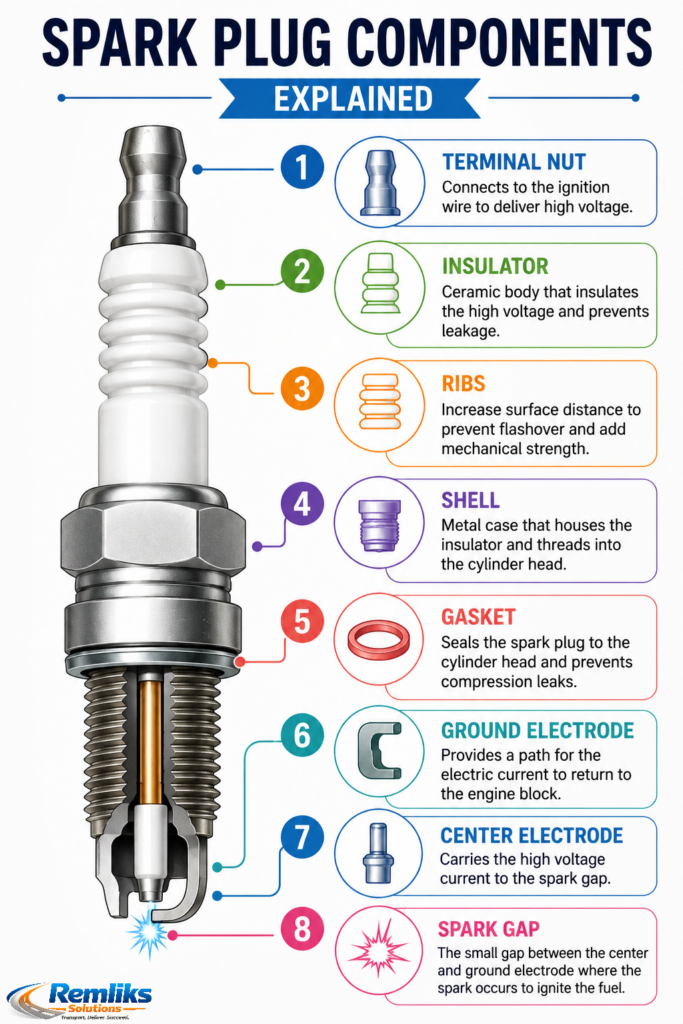
Different materials are used in spark plug construction, particularly for the electrodes:
| Material | Characteristics | Typical Lifespan | Best For |
|---|---|---|---|
| Copper/Nickel | Standard material, good conductivity | 20,000-30,000 miles | Older vehicles, budget-conscious owners |
| Platinum | Harder than copper, resists wear | 60,000-100,000 miles | Modern vehicles, improved performance |
| Double Platinum | Platinum on both electrodes | 100,000 miles | Vehicles with distributorless ignition systems |
| Iridium | Extremely hard, best wear resistance | 100,000-120,000 miles | High-performance engines, longevity |
| Iridium/Platinum | Iridium center, platinum ground | 100,000+ miles | Premium applications, optimal performance |
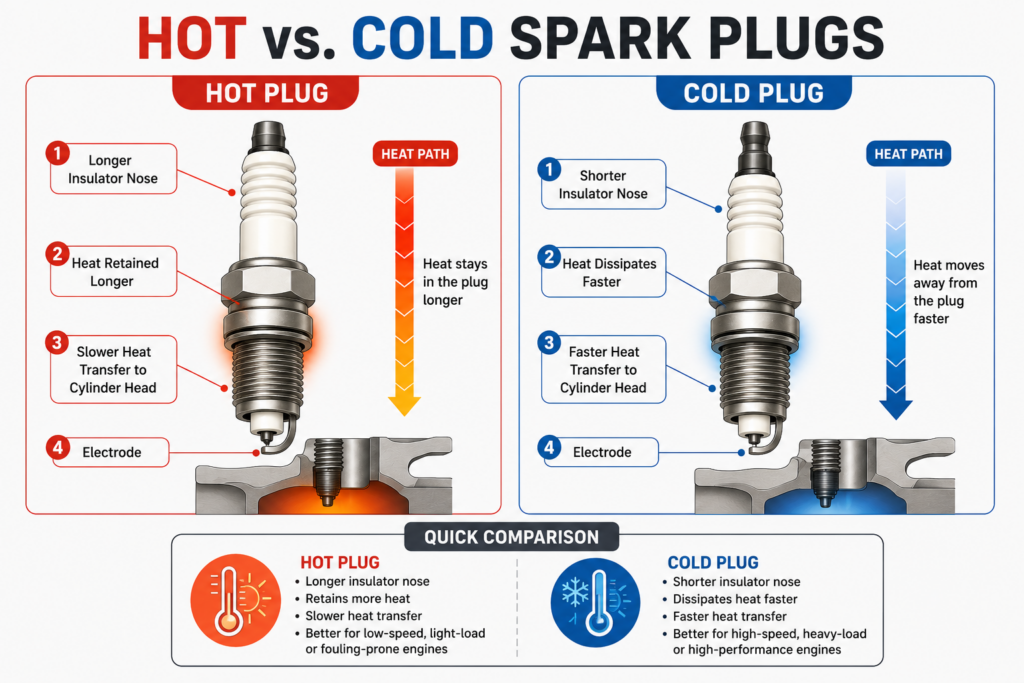
Spark plugs are designed with different heat ranges to match engine requirements:
Heat Range Explanation:
Omar and Bilal Workshop Scenario
Bilal: How do I know if I need a hot or cold spark plug?
Omar: The manufacturer specifies the correct heat range for your engine. Generally, high-performance engines or those driven hard need colder plugs to prevent pre-ignition. Normal driving conditions usually use hotter plugs that stay clean by burning off deposits.
Bilal: What happens if I use the wrong heat range?
Omar: Using a plug that’s too hot can cause pre-ignition or detonation, potentially damaging the engine. A plug that’s too cold may not reach self-cleaning temperature, leading to fouling and misfires.
Modern spark plugs come in several design variations:
The spark plug operates through a sequence of electrical events:
The spark created by the plug initiates a chain reaction in the combustion chamber:
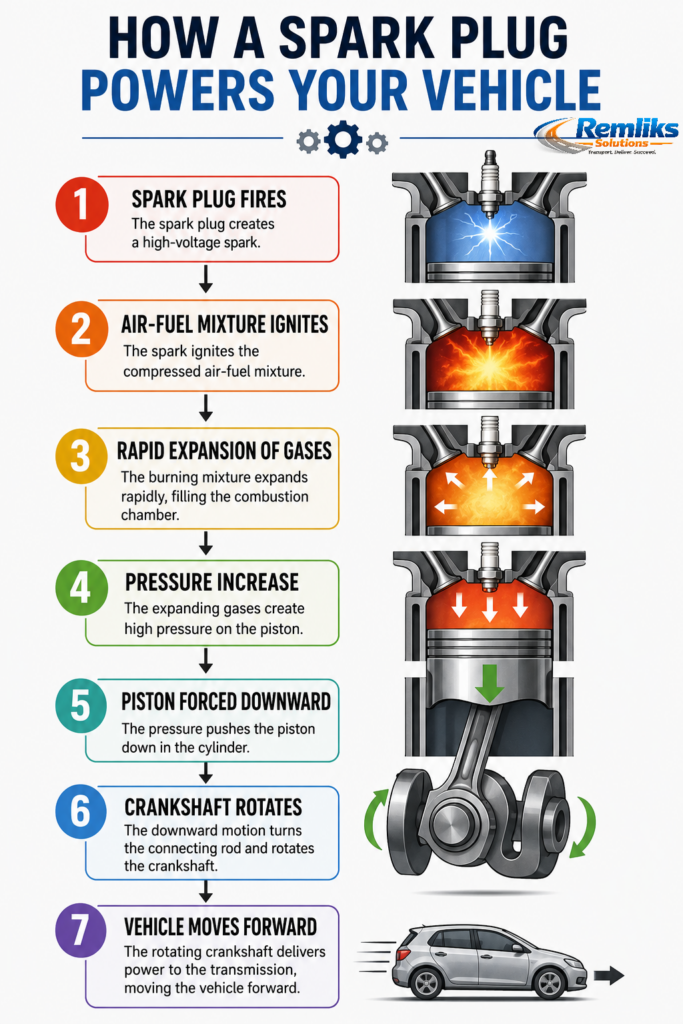
The quality and timing of this spark directly affects how efficiently this process occurs. A weak or poorly timed spark results in incomplete combustion, reducing power and efficiency while increasing emissions.
Omar and Bilal Workshop Scenario
Bilal: Why does the spark need to be so powerful? Can’t a smaller spark do the job?
Omar: The spark needs enough energy to reliably ignite the mixture under all conditions. Inside the cylinder, the air-fuel mixture is under high pressure, which makes it harder for electricity to jump the gap. Additionally, a stronger spark ensures more complete combustion, especially with leaner fuel mixtures used in modern engines for better fuel economy.
Recognizing the symptoms of failing spark plugs can help you address issues before they lead to more serious problems.
| Symptom | Description | Severity |
|---|---|---|
| Engine Misfire | Engine runs rough, may jerk or hesitate | Medium-High |
| Poor Fuel Economy | Noticeable decrease in miles per gallon | Medium |
| Rough Idling | Engine vibrates or sounds uneven at idle | Medium |
| Difficulty Starting | Engine cranks but doesn’t start quickly | Medium-High |
| Lack of Acceleration | Sluggish response when pressing gas pedal | Medium |
| Engine Surging | Inconsistent engine speed at constant throttle | Medium |
| Increased Emissions | Failed emissions test or visible exhaust smoke | High |
When you remove a spark plug, its appearance can tell you about engine conditions:
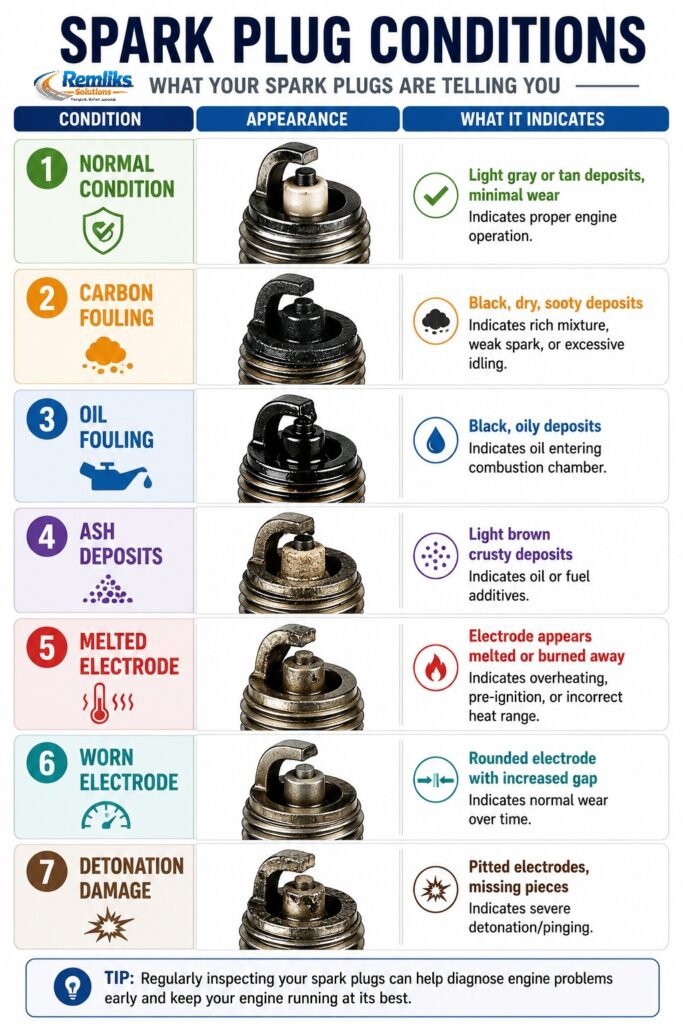
Omar and Bilal Workshop Scenario
Bilal: I pulled out one of my spark plugs and it’s completely black and oily. What does that mean?
Omar: That’s oil fouling, which means engine oil is getting into the combustion chamber. This could be due to worn piston rings, valve guides, or valve seals. Simply replacing the spark plug won’t solve the underlying issue, though it may temporarily improve performance.
Bilal: Should I try a hotter plug to burn off the oil?
Omar: That might help temporarily, but it’s not a proper solution. A hotter plug could mask the symptom but might lead to other problems like pre-ignition. The best approach is to diagnose and repair the source of the oil leakage first.
Regular inspection of spark plugs helps identify issues before they cause significant problems:
| Vehicle Type | Inspection Interval | Replacement Interval |
|---|---|---|
| Standard Vehicles | Every 30,000 miles | 30,000-60,000 miles |
| Modern Vehicles with Platinum/Iridium | Every 60,000 miles | 60,000-100,000 miles |
| Performance Vehicles | Every 15,000-20,000 miles | 15,000-30,000 miles |
| Vehicles Used in Severe Conditions | Every 15,000-20,000 miles | 30,000-60,000 miles |
Note: Always follow the manufacturer’s specific recommendations for your vehicle.
The spark plug gap is the distance between the center and ground electrode. This gap must be set correctly for optimal performance:
CORRECT GAP SETTING PROCESS

1. Check manufacturer's specification for correct gap
   └── Usually between 0.028" - 0.060" (0.7mm - 1.5mm)

2. Measure current gap with a feeler gauge
   └── Insert appropriate blade between electrodes

3. Adjust if necessary
   └── For widening: Gently bend ground electrode
   └── For narrowing: Tap electrode on soft surface
   └── Never bend center electrode

4. Re-measure to confirm correct gap
   └── Verify at multiple points around electrode

5. Inspect electrodes for damage
   └── Ensure no cracking or uneven surfaces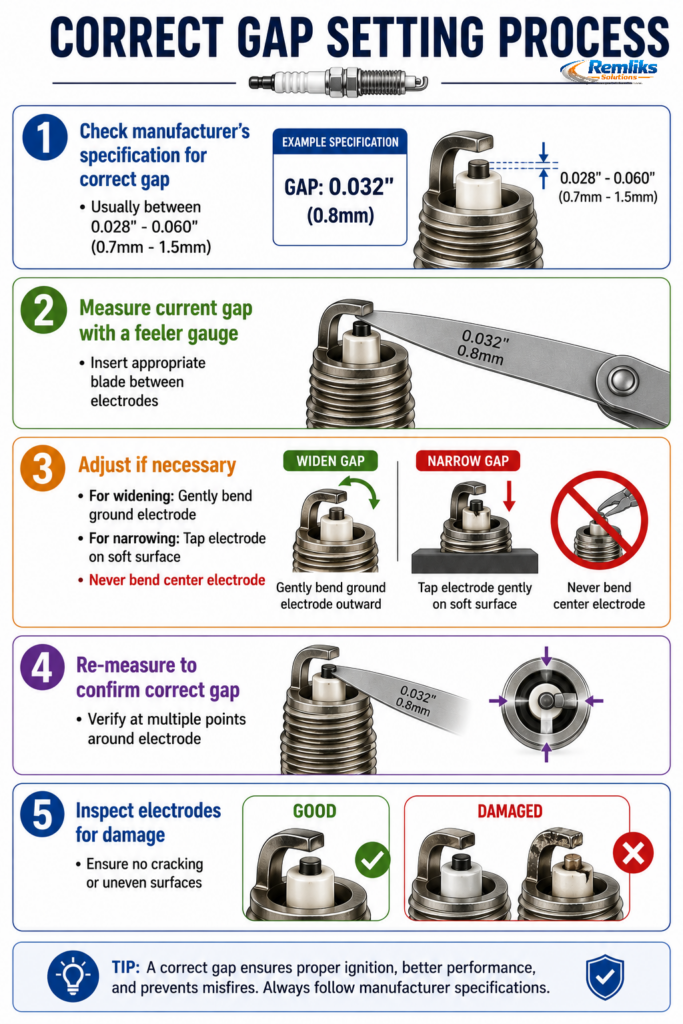
Omar and Bilal Workshop Scenario
Bilal: I bought new spark plugs, but should I check the gap before installing them?
Omar: Yes, that’s a good practice. While many new plugs come pre-gapped, they can sometimes be adjusted during shipping or handling. It only takes a minute to verify with a feeler gauge, and it ensures you’re starting with the correct specification.
Bilal: What happens if the gap is too small or too large?
Omar: If the gap is too small, the spark may be too weak to ignite the mixture properly. If it’s too large, the voltage might not be sufficient to jump the gap, especially under high pressure conditions. Both situations can cause misfires and poor performance.
The most reliable way to select the correct spark plugs is to follow your vehicle manufacturer’s recommendations. This information can typically be found in:
Spark plug part numbers contain coded information about the plug’s specifications:
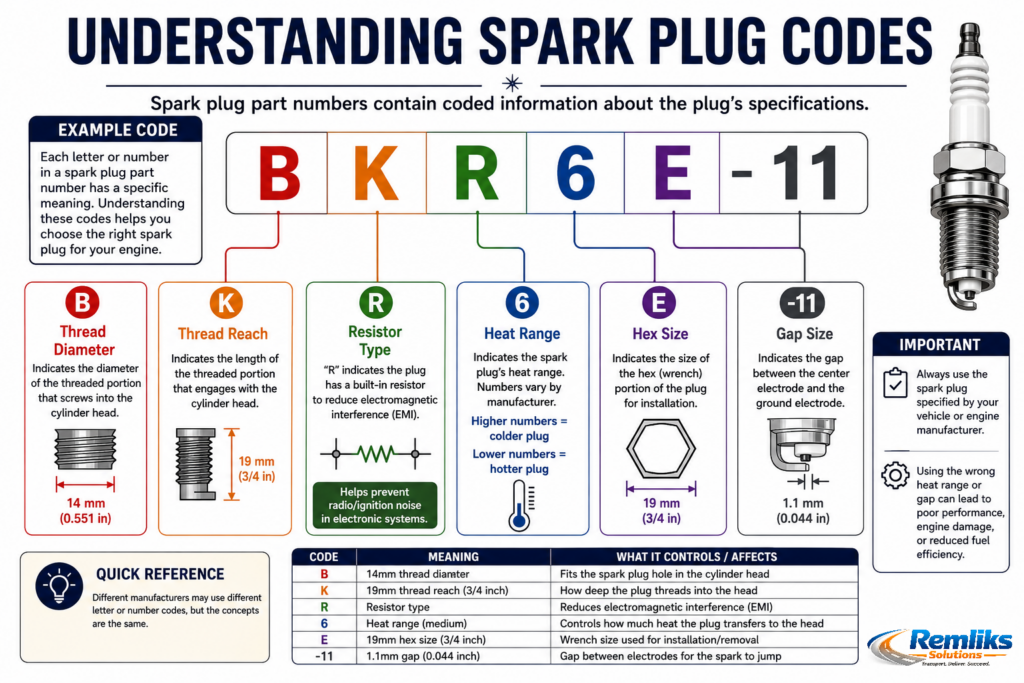
Different manufacturers use different coding systems, so it’s important to reference the specific manufacturer’s catalog for accurate interpretation.
Many vehicle owners consider upgrading from standard copper plugs to platinum or iridium options:
| Consideration | Standard Copper | Platinum | Iridium |
|---|---|---|---|
| Initial Cost | Lowest | Medium | Highest |
| Replacement Frequency | Most Often | Less Often | Least Often |
| Performance | Good | Better | Best |
| Fuel Efficiency | Good | Better | Best |
| Longevity | Shortest | Longer | Longest |
| Cold Starting | Good | Better | Best |
| High RPM Performance | Limited | Good | Excellent |
Omar and Bilal Workshop Scenario
Bilal: I’m thinking about upgrading to iridium spark plugs for better performance. Is this a good idea?
Omar: Iridium plugs can offer benefits like better throttle response, smoother idling, and improved fuel efficiency in some cases. However, the improvement is often subtle in normal driving conditions. The main advantage is longer service intervals, which can offset the higher initial cost over time.
Bilal: Are there any downsides to upgrading?
Omar: The main consideration is cost. Iridium plugs are significantly more expensive upfront. Also, some engines are specifically designed for a certain type of plug, and deviating from the manufacturer’s recommendation may not provide additional benefits. It’s always best to check if your vehicle’s manufacturer offers an iridium option before making the switch.
Before beginning the replacement process, gather these tools:
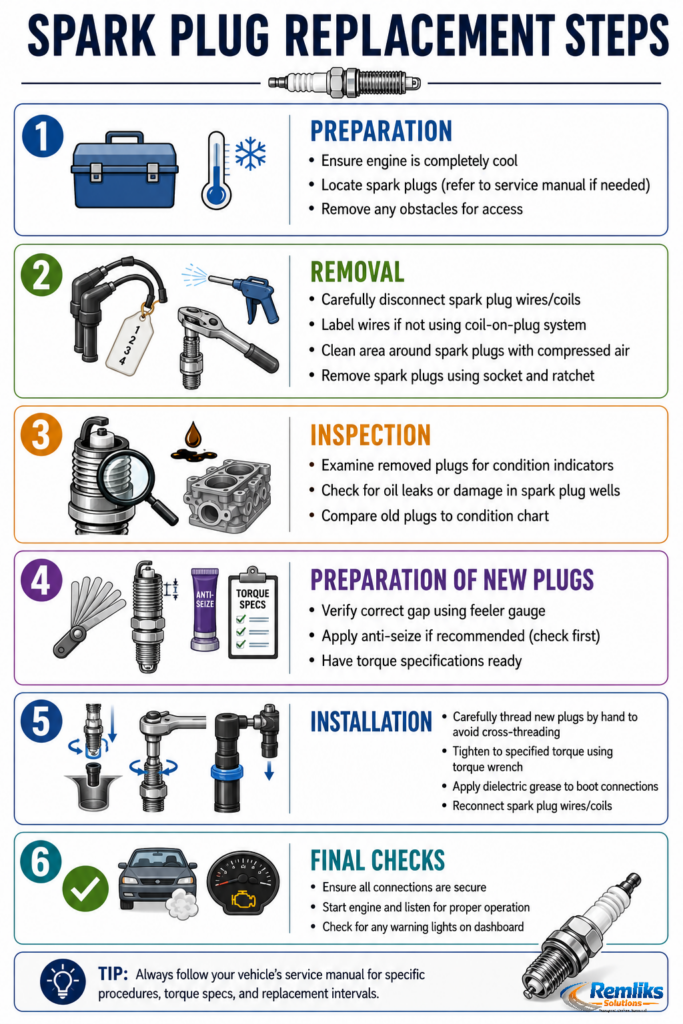
When replacing spark plugs, avoid these common errors:
Omar and Bilal Workshop Scenario
Bilal: I tried to replace my spark plugs, but I couldn’t get one of them out. It felt really tight. What should I do?
Omar: First, make absolutely sure you’re turning it the right direction—counterclockwise to loosen. If it’s still stuck, spray some penetrating oil around the base and let it sit for 15-30 minutes. Then try again with gentle pressure. If it still won’t budge, it’s best to have a professional handle it to avoid breaking the plug in the cylinder head.
Bilal: What happens if a plug breaks during removal?
Omar: That’s a serious situation. Part of the plug may remain in the cylinder head, requiring special tools and techniques to remove. In some cases, the cylinder head may need to be removed for repair. This is why it’s important to use proper technique and not force a stuck plug.
Modern engineering has led to several advanced spark plug designs:
Different fuel types require specialized spark plug considerations:
| Fuel Type | Special Considerations | Typical Plug Requirements |
|---|---|---|
| Compressed Natural Gas (CNG) | Higher combustion temperatures | Colder heat range, more durable electrodes |
| Liquefied Petroleum Gas (LPG) | Different combustion characteristics | Specific gap settings, resistant to wear |
| Ethanol Blends (E85) | May run leaner, different burn rate | Proper heat range, possibly cooler plug |
| Hydrogen | Extremely fast burn rate | Specialized plugs with specific gap requirements |
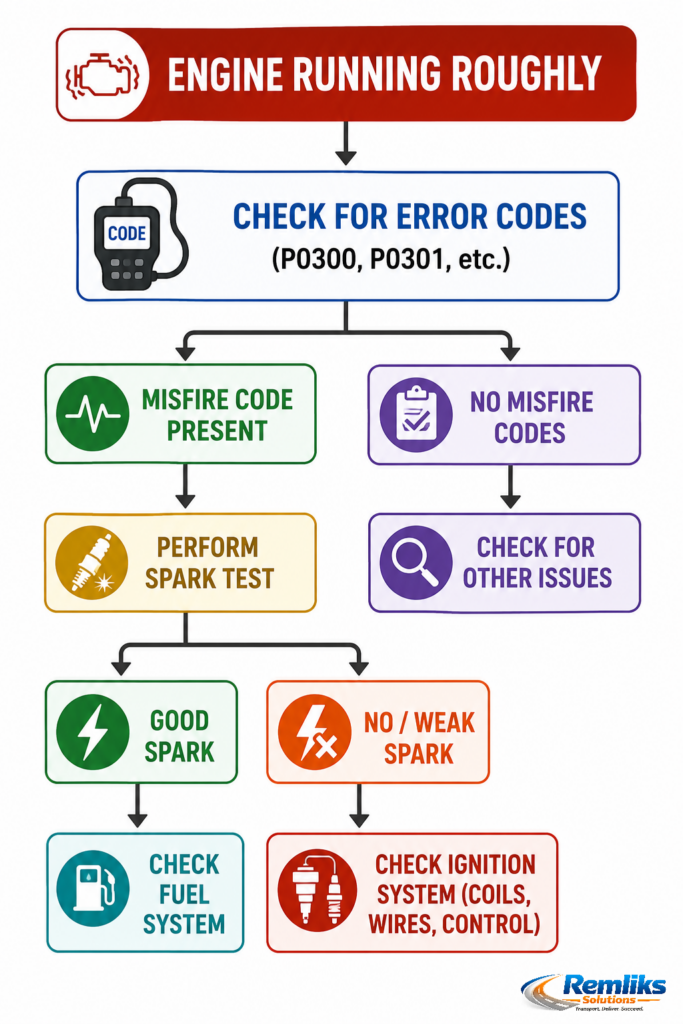
| Problem | Possible Causes | Solutions |
|---|---|---|
| Carbon Fouling | Rich mixture, weak spark, excessive idling | Address fuel system issues, check ignition components, ensure proper heat range |
| Oil Fouling | Worn piston rings, valve guides, or seals | Repair internal engine issues, may temporarily use hotter plug |
| Overheating | Incorrect heat range, lean mixture, advanced timing | Install correct heat range plug, address fuel/ignition issues |
| Rapid Electrode Wear | Low-quality fuel, incorrect gap, high-performance use | Use quality fuel, verify gap, consider upgraded plug material |
| Cracked Insulator | Thermal shock, physical damage, improper installation | Handle carefully, torque correctly, avoid thermal shock |
| Deposit Buildup | Fuel additives, oil consumption, short trips | Address oil consumption, ensure proper operating temperature, may need hotter plug |
Omar and Bilal Workshop Scenario
Bilal: My engine has a slight misfire, but the check engine light isn’t on. Could it still be a spark plug issue?
Omar: Absolutely. A minor misfire might not be severe enough to trigger a code immediately. Spark plugs can degrade gradually, causing subtle performance issues before they fail completely. If your plugs are near their replacement interval, it might be worth inspecting them.
Bilal: How can I tell which cylinder is misfiring without a code?
Omar: You can try a simple process of elimination. With the engine idling, use insulated pliers to disconnect one spark plug wire at a time. When you disconnect the cylinder that’s misfiring, you likely won’t notice much change in engine speed. When you disconnect a good cylinder, the engine will run noticeably rougher. This can help identify the problematic cylinder.
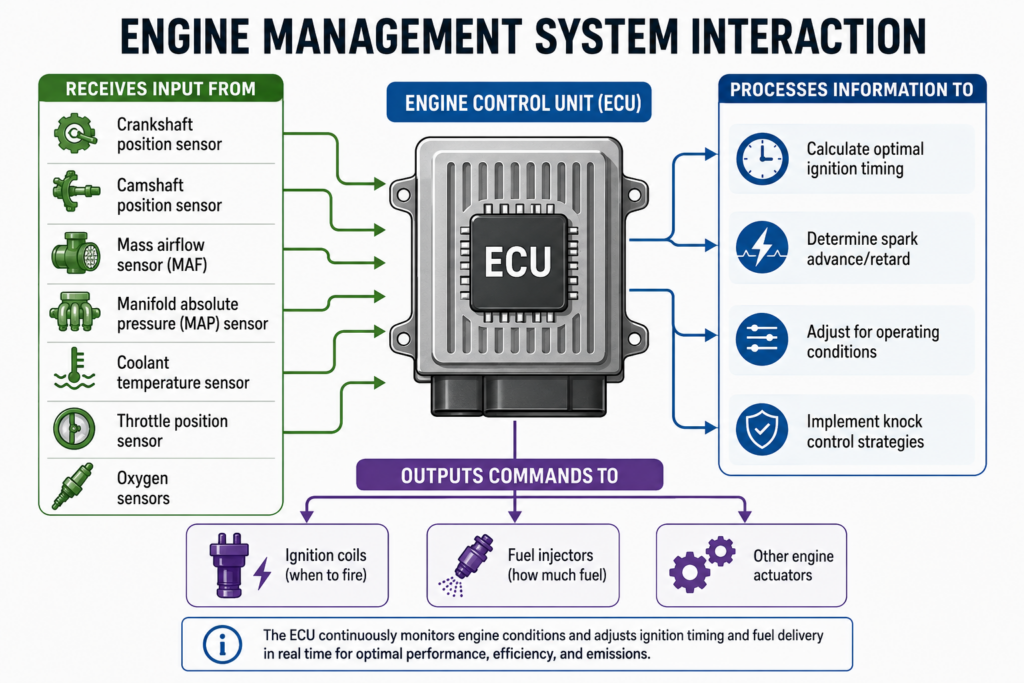
Modern vehicles rely on sophisticated engine management systems that work in conjunction with spark plugs:
Many modern vehicles use coil-on-plug (COP) ignition systems, where each spark plug has its own ignition coil:
Advantages of COP Systems:
Diagnostic Considerations:
Omar and Bilal Workshop Scenario
Bilal: My car has coil-on-plug ignition. Does that mean I never have to worry about the ignition system?
Omar: Not at all. While COP systems eliminate spark plug wires, the coils themselves can fail. Each coil operates under high stress and heat, and they can degrade over time. The good news is that when one fails, it typically only affects one cylinder, making diagnosis more straightforward.
Bilal: How can I tell if a coil is failing?
Omar: Common symptoms include a misfire on a specific cylinder, rough idle, lack of power, and potentially a check engine light with a misfire code for that cylinder. You can also try swapping coils between cylinders to see if the misfire follows the coil.
Spark plug requirements can differ significantly between passenger cars and trucks:
| Aspect | Passenger Cars | Trucks |
|---|---|---|
| Typical Heat Range | Medium | Often cooler |
| Electrode Material | Varies by model | Often platinum or iridium for longevity |
| Gap Size | Generally smaller | Often larger for better ignition of lean mixtures |
| Replacement Interval | Varies by plug type | May be more frequent due to heavier use |
| Special Considerations | Fuel efficiency emphasis | Durability under load emphasis |
High-performance applications have unique spark plug requirements:
Lawn mowers, generators, and other small engines have their own spark plug considerations:
Properly functioning spark plugs contribute to reduced emissions and improved fuel efficiency:
Spark plugs contain materials that can be recycled:
When disposing of spark plugs:
Use this comprehensive checklist to ensure proper spark plug maintenance:
□ Check manufacturer’s recommended replacement interval
□ Verify correct spark plug part number for your vehicle
□ Gather all necessary tools before starting
□ Ensure engine is completely cool before beginning
□ Label spark plug wires if not using coil-on-plug system
□ Clean area around spark plugs to prevent debris entry
□ Remove plugs carefully to avoid damage to cylinder head threads
□ Inspect removed plugs for condition indicators
□ Check for oil in spark plug wells (indicates seal issues)
□ Verify gap on new plugs using feeler gauge
□ Apply anti-seize compound only if recommended by manufacturer
□ Thread new plugs by hand to prevent cross-threading
□ Torque plugs to manufacturer’s specification
□ Apply dielectric grease to boot connections
□ Ensure all connections are secure and properly seated
□ Start engine and verify smooth operation
□ Check for any warning lights on dashboard
□ Record date and mileage of replacement for future reference
A: Replacement intervals vary based on plug type and vehicle. Standard copper plugs typically need replacement every 20,000-30,000 miles, while platinum and iridium plugs can last 60,000-100,000 miles or more. Always follow your vehicle manufacturer’s specific recommendations.
A: While it’s possible to clean spark plugs, it’s generally not recommended as a long-term solution. Cleaning may temporarily restore function, but the electrodes still experience wear, and the plug may not perform like new. For reliable performance, replacement is usually the better option.
A: You don’t necessarily need the exact brand, but you should use a plug with identical specifications (heat range, gap, thread size, reach, etc.). Cross-reference charts can help you find equivalent plugs from different manufacturers.
A: Premium spark plugs (platinum, iridium) may provide slight improvements in fuel economy due to more consistent spark and better combustion. However, the improvement is typically modest (1-2% at most) and may not be noticeable in everyday driving. The main benefit is longer service life.
A: Yes, severely worn or failing spark plugs can cause engine damage over time. Misfires allow unburned fuel to enter the exhaust system, which can overheat and damage the catalytic converter—a potentially expensive repair. Persistent misfires can also cause cylinder wash-down, leading to increased wear.
A: Resistor spark plugs contain a ceramic resistor that suppresses electromagnetic interference (EMI). This prevents the spark plug from generating electrical noise that could interfere with electronic components like the radio, engine management computer, and other sensitive electronics in modern vehicles.
A: Using plugs that are too hot can cause pre-ignition or detonation, potentially damaging pistons and valves. Plugs that are too cold may not reach self-cleaning temperature, leading to fouling and misfires. Always use the heat range specified by the manufacturer.
A: Many vehicle owners can replace spark plugs themselves if they have basic mechanical skills, the right tools, and access to the plugs. However, if the plugs are difficult to access, if you’re not comfortable working on your vehicle, or if you encounter any problems, it’s best to have a professional handle the job.
A: Yes, spark plugs play a crucial role in cold starting. As plugs wear, they require more voltage to fire, which can make cold starting more difficult. Premium plugs with fine-wire electrodes (like iridium) often provide better cold starting performance due to their lower voltage requirements.
A: The only way to verify correct gap is to measure it with a feeler gauge or wire-style gap tool. The gap should match your vehicle manufacturer’s specification exactly. Even new “pre-gapped” plugs should be checked, as they can be adjusted during shipping or handling.
Spark plugs may be small, but they play a critical role in your vehicle’s performance, efficiency, and reliability. Understanding their function, types, and maintenance needs empowers you to make informed decisions about this essential engine component.
Regular inspection and timely replacement of spark plugs can help maintain optimal engine performance, improve fuel economy, reduce emissions, and prevent more costly repairs down the road. By following manufacturer recommendations and using the proper techniques outlined in this guide, you can ensure your engine continues to run smoothly for miles to come.
Remember that while this guide provides comprehensive information about spark plugs, specific requirements can vary significantly between different vehicles. Always consult your owner’s manual or a qualified professional for advice tailored to your particular vehicle.
For more information about related engine systems, you might find these resources helpful:
