Physical Address
304 North Cardinal St.
Dorchester Center, MA 02124
Physical Address
304 North Cardinal St.
Dorchester Center, MA 02124

Disclaimer: This article is for general information only. Always refer to your vehicle’s official service manual for specific procedures, torque specifications, and safety warnings. Consult a professional mechanic for diagnostic and repair work.
Fuel injectors are the precise metering valves of your engine. They take liquid fuel and turn it into a fine mist, mixing it with air so your engine can run efficiently. Without properly working fuel injectors, your engine will struggle to start, lose power, and waste fuel.
Throughout this guide, you may see Bilal and Omar discussing vehicle systems, maintenance procedures, and troubleshooting situations. They are fictional educational characters created by Remliks Solutions to help explain automotive and truck concepts in a practical and engaging way.
first see the image below and remember the car fuel system components and how they function.
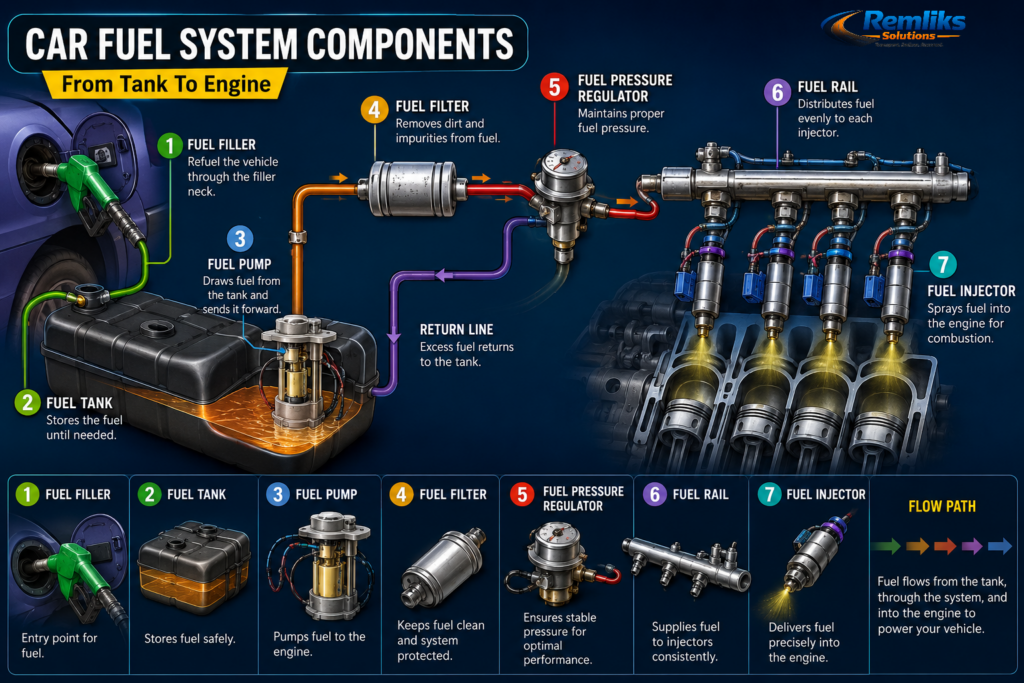
Before the 1980s, most cars used carburetors to mix air and fuel. However, carburetors were not very precise. When governments required better fuel economy and lower emissions, automakers switched to fuel injection systems.
A fuel injector is an electromechanical device. It sits in the intake manifold or directly inside the engine cylinder. The engine computer (ECU) tells the injector exactly when to open and for how long. This time is measured in milliseconds.
For fuel to burn, it must mix with oxygen. Liquid fuel does not burn easily. However, if you turn that liquid into a fine mist, the surface area increases massively. This process is called atomization.
When the injector opens, fuel sprays out of a tiny nozzle. The nozzle has multiple holes that shape the spray into a cone. This ensures the fuel mixes perfectly with the incoming air.
Bilal: Omar, I know the fuel pump sends fuel to the engine. But how does the injector know exactly how much fuel to let out?
Omar: That is a great question, Bilal. The injector itself does not measure the fuel. It simply acts as a valve. The Engine Control Unit (ECU) calculates the required fuel based on data from the Mass Air Flow (MAF) sensor, engine temperature, and throttle position. It then sends an electrical pulse to the injector. The longer the pulse, the more fuel flows out.
Bilal: So, if the MAF sensor gives wrong information, the ECU might command the wrong amount of fuel?
Omar: Exactly. Diagnostics is about looking at the whole system. A misfire caused by a “bad” fuel injector might actually be caused by a dirty MAF sensor. We must test before replacing parts. You can read more about how the ECU uses air data in our Air Intake System Guide.
Fuel injection has evolved over the years. Today, there are three main types of systems used in cars and trucks.
TBI was the first step away from carburetors. It looks like a carburetor but has one or two electric injectors sitting above the throttle plate.
This is the most common type of injection. Instead of one injector for the whole engine, there is one injector for every cylinder. The injector sits in the intake manifold, right outside the intake valve.
In a Direct Injection system, the injector is placed inside the cylinder head. It sprays fuel directly into the combustion chamber. This allows for extreme precision and very high fuel pressure.
| Feature | Throttle Body (TBI) | Port Injection (PFI) | Direct Injection (GDI) |
|---|---|---|---|
| Injector Location | Top of throttle body | Intake manifold | Inside cylinder |
| Fuel Pressure | Low (10-15 PSI) | Medium (40-60 PSI) | High (500-3000 PSI) |
| Complexity | Low | Medium | High |
| Carbon Buildup on Valves | Low | Low | High |
| Fuel Efficiency | Low | Medium | High |
Fuel injectors are mechanical parts, and they wear out. They can clog with dirt, or their internal electrical coils can fail. When this happens, your vehicle will show clear warning signs.
If an injector is clogged, it cannot spray enough fuel. The engine computer detects this lean condition (too much air, not enough fuel). The engine will shake at traffic lights, and the RPM needle might bounce up and down.
If an injector leaks or sticks open, it will drip fuel continuously. This wastes gas and makes your fuel economy drop quickly. You might notice you have to visit the gas station more often.
A leaking injector will cause a rich mixture (too much fuel, not enough air). Unburned fuel will exit the exhaust as black smoke. You will also smell raw gasoline near the car or inside the cabin. This requires immediate attention, as it is a fire hazard.
When an injector fails, the ECU detects a misfire. It turns on the Check Engine Light. You must use an OBD2 scanner to read the code. Codes like P0300 (Random Misfire) or P0171 (System Too Lean) often point to fuel delivery issues. Find more code explanations in our Warning Lights & Error Codes category.
Professional mechanics do not guess; they test. If you suspect a bad fuel injector, you can perform a few diagnostic tests.
Bilal: The engine has a misfire on cylinder 3. The spark plug is good. How do I test the fuel injector?
Omar: We will use the cylinder balance test. While the engine is running, we will disconnect the electrical connector to the cylinder 3 injector. If the engine idle drops significantly, that injector was working.
Bilal: What if the engine sound does not change when I unplug it?
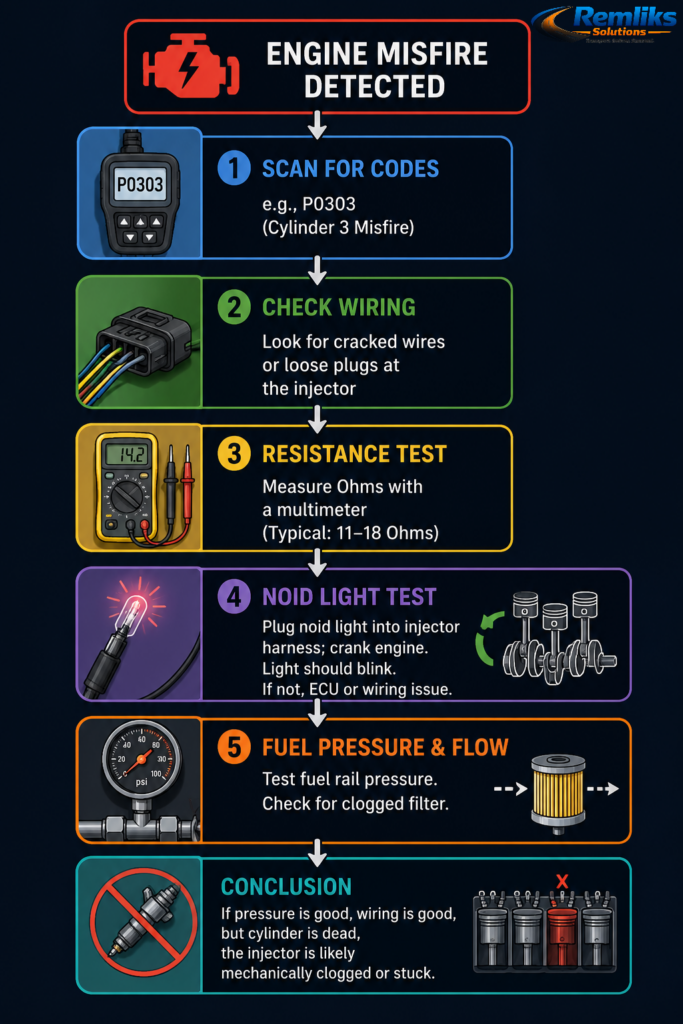
Omar: Then that cylinder was already dead. The injector is either not getting power, not opening, or not receiving fuel. We must use a multimeter to check the injector’s electrical resistance. We can also use a tool called a noid light to verify the computer is sending the signal.
Here is a simple mind-map style flow for diagnosing a suspected bad fuel injector:
Always ensure you follow safety protocols when working around fuel. High-pressure systems, especially Direct Injection, hold pressure even when the engine is off.
Preventive maintenance is better than expensive repairs. Keeping your fuel injectors clean ensures proper atomization and engine health. You can explore our Maintenance Guides for broader vehicle care.
Fuel additives are chemicals you pour into your gas tank. Good quality cleaners contain a chemical called Polyetheramine (PEA). PEA is scientifically proven to break down carbon deposits in fuel systems.
Important Note: Additives are tools that may help maintain cleanliness, but they are not guaranteed magic cures for severe clogs. Always follow the instructions on the bottle and do not over-treat your fuel.
If your injectors are severely clogged, a professional cleaning service is the best option. Mechanics remove the injectors and place them in an ultrasonic cleaning machine.
The machine sends high-frequency sound waves through a cleaning liquid. This shakes loose microscopic dirt. Afterward, they test the spray pattern and flow rate to ensure all injectors match. If you need tools to remove injectors, check our Automotive Tools & Equipment section.
Gasoline and diesel engines both use fuel injectors, but they work very differently.
Diesel engines do not have spark plugs. The fuel ignites purely from the heat of compressed air. Therefore, diesel fuel injectors must handle massive pressure.
When DIY mechanics replace fuel injectors, they sometimes make errors that lead to bigger problems.
Use this checklist to keep your fuel injectors in good condition. It represents a balanced approach to engine care.
1. How long do fuel injectors last?
Fuel injectors often last the lifetime of the car, typically 100,000 to 150,000 miles. However, their lifespan depends heavily on fuel quality and regular filter maintenance.
2. Can a bad fuel injector damage the engine?
Yes. A leaking injector can wash the oil off the cylinder walls, causing friction and scoring the cylinder. In diesel engines, a stuck injector can cause extremely high cylinder pressures, leading to a cracked piston.
3. Should I clean or replace my fuel injectors?
If the injector is just clogged, professional ultrasonic cleaning may restore it. However, if the internal electrical coil is broken or the nozzle is mechanically worn, you must replace it.
4. Do fuel injector cleaners really work?
Yes, cleaners containing PEA (Polyetheramine) are scientifically shown to dissolve carbon deposits. However, they cannot fix mechanical failures or severe internal clogs. They are preventive tools, not guaranteed cures.
5. What does a bad fuel injector sound like?
A bad injector might cause a ticking or clicking noise if it is stuck closed. Alternatively, a leaking injector might cause a sputtering sound from the exhaust due to unburned fuel igniting in the exhaust pipe.
Fuel injectors are vital components that require precision and care. They must deliver the exact amount of fuel at the exact right moment. Understanding how they work, recognizing the symptoms of failure, and practicing regular maintenance will help keep your engine running efficiently and safely.
Remember to always rely on proper diagnostic procedures rather than guessing. If you need to understand error codes pointing to your fuel system, visit our Troubleshooting Center. By keeping your fuel system clean and well-maintained, you protect your engine, save money on fuel, and ensure a safe driving experience.
