Physical Address
304 North Cardinal St.
Dorchester Center, MA 02124
Physical Address
304 North Cardinal St.
Dorchester Center, MA 02124

Disclaimer: The information provided in this article is for general educational purposes only. It is not a substitute for professional advice or service. Always follow your vehicle manufacturer’s guidelines and consult a certified mechanic for repairs or safety concerns.
Internal combustion engines are the beating heart of most vehicles on the road today. These machines turn fuel into motion through a series of small, controlled explosions. For many people, the sheer complexity of an engine can feel intimidating. However, when we break it down into simple parts, it becomes much easier to understand.
Throughout this guide, you may see Bilal and Omar discussing vehicle systems, maintenance procedures, and troubleshooting situations. They are fictional educational characters created by Remliks Solutions to help explain automotive and truck concepts in a practical and engaging way, they often work in the workshop to solve tough problems.
Just last week, a young driver brought in a car that was making a strange noise. The driver was worried the engine was broken. Bilal smiled and opened the hood. “Don’t worry,” he said. “Let’s look at how this system works. Understanding the basics helps us find the real problem.” Omar nodded, grabbing his flashlight. “Exactly. An engine is just a machine that follows rules. If we know the rules, we can fix the problem.”
In this guide, we will explore how internal combustion engines work, the main parts involved, and how to keep them running smoothly.
An internal combustion engine (ICE) is a type of engine where the combustion of fuel occurs with an oxidizer (usually air) in a combustion chamber. This is different from external combustion engines, like old steam trains, where the fire happens outside the engine.
In a car, the expansion of the high-temperature and high-pressure gases produced by combustion applies direct force to some component of the engine. This force moves the component over a distance, transforming chemical energy into useful mechanical energy.
The term “internal” simply means that the fire (combustion) happens inside the engine itself. This design makes the engine very efficient and powerful for its size compared to older technologies.
To understand the process, we first need to know the players. Think of an engine like a team. Every part has a specific job to do.
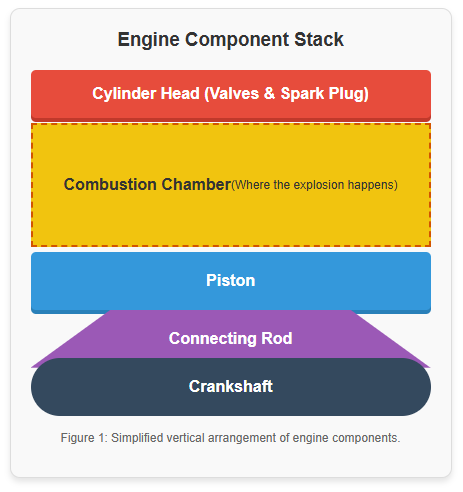
Omar and Bilal often use a diagram to explain this to their apprentices. Below is a visual representation of the main components located inside the engine block. You can use the code provided below the image to add this colored diagram to your website.
Visual Diagram 1: Engine Component Stack
| Component | Function | Simple Explanation |
|---|---|---|
| Engine Block | The main structure. | The metal housing that holds everything together. |
| Cylinders | The workspace. | Tubes where the pistons move up and down. |
| Pistons | The movers. | Metal cylinders that move up and down to compress gas. |
| Crankshaft | The converter. | Turns the up-down motion of pistons into spinning motion. |
| Connecting Rods | The connection. | Connects the piston to the crankshaft. |
| Valves | The doors. | Intake valves let air/fuel in; exhaust valves let gas out. |
| Spark Plug | The lighter (Petrol). | Creates the spark that starts the fire. |
| Camshaft | The timer. | Opens and closes the valves at the right time. |
| Fuel Injector | The feeder. | Sprays the correct amount of fuel into the cylinder. |
Bilal points to the valves. “These are like the nose and mouth,” he explains. “The engine needs to breathe in clean air and fuel, and breathe out the exhaust.” Omar adds, “And the pistons are the muscles. They take the energy from the explosion and push it to the wheels.”
When you look under the hood, you might notice engines look different. The arrangement of the cylinders is called the “configuration.”
In an inline engine, the cylinders are arranged in a straight line, one after the other. This is common in smaller cars.
In a V-engine, the cylinders are split into two banks, set at an angle to each other, forming a “V”.
The cylinders lie flat, opposite each other.
Omar prefers V8 engines for his trucks because they provide high torque (pulling power) at low speeds. Bilal often works on inline-4 engines found in sedans because they are very fuel-efficient.
Most modern car engines use a “four-stroke” cycle. This means the piston moves up and down two times (four strokes) to create one burst of power.
Bilal loves to explain this using a bicycle pump analogy. “Imagine using a bike pump. You push the handle down, pull it up, push it down again. That motion creates air pressure. The engine does the same thing, but with fire.”
Here is the step-by-step process, often called the Otto Cycle.
Visual Diagram 2: The 4-Stroke Cycle

The piston starts at the top (Top Dead Center). It moves down, creating a empty space (vacuum). At the same time, the Intake Valve opens.
Once the cylinder is full of the mixture, the valves close tightly. Now the piston moves back up.
This is the moment where the engine makes power. When the piston reaches the top, the Spark Plug fires.
After the explosion, the cylinder is full of burned gas (exhaust). The piston moves back up one more time.
Then, the cycle starts all over again, thousands of times per minute.
Bilal often emphasizes timing. “It’s not just about the strokes,” he says. “It’s about when they happen.” If the spark plug fires too early or the valves open at the wrong time, the engine will run poorly or break. This is managed by the Timing Belt or Timing Chain, which connects the crankshaft to the camshaft.
While both are internal combustion engines, Diesel and Gasoline engines work slightly differently. Omar often deals with diesel trucks, while Bilal handles many gasoline cars.
| Feature | Gasoline Engine | Diesel Engine |
|---|---|---|
| Ignition | Uses a Spark Plug to ignite fuel. | Uses Compression (heat) to ignite fuel. No spark plug. |
| Fuel | Lighter, evaporates easily. | Heavier, oilier. |
| Efficiency | Good for city driving. | Better for long distances and heavy loads. |
| Noise | Generally quieter. | Louder (characteristic “clatter”). |
| Torque | Lower torque, higher RPM. | High torque (pulling power) at low RPM. |
Scenario: Omar is working on a large delivery truck. He explains to Bilal, “This diesel engine doesn’t have spark plugs. The air is squeezed so tight it gets incredibly hot—hotter than the burning point of diesel. When the fuel sprays in, it just burns instantly.”
Bilal nods. “That’s why diesel engines need to be built stronger. They have to handle all that pressure. In our gasoline cars, we rely on the precise timing of that spark.”
Even with good maintenance, things can go wrong. Omar and Bilal recommend paying attention to these signs early to prevent bigger damage.
This is the car’s computer saying, “I noticed something.”
A deep “knock-knock” sound usually means trouble inside.
If the temperature gauge goes into the red zone, the engine is too hot.
The color of the smoke tells a story:
“An engine is like the human body,” Omar says. “If you feed it good oil and keep it clean, it will run for a long time.”
Here are the fundamental steps to maintain internal combustion engines.
Oil is the lifeblood of the engine. It lubricates the moving parts so they don’t grind against each other.
The engine needs to breathe. A dirty air filter chokes the engine.
Keep the coolant (antifreeze) at the right level.
Always use the fuel recommended by the manufacturer.
Bilal always tells his students, “Listen to the engine when you start it. Does it sound smooth? Does it shake? Your ears are great diagnostic tools.”
While electric vehicles are becoming popular, internal combustion engines are still very important. They are getting cleaner and more efficient every year. For heavy-duty hauling, long-distance travel, and existing vehicles, these engines will remain a central part of our lives for many years.
Omar and Bilal believe that learning the fundamentals now helps you adapt to future technology. “Even if the fuel changes,” Bilal says, “the basics of motion, friction, and heat stay the same.”
Use this simple checklist to keep your engine in good shape.
Q: How long does an internal combustion engine last?
A: With proper maintenance, a modern engine can last over 200,000 miles. Regular oil changes are the most important factor.
Q: Can I switch from synthetic oil to regular oil?
A: Yes, generally you can switch types. However, synthetic oil offers better protection for high-performance or newer engines. Always check your owner’s manual first.
Q: What happens if I put diesel fuel in a gasoline car?
A: This is a serious problem. Diesel fuel does not evaporate like gasoline and will clog the fuel system and spark plugs. Do not start the engine. If you realize the mistake, have the car towed to a mechanic to drain the tank.
Q: Why does my car shake when the AC is on?
A: The air conditioner compressor puts extra load on the engine. A slight vibration is normal, but excessive shaking could mean the engine mounts are worn or the idle speed is too low.
Q: Do I need to warm up my car in the morning?
A: Modern cars do not need long warm-up times. You can drive gently after 30 seconds of idling. Driving gently helps the engine warm up faster than sitting still, which is also better for fuel economy.
Internal combustion engines are marvels of engineering. They turn simple fuel into the power that moves our families and goods. By understanding the basic components—the pistons, valves, and crankshaft—and the four-stroke cycle, you become a more responsible car owner.
Remember Omar and Bilal in the workshop. They use their knowledge not just to fix things, but to prevent problems. With the information in this guide, you can do the same. Take care of your engine, and it will take care of you.
