Physical Address
304 North Cardinal St.
Dorchester Center, MA 02124
Physical Address
304 North Cardinal St.
Dorchester Center, MA 02124

Disclaimer: This article is for general information only. It is not professional mechanical advice. Always consult a certified technician for specific vehicle issues and follow USA safety standards when working on any vehicle.
Throughout this guide, you may see Bilal and Omar discussing vehicle systems, maintenance procedures, and troubleshooting situations. They are fictional educational characters created by Remliks Solutions to help explain automotive and truck concepts in a practical and engaging way.
In the first part of our air intake series, we explored the pipes and manifolds that carry air. Now, we must look at the door that controls that air. That door is the throttle body.
The engine needs air to burn fuel. However, it cannot take all the air at once. The throttle body regulates the amount of air entering the engine based on how hard you press the gas pedal. When this component is clean and working correctly, your engine runs smoothly. When it fails or gets dirty, you will notice rough idling, stalling, and poor fuel economy.
In this guide, we will break down how the throttle body works, how to identify problems, and how to maintain it safely.
Bilal: The engine idles very low and sometimes stalls when I stop at a red light. I checked for vacuum leaks, but the intake ducts look fine. What should I check next?
Omar: Since the ducts are sealed, we should inspect the throttle body. Over time, carbon and oil sludge build up around the throttle plate.
Bilal: Does that sludge stop the plate from closing?
Omar: Exactly. The plate gets stuck slightly open, or the computer loses its correct “closed” position. Cleaning the throttle body may help restore the proper idle. Let us remove the intake duct and look inside.
The throttle body is a valve located between the air intake duct and the intake manifold. It contains a flat piece of metal called a throttle plate (or butterfly valve).
When your engine is off, the throttle plate is completely closed, blocking air from entering. When you start the engine and press the gas pedal, the throttle plate rotates open. This allows air to flow past it and into the intake manifold.
The further you press the pedal, the wider the plate opens. More air means the computer adds more fuel, and the engine speeds up. It is a simple but highly precise mechanical concept.
To understand the throttle body fully, we must look at how it has evolved. There are two main types: mechanical and electronic.
In older vehicles, a physical steel cable connected the gas pedal directly to the throttle body.
Almost all modern vehicles use an Electronic Throttle Control (ETC) system, often called “drive-by-wire.”
The throttle body looks like a simple metal tube, but it contains several sensitive parts.
This is the metal disc that rotates inside the bore. It must fit perfectly to block all air when closed. Even a tiny gap can cause a high idle.
The TPS is attached to the side of the throttle body. It measures the exact angle of the throttle plate. It sends this angle to the engine computer so the computer knows how much air is entering.
This small electric motor receives commands from the computer to move the throttle plate. It allows for smooth, precise movements.
Older mechanical throttle bodies have a small bypass valve called the IACV. When your foot is off the pedal and the throttle plate is fully closed, the engine still needs a little air to stay running. The IACV opens a tiny bypass channel to let this air in. Modern electronic throttle bodies do not need an IACV; they simply crack the throttle plate open a fraction of a millimeter to maintain idle.
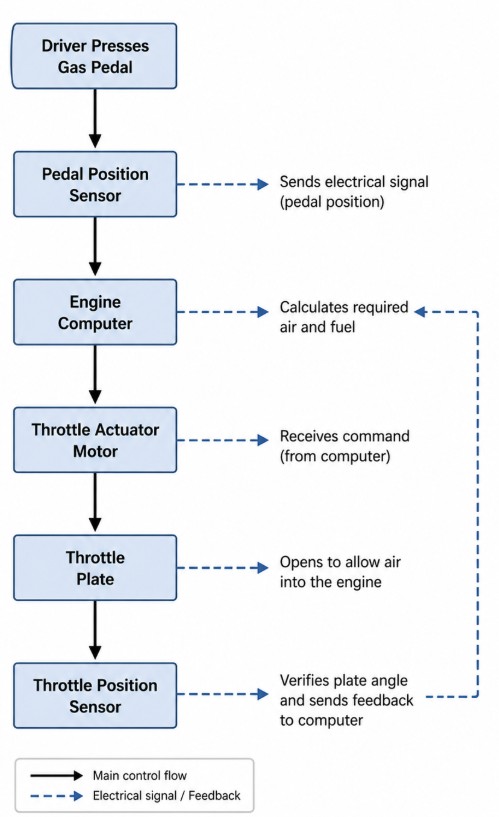
To help you visualize how these parts interact, here is a simple flow diagram showing the electronic throttle body process.
As you can see, the system is a continuous loop of feedback. The computer demands an action, the motor performs it, and the sensor verifies it.
The throttle body operates in a harsh environment. It constantly deals with air, fuel vapors, and crankcase gases. Here are the most common issues.
This is the number one problem. Engines use a Positive Crankcase Ventilation (PCV) system. This system vents oily gases from the engine crankcase back into the intake manifold to be burned.
The throttle body is bolted to the intake manifold using a rubber or paper gasket.
In electronic throttle bodies, the TPS or the actuator motor can fail due to electrical wear.
You do not need to wait for a problem to clean your throttle body. Preventive maintenance may help extend the life of the component and keep your idle smooth.
Before you begin, you must gather the right supplies. Always use a specialized Throttle Body Cleaner, not standard brake cleaner or carburetor cleaner. Throttle body cleaner is formulated to be safe on the delicate sensors and coatings inside the bore.
Bilal: I sprayed throttle body cleaner directly into the open bore to clean it faster. Was that wrong?
Omar: It is not the best method. Spraying directly can push dirt into the intake manifold. Also, the liquid cleaner can damage the Throttle Position Sensor if it gets inside the housing.
Bilal: So, I should always spray the cleaner onto a rag first?
Omar: Yes. A rag gives you control. You wipe away the dirt instead of washing it deeper into the engine.
After you clean an electronic throttle body, the engine might idle very high or very low for a few minutes. This happens because the computer still remembers the old, dirty throttle position.
The computer needs to “relearn” the new, clean position. In many cases, simply driving the vehicle for 10 to 20 minutes allows the computer to adjust automatically.
However, some vehicles require a manual “Idle Relearn” procedure.
If your idle does not stabilize after a day of driving, you may need to visit a shop for a quick computer reset.
When the throttle body has an issue, the engine computer triggers a Diagnostic Trouble Code (DTC). You can read these codes using an OBD2 scanner.
Here is a table of common throttle body related codes and what they mean.
| OBD2 Code | Meaning | Possible Cause | Action to Take |
|---|---|---|---|
| P0121 | Throttle Position Sensor “A” Circuit Range/Performance | Dirty throttle plate, failing TPS sensor, bad wiring | Clean throttle body, inspect wiring |
| P0221 | Throttle Position Sensor “B” Circuit Range/Performance | Failing actuator motor, internal sensor failure | May require full throttle body replacement |
| P0505 | Idle Air Control System Malfunction | Vacuum leak, dirty IACV (older cars), dirty throttle plate | Inspect gaskets, clean throttle body |
| P2111 | Throttle Actuator Control System – Stuck Open | Carbon buildup holding plate open, broken return spring | Deep clean, check spring tension |
When diagnosing these codes, remember that a dirty throttle body often mimics a broken sensor. Always try cleaning the component before replacing it.
How do you know when to clean and when to replace?
You should clean the throttle body if you experience rough idling, hesitation, or have a P0505 code. Cleaning is cheap, safe, and should be done every 30,000 to 50,000 miles as preventive maintenance.
You may need to replace the throttle body if:
If you must replace the part, you have choices.
Keep your engine breathing correctly by following this simple checklist.
What is the main function of the throttle body?
The throttle body controls the amount of air that flows into the engine. It uses a flat plate, called a butterfly valve, which opens when you press the gas pedal and closes when you release it.
Can I drive with a bad throttle body?
It is not recommended. A failing throttle body can cause stalling in traffic, which is dangerous. In electronic systems, it can trigger “limp mode,” leaving you with very little power. You should address the issue immediately.
How often should I clean my throttle body?
As a general rule, you should inspect and clean the throttle body every 30,000 to 50,000 miles. However, if you drive in dusty conditions or notice a rough idle, you may need to clean it sooner.
What is the difference between a throttle body and a carburetor?
A carburetor is an older device that mixed air and fuel together mechanically. A throttle body in modern vehicles only controls air. The fuel is injected separately by fuel injectors located in the intake manifold or cylinders.
Can I use WD-40 to clean my throttle body?
No. WD-40 is a lubricant, not a solvent. It will leave an oily residue that attracts more dirt. You must use a specialized Throttle Body Cleaner that evaporates completely and leaves no residue.
The throttle body is the critical gateway for air entering your engine. Whether mechanical or electronic, it requires a clean surface to function accurately. Carbon buildup is the most common enemy, leading to rough idling and stalling. By understanding how this component works and performing regular, safe cleaning, you can maintain smooth engine performance.
In the next part of our Air Intake System series, we will explore the Mass Air Flow (MAF) Sensor, the component that measures the air passing through the throttle body.
