Physical Address
304 North Cardinal St.
Dorchester Center, MA 02124
Physical Address
304 North Cardinal St.
Dorchester Center, MA 02124

Disclaimer: This article is for general informational purposes only. Always consult a certified automotive technician for professional diagnosis and repairs. Driving with faulty brakes is dangerous; prioritize professional care for safety-critical systems.
Throughout this guide, you may see Bilal and Omar discussing vehicle systems, maintenance procedures, and troubleshooting situations. They are fictional educational characters created by Remliks Solutions to help explain automotive and truck concepts in a practical and engaging way.
When you press the brake pedal, you expect your vehicle to slow down safely and smoothly. The car brake system is the most critical safety feature on any vehicle. Understanding how it works, what its components do, and how to maintain it empowers you to drive with confidence and catch problems before they become dangerous.
In this guide, we will break down the science of friction, explore the hydraulic network, and explain how modern technology keeps you safe on the road.
To understand the car brake system, you must understand two basic principles: friction and hydraulics.
Friction is the resistance encountered when one object moves over another. In a vehicle, kinetic energy (the energy of motion) must be transformed into thermal energy (heat) to stop the car. The brake system forces a stationary friction material against a moving surface. This contact creates friction, which slows the wheel rotation and generates heat. The heat then dissipates into the air.
Brakes rely on hydraulics to multiply the force from your foot. When you press the brake pedal, you push a piston inside the master cylinder. The master cylinder is filled with brake fluid. Because liquids cannot be compressed, the fluid transfers your foot pressure through the brake lines to the wheels.
This system multiplies your effort through differing piston sizes. A small piston in the master cylinder pushes fluid into larger pistons at the wheels. Therefore, a gentle push on the pedal creates a powerful clamping force at the brakes.
Every car brake system relies on a network of components working in perfect harmony. If one part fails, the entire system suffers. Let us explore these parts in detail.
The journey begins at the pedal. The brake pedal acts as a lever, increasing the force you apply. This force pushes a pushrod into the master cylinder. The master cylinder contains a reservoir of brake fluid and internal pistons. When activated, it distributes hydraulic pressure to the wheels. It also splits the system into two independent circuits (front and rear, or diagonal). If one circuit leaks, the other still provides partial stopping power.
Brake lines carry the fluid from the master cylinder to the wheels. Most of the line is rigid steel or aluminum, which prevents expansion under high pressure. However, near the wheels, the suspension and steering must move freely. Here, flexible reinforced rubber hoses (or braided stainless steel hoses) connect the rigid lines to the moving brake calipers.
Most modern vehicles use disc brakes on at least the front wheels, and often on all four.
Many older vehicles and some modern rear brakes use drum brakes. Instead of clamping a rotor from the outside, drum brakes push outward.
Disc vs. Drum Brakes Comparison
| Feature | Disc Brakes | Drum Brakes |
|---|---|---|
| Stopping Power | High, consistent | Good, but can fade under heavy use |
| Heat Dissipation | Excellent (exposed to air) | Poor (trapped inside the drum) |
| Water Drainage | Drains quickly | Can trap water, reducing friction |
| Maintenance | Easier to inspect and replace | More complex to service |
| Common Use | Front wheels, performance cars | Rear wheels, heavy trucks |
Modern vehicles use advanced electronics to prevent skidding and maintain control during panic stops.
When you slam on the brakes, wheels can lock up and stop spinning. A locked wheel cannot be steered, and the vehicle skids. The ABS prevents this. Speed sensors at each wheel monitor rotation. If a sensor detects a wheel is about to lock, the ABS module rapidly pulses the hydraulic pressure to that wheel—up to 15 times per second. This allows the driver to maintain steering control while braking hard.
EBD often works alongside ABS. Vehicle weight shifts forward during braking. EBD uses sensors to calculate the optimal brake force for each wheel based on speed, load, and road conditions. It may send more pressure to the front wheels and less to the rear, preventing the rear wheels from locking up prematurely.
Bilal is working on his sedan. He notices the brake pedal feels unusually soft and travels almost to the floor before the brakes engage.
Bilal: The engine cranks fine, Omar, but my brake pedal feels spongy. I think I just need new brake pads. Should I buy a set today?
Omar: Wait, Bilal. Before you buy parts, let us think about how the system works. Do you know what spongy brakes usually indicate?
Bilal: Not exactly. I just assumed worn-out parts make the pedal soft.
Omar: Worn brake pads usually cause a hard pedal or a squealing noise, not a spongy one. A spongy pedal often means there is air in the hydraulic system. Air can be compressed, but brake fluid cannot. When you press the pedal, the force compresses the air instead of pushing the caliper pistons.
Bilal: So, new pads will not fix this?
Omar: Probably not. We must diagnose before we replace. Let us check the master cylinder fluid level first. If it is low, we might have a leak in the lines or at the calipers. If there are no leaks, the system may just need a brake fluid bleed to remove trapped air.
Bilal: That makes sense. I will check the fluid reservoir before ordering any parts. Diagnosing first saves money and time.
Omar: Exactly. Always test and verify. Guessing leads to wasted effort and unresolved safety issues.
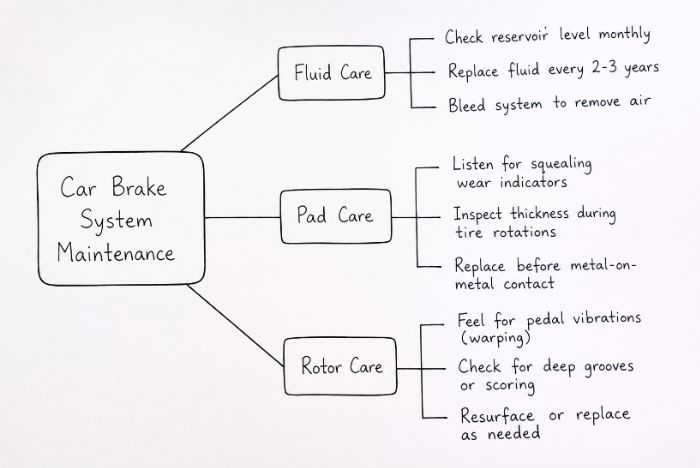
A car brake system requires regular care to function reliably. Neglecting maintenance leads to poor performance, costly repairs, and dangerous driving conditions.
Brake fluid is hygroscopic, meaning it naturally absorbs moisture from the air over time. Water in the brake fluid lowers its boiling point. During heavy braking, the intense heat can boil the water, creating steam. Since steam is compressible, the brake pedal will fail (brake fade).
To prevent this, flush the brake fluid according to the manufacturer’s schedule, usually every two to three years. A technician uses a pressure bleeder or manual bleeding method to push fresh fluid through the system, expelling the old, moisture-laden fluid and any trapped air. Learn more about vehicle fluids in our Automotive Fluids & Chemicals section.
Brake pads are consumable items. As they wear down, the friction material becomes thin. Most pads have a small metal tab called a wear indicator. When the pad wears to a certain point, this tab scrapes against the rotor, creating a high-pitched squealing noise. This is a warning that the pads need replacement soon. If you ignore the squeal, the metal backing plate will grind into the rotor, destroying it and creating a severe safety hazard.
Rotors endure extreme heat and pressure. Over time, they can develop grooves, warping, or uneven wear. Warped rotors cause a pulsating vibration in the brake pedal or steering wheel during braking. Sometimes, a machine shop can resurface (turn) the rotors to make them flat and smooth again. However, rotors have a minimum thickness limit. If they are too thin, they cannot dissipate heat properly and must be replaced.
Even with proper maintenance, brake issues can arise. Recognizing the symptoms early can prevent accidents and expensive damage. If you need help with specific error codes, visit our Warning Lights & Error Codes resource.
As mentioned, a light squeal often indicates the wear indicators are touching the rotors. However, brakes can also squeak if they are cold or damp. A loud grinding noise, however, indicates metal-on-metal contact. This requires immediate attention. Driving with grinding brakes ruins the rotors and drastically increases stopping distance.
If the steering wheel or brake pedal shakes when you apply the brakes, the rotors are likely warped. Heat unevenness causes the rotor to warp slightly. When the brake pads clamp down, they bounce over the uneven surface, causing the vibration. Resurfacing or replacing the rotors usually resolves this issue. However, vibrations can also stem from loose suspension components. Check our Suspension & Steering guides for related information.
As Bilal learned, a spongy pedal often means air in the lines or a fluid leak. A low pedal that slowly sinks to the floor while holding pressure strongly suggests a failing master cylinder. The internal seals may be leaking fluid past the piston, preventing pressure from building up.
Brake Troubleshooting Table
| Symptom | Possible Cause | Recommended Action |
|---|---|---|
| High-pitched squeal | Pad wear indicator touching rotor | Inspect pads; replace if worn |
| Grinding noise | Metal backing plate on rotor | Replace pads and inspect rotors immediately |
| Pedal pulsation | Warped rotors or loose suspension | Measure rotor runout; resurface or replace |
| Spongy pedal | Air in hydraulic system or leak | Inspect lines/hoses; bleed brake system |
| Pulling to one side | Stuck caliper or contaminated pad | Inspect caliper function; replace pads/rotors |
When replacing brake components, selecting the correct parts ensures safe and reliable operation. Always choose parts that meet or exceed the original equipment manufacturer (OEM) specifications. You can explore more options in our Product Reviews & Buying Guides.
The Department of Transportation (DOT) sets standards for brake fluid based on its boiling points and viscosity.
The car brake system protects your life, so treat it with respect. Follow these best practices:
Use this practical checklist to monitor your brake health. A quick visual check takes only a few minutes but provides valuable peace of mind.
Q1: How often should I check my brake fluid?
A: You should visually check the brake fluid reservoir level at least once a month. Furthermore, test the fluid’s moisture content during routine service. Most manufacturers recommend replacing the brake fluid entirely every two to three years, regardless of mileage, to prevent internal corrosion and boiling.
Q2: Can I just replace my brake pads and not the rotors?
A: It depends on the rotor’s condition. If the rotors are smooth, free of deep grooves, and within the minimum thickness specification, you may only need pads. However, new pads pressing against worn or grooved rotors will not seat properly. This may reduce braking performance and cause noise. Always measure the rotors before deciding.
Q3: Why does my car pull to one side when I brake?
A: This often indicates an uneven braking force. A stuck caliper (failing to apply pressure on one side), a collapsed brake hose restricting fluid, or contaminated brake pads can cause this. It may also relate to suspension issues. Have a professional inspect the vehicle immediately, as uneven braking reduces control.
Q4: Is it safe to drive with the ABS warning light on?
A: When the ABS light is on, the Anti-lock Braking System is disabled. Your standard brakes will still work, but the wheels may lock up if you slam on the brakes, causing you to lose steering control. It is safe to drive carefully to a repair shop, but the issue should be diagnosed and repaired as soon as possible.
Q5: What does it mean if my brake pedal goes all the way to the floor?
A: This is a severe safety hazard. It usually indicates a major leak in the hydraulic system, a completely failed master cylinder, or massive air intrusion. Do not drive the vehicle. Tow it to a qualified mechanic for immediate repair.
The car brake system is a brilliant application of friction and hydraulics. By understanding how the master cylinder, calipers, pads, and rotors work together, you can better maintain your vehicle and recognize problems early. Regular inspections, timely fluid changes, and using the correct replacement parts ensure that every time you press the pedal, your vehicle responds safely. Always prioritize professional diagnosis for safety-critical systems, and never ignore the warning signs your vehicle gives you.
