Physical Address
304 North Cardinal St.
Dorchester Center, MA 02124
Physical Address
304 North Cardinal St.
Dorchester Center, MA 02124

Understanding Automotive Fundamentals is the first step for anyone who wants to take care of their vehicle, save money on repairs, or simply feel more confident on the road.
Throughout this guide, you may see Bilal and Omar discussing vehicle systems, maintenance procedures, and troubleshooting situations. They are fictional educational characters created by Remliks Solutions to help explain automotive and truck concepts in a practical and engaging way.
story : Imagine a sunny morning at omar garage the Remliks Solutions garage. Bilal, our expert in passenger cars, is wiping grease from his hands. Omar, the heavy-duty truck specialist, is looking at the engine of a large delivery truck.
“You know, Omar,” Bilal says, “most people drive their vehicles every day, but they don’t understand the heart beating underneath the hood.”
Omar nods. “True. But when they understand the basics—how the air gets in, how the fuel burns, and how the power reaches the wheels—they treat the machine with more respect.”
This guide is here to help you do just that. We will explore the core systems that make your vehicle move. We will break down complex ideas into simple parts, using examples from Bilal and Omar’s daily work to make it real.
Most cars and trucks on the road today use an internal combustion engine (ICE). This is the part of the car that creates the power. The name might sound complicated, but the idea is simple. “Combustion” means burning, and “Internal” means it happens inside the engine.
To understand this, think of a small bicycle pump. If you put your thumb over the hole and push the handle, the air inside gets hot and pushes back. An engine does this, but it adds fuel and a spark to create a controlled explosion.
Almost every modern car engine works on a four-stroke cycle. This cycle happens over and over again, thousands of times per minute. Bilal often explains this to his customers using the acronym “Suck, Squeeze, Bang, Blow.” While we use professional terms, the idea is the same.
To visualize this continuous process, look at the diagram below. It shows how the engine cycles through different states to create power.
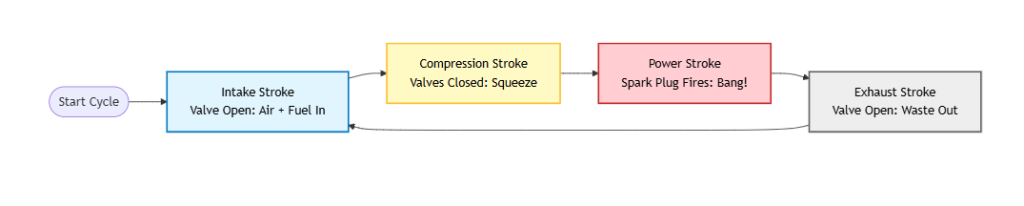
Understanding the Diagram:
Engines come in different shapes and sizes. You might hear terms like V6, Inline-4, or V8.
The engine block is the main metal part of the engine. It holds the cylinders, pistons, and crankshaft. The crankshaft is the part that turns the up-and-down motion of the pistons into the spinning motion needed to turn the wheels.
An engine needs three things to run: fuel, spark, and air. In fact, for every part of fuel, the engine needs about 14 parts of air. This makes the air intake system very important.
One day, a customer came to Bilal complaining that their car was sluggish. Bilal checked the air filter. It was clogged with dirt and leaves. The engine was choking! After replacing the filter, the car “breathed” easily again.
In modern cars, computers control how much air enters the engine to ensure efficiency. Omar explains that in trucks, the air intake is often larger and located higher up. This is because trucks sometimes drive through water or dust, and the higher placement helps the engine breathe cleaner air.
While air provides the oxygen, fuel provides the energy. The fuel system ensures that the right amount of fuel gets to the engine at the exact right moment.
The process starts at the fuel tank. A fuel pump (usually electric in modern cars) pulls fuel from the tank and sends it through fuel lines to the engine.
Old vs. New Technology:
It is vital to understand how these two systems meet. The diagram below illustrates the journey of both air and fuel as they combine to create energy.
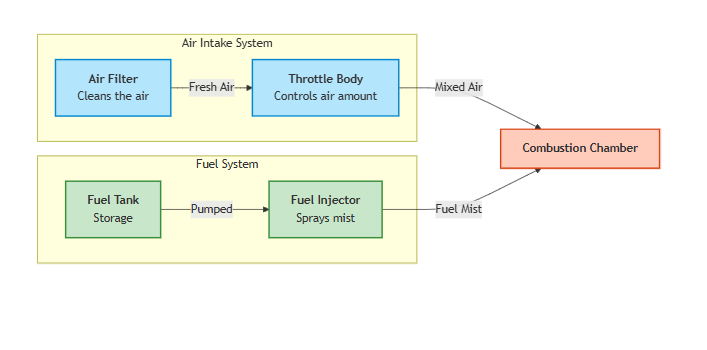
Understanding the Diagram:
Getting the mix of air and fuel right is crucial. Too much fuel and the engine runs “rich” (wastes gas, smells bad). Too little fuel and the engine runs “lean” (overheats, loses power).
Omar points out that diesel engines are slightly different. They do not use spark plugs. Instead, they compress air so much that it gets hot enough to ignite the diesel fuel without a spark. This is why diesel engines are often stronger and last longer, though they can be noisier.
Creating power is useless if you cannot get that power to the wheels. This is the job of the transmission and drivetrain.
Think of a bicycle. If you are in a high gear, it is hard to pedal from a stop, but you go fast once you are moving. If you are in a low gear, it is easy to pedal from a stop, but you cannot go very fast. The transmission in your car does exactly the same thing.
There are two main types of transmissions:
Table: Comparing Transmission Types
| Feature | Manual Transmission | Automatic Transmission |
|---|---|---|
| Driver Input | High (Must use clutch and shifter) | Low (Just brake and gas) |
| Fuel Economy | Often slightly better | Very good in modern cars (CVT/DCT) |
| Maintenance | Clutch wear may need replacement | Fluid changes are critical |
| Best For | Enthusiasts, rugged conditions | Daily commuting, city driving |
Once the transmission selects the right gear, the power goes to the wheels. The following diagram traces the path of energy from the engine all the way to the tires.

Understanding the Diagram:
Once the transmission selects the right gear, the power goes to the wheels.
In trucks, Omar deals with “Four-Wheel Drive” (4WD) systems. This sends power to all four wheels, providing better grip in mud or snow. It adds complexity but is essential for heavy work.
Modern vehicles are as much about computers as they are about mechanics. The electrical system is the nervous system of the car. It carries signals and power to every part of the vehicle.
Every car has three main electrical components:
Bilal remembers a time a customer called because their car died while driving. They thought the battery was bad. However, it was actually the alternator. The battery had started the car, but once the car was running, the alternator failed. The car ran off the battery until it was empty, leaving the driver stranded.
Today’s cars have a “brain” called the Engine Control Unit (ECU). It uses a network of sensors to monitor everything.
Scheme: Electrical Flow Diagram
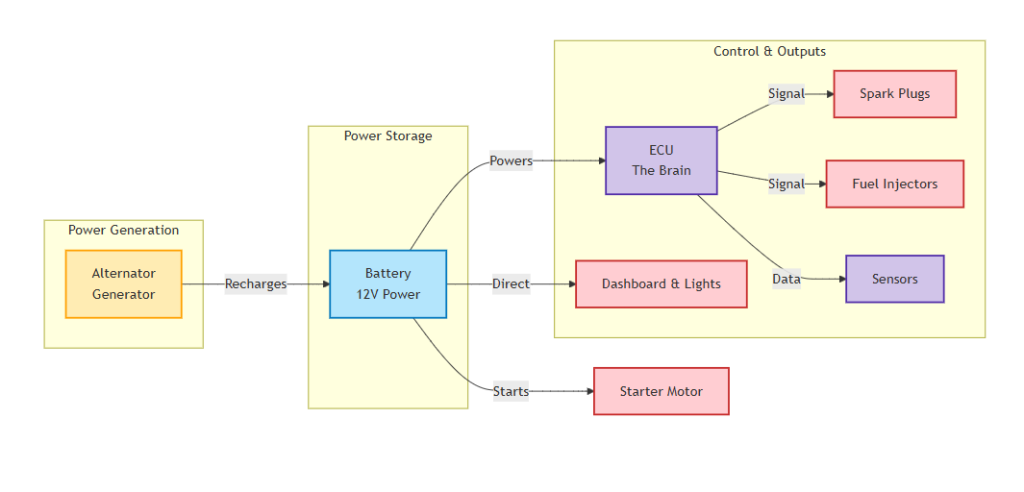
If a sensor fails, the “Check Engine” light comes on. Omar uses a special tool (Scan Tool) to talk to the ECU and find out exactly what is wrong. This makes diagnostics faster and more accurate than in the past.
Understanding Automotive Fundamentals is about seeing the big picture. It is not just about the engine, the fuel, or the electrical system working alone. It is about how they work together.
When you press the gas pedal:
This seamless integration happens in milliseconds. When everything is in sync, the car runs smoothly, efficiently, and safely.
Knowing how things work helps you maintain them.
Bilal and Omar always tell their clients: “Listen to your car.” A strange squeak, a new smell, or a hesitation when accelerating are all signs that one of these fundamental systems needs attention.
Use this simple checklist to understand the basic health of your vehicle. Always ensure the car is parked safely and the engine is cool before checking.
What is the most important part of a car to learn about first?
We recommend starting with the engine and the electrical system. The engine creates the power, and the electrical system manages it. If you understand these two, the rest is easier to learn.
Why does my car need air filters if there is no air filter in my house?
A car drives on dirty roads where it kicks up dust and sand. An engine is very precise; even a small grain of sand can scratch the inside of the cylinder and ruin it. The air filter is essential protection.
Can I drive with a bad alternator?
You can drive for a short distance, but not for long. The car will run off the battery. Once the battery dies, the car will stop, and you will be stranded. It is best to fix it immediately.
Is a manual transmission better than an automatic?
Neither is “better.” A manual transmission gives you more control and can be more durable. An automatic is more convenient. It depends on your driving needs and comfort level.
How does a truck engine differ from a car engine?
Truck engines (like the ones Omar works on) are usually larger, built with stronger metal parts (iron instead of aluminum often), and designed to produce high “torque” (pulling power) rather than just high speed. They are built for endurance and heavy loads.
What should I do if my Check Engine light comes on?
Don’t panic. First, check if your gas cap is loose (a common cause). If it stays on, take your vehicle to a professional like Bilal or Omar. They can use a computer to read the error code and tell you exactly what is wrong.
Learning Automotive Fundamentals empowers you as a vehicle owner. You do not need to be a mechanic to understand how your car works. You just need to grasp the basics of how air, fuel, spark, and mechanics combine to move you forward.
Whether you are driving a small sedan like the ones Bilal repairs or a heavy truck like Omar’s, the principles are largely the same. By respecting these systems and maintaining them, you ensure your safety, save money, and extend the life of your vehicle.
visit our learning center and other sections to learn more.
