Physical Address
304 North Cardinal St.
Dorchester Center, MA 02124
Physical Address
304 North Cardinal St.
Dorchester Center, MA 02124

Disclaimer: This guide provides general information only. Always consult a qualified professional for specific diagnostic, repair, or safety advice.
Understanding your vehicle starts with understanding the language used to describe it. Whether you are reading a diagnostic report, talking to a mechanic, or browsing our Learning Center, knowing essential automotive terms A-Z gives you the confidence to make informed decisions. This comprehensive glossary by Remliks Solutions breaks down complex vehicle systems, diagnostics, and maintenance concepts into simple, clear English.
Throughout this guide, you may see Bilal and Omar discussing vehicle systems, maintenance procedures, and troubleshooting situations. They are fictional educational characters created by Remliks Solutions to help explain automotive and truck concepts in a practical and engaging way.
Vehicles are complex machines with thousands of parts. When a dashboard warning light turns on, or a mechanic mentions a failing component, understanding the basic terminology can save you time, money, and stress.
Also, when you know the correct terms, you can:
Before we dive into the alphabetical list, let us look at how these terms connect to the major systems in your vehicle.
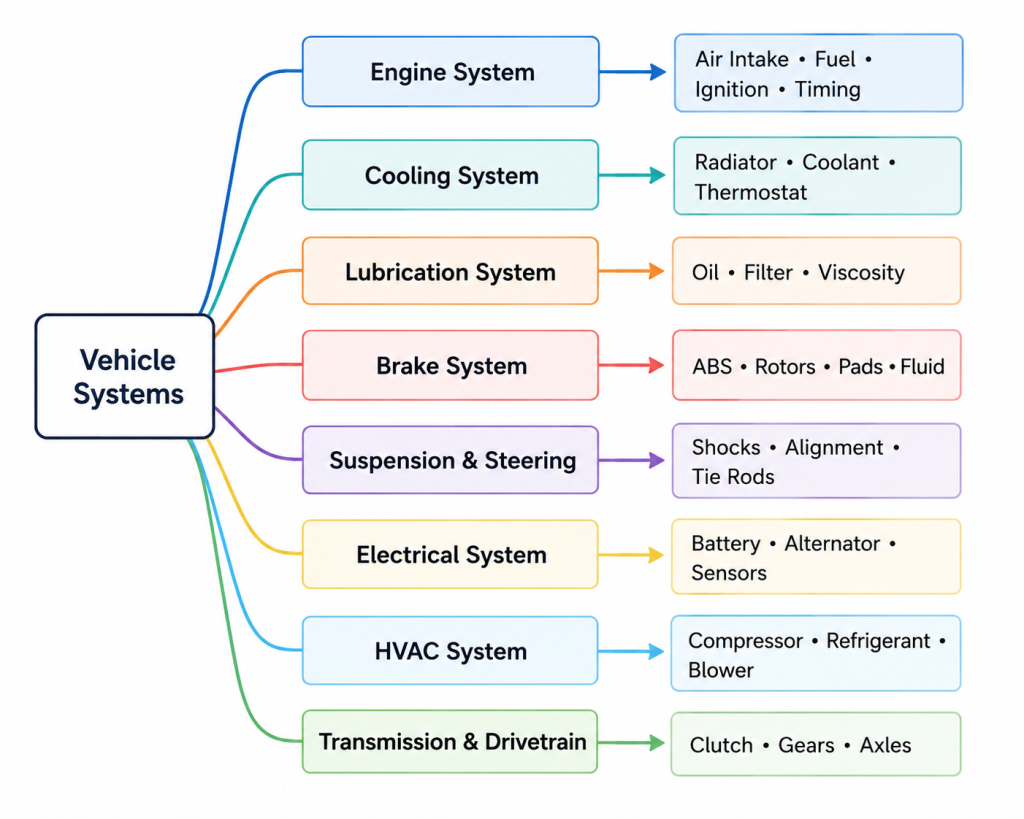
To help you visualize how these terms relate to each other, here is a simple text-based mind map of the primary vehicle categories:
Vehicle Systems:
Let us begin our automotive terms A-Z journey with the foundational components that make a vehicle start and move.
| Term | Simple Definition | Vehicle System | Practical Importance |
|---|---|---|---|
| ABS (Anti-lock Braking System) | A safety system that prevents wheels from locking during hard braking. | Brake System | Helps the driver maintain steering control on slippery roads. Meets USA FMVSS standards. |
| Air-Fuel Ratio (AFR) | The ratio of air to fuel entering the engine cylinders. | Engine System | A correct AFR ensures efficient combustion and prevents engine damage. |
| Alignment | Adjusting the angles of the wheels so they are perpendicular to the ground and parallel to each other. | Suspension & Steering | Prevents uneven tire wear and ensures the vehicle drives straight. |
Omar and Bilal Workshop Scenario
Bilal: The brake pedal vibrates a lot when I stop quickly on wet roads. Is the brake system failing?
Omar: Not necessarily. If your vehicle has ABS, a vibrating pedal is a normal function. The system rapidly pulses the brakes to prevent the wheels from locking up. However, if the vibration happens during normal, dry braking, the brake rotors may be warped. We should inspect them to be sure.
How Boost Works (Forced Induction):
When an engine needs more power, it needs more air. A turbocharger uses exhaust gases to spin a turbine. This turbine forces extra air (boost) into the engine. More air means the engine can burn more fuel, which may help increase power output. However, it also increases engine temperatures, requiring proper cooling and lubrication.
| Term | Simple Definition | Vehicle System | Practical Importance |
|---|---|---|---|
| Catalytic Converter | An emissions control device that changes toxic gases into less harmful emissions. | Engine/Exhaust | Required by USA law; a failing converter triggers a Check Engine Light. |
| Coolant | A liquid mixture (usually water and antifreeze) that absorbs engine heat. | Cooling System | Prevents the engine from overheating in summer or freezing in winter. |
| Compression | The process of squeezing the air-fuel mixture inside the engine cylinder before ignition. | Engine System | Low compression may cause poor engine performance or starting issues. |
| Term | Simple Definition | Vehicle System | Practical Importance |
|---|---|---|---|
| ECU (Engine Control Unit) | The vehicle’s main computer that manages engine performance and emissions. | Electrical System | Uses sensor data to adjust fuel, ignition, and emissions systems. |
| EGR (Exhaust Gas Recirculation) | A system that reroutes a small amount of exhaust gas back into the intake to lower combustion temperatures. | Engine System | Reduces harmful nitrogen oxide (NOx) emissions. |
| Exhaust Manifold | A pipe that collects exhaust gases from multiple cylinders and delivers them to the exhaust pipe. | Engine/Exhaust | Cracks can cause loud engine noise and exhaust leaks. |
| Term | Simple Definition | Vehicle System | Practical Importance |
|---|---|---|---|
| Horsepower (HP) | A unit of measurement for the engine’s power output. | Engine System | Helps compare the power capabilities of different vehicles. |
| HVAC | Heating, Ventilation, and Air Conditioning. | HVAC System | Controls cabin temperature and air quality for passenger comfort. |
| Head Gasket | A critical seal between the engine block and the cylinder head. | Engine/Cooling | A blown head gasket may allow coolant to mix with engine oil, causing severe engine damage. |
Omar and Bilal Workshop Scenario
Bilal: I hear a rattling sound from the engine when I accelerate uphill. Is that normal?
Omar: That sound is often called “knocking” or “pinging.” It happens when the air-fuel mixture ignites too early or unevenly. The knock sensor should detect this and tell the ECU to adjust the timing. If the sound continues, the sensor may be failing, or the fuel grade may be incorrect. We should scan the system for a DTC.
| Term | Simple Definition | Vehicle System | Practical Importance |
|---|---|---|---|
| MAP Sensor | Manifold Absolute Pressure sensor; measures the air pressure inside the intake manifold. | Engine/Electrical | Helps the ECU calculate the correct air-fuel mixture. |
| Misfire | When the air-fuel mixture inside a cylinder fails to ignite at the correct time. | Engine/Ignition | Causes rough idling, loss of power, and increased emissions. |
| Maintenance | Routine care (like oil changes and filter replacements) performed to keep the vehicle in working order. | All Systems | Prevents costly breakdowns and extends vehicle life. |
| Term | Simple Definition | Vehicle System | Practical Importance |
|---|---|---|---|
| Radiator | A heat exchanger that cools the engine coolant as air flows through its fins. | Cooling System | A leaking or clogged radiator may cause the engine to overheat. |
| Rotor (Brake Disc) | The flat, round metal disc that the brake pads press against to stop the wheel. | Brake System | Warped rotors cause steering wheel vibration during braking. |
| Refrigerant | The chemical fluid used in the AC system to absorb and release heat, cooling the cabin. | HVAC System | Must be handled carefully according to EPA regulations. |
| Term | Simple Definition | Vehicle System | Practical Importance |
|---|---|---|---|
| Zerk Fitting | A small metal fitting used to inject grease into suspension or steering components. | Suspension/Steering | Allows for easy lubrication of moving parts during routine maintenance. |
| Zero Emissions | A vehicle that produces no tailpipe pollutants (like battery-electric vehicles). | Electrical/Powertrain | Important environmental standard and regulatory category. |
Below is a Flexbox-style table that connects the automotive terms A-Z to the core sections of the Remliks Solutions Learning Center. Use this to navigate your learning path.
| Remliks Learning Center Section | Key Automotive Terms Covered |
|---|---|
| Engine System | Air-Fuel Ratio, Compression, ECU, Misfire, Spark Plug, Boost |
| Cooling System | Coolant, Radiator, Thermostat |
| Lubrication System | Viscosity, PCV Valve, Lubrication, Oil Filter |
| Brake System | ABS, Brake Fade, Rotor, Wheel Speed Sensor |
| Suspension & Steering | Alignment, Jounce, Steering Rack, U-Joint, Zerk Fitting |
| Electrical System | Voltage, ECU, Fuse, Alternator, Sensor |
| HVAC System | HVAC, Refrigerant, Blower Motor |
| Transmission & Drivetrain | Differential, Gear Ratio, Torque, Transmission, Powertrain |
| Diagnostics & Scan Tools | DTC, OBD2, Knock Sensor, MAP Sensor, Warning Lights |
Use this simple checklist to apply these terms safely and effectively in your daily vehicle ownership:
There is no single most important term, because vehicle systems work together. However, understanding OBD2 (On-Board Diagnostics) is incredibly valuable. When a problem occurs, the OBD2 system generates a DTC (Diagnostic Trouble Code). Knowing this term helps you use a scan tool to find out exactly why a warning light is on, rather than guessing.
Knowing the correct terms ensures you buy the right parts and fluids. For example, knowing the term “viscosity” prevents you from pouring the wrong thickness of oil into your engine. Also, knowing the difference between a “rotor” and a “brake pad” ensures you purchase the correct component when doing a brake job.
Many terms are the same, but trucks often use specific terminology related to heavy-duty applications. For instance, trucks frequently use “air brakes” instead of hydraulic brake systems, and “diesel compression ignition” instead of spark ignition. You can explore our Truck Systems section for more heavy-duty terminology.
Torque is the twisting force the engine creates—think of it as the strength needed to get a heavy vehicle moving from a stop. Horsepower is how quickly that force is delivered—think of it as the ability to maintain high speeds. In simple terms, torque gets you moving; horsepower keeps you moving fast.
Always ask for clarification. A good mechanic will be happy to explain a term in simple language. You can also use this automotive terms A-Z guide from Remliks Solutions as a reference before or after your repair visit to ensure you understand the work being done to your vehicle.
This glossary is just the beginning of your learning path. If you want to explore specific systems in greater detail, we invite you to visit our Learning Center. You can also check our Maintenance Guides for routine care schedules, or use our Troubleshooting Center when a specific problem arises.
